
Venue · ICML
ICML Paper Figures: Figure 1 Examples to Learn From
An ICML paper often has to show a method and the math behind it in one opening figure. This page gathers 562 Figure 1 images from ICML 2024 to 2026, each from a paper whose OpenReview record shows the CC BY 4.0 license. ICML, the International Conference on Machine Learning, covers the field from theory to applications, so spare line drawings sit next to busy multi-panel figures here. Filter by year, type or rank, open any figure for its color palette and credit, and compare how authors fit equations, baselines and results into a single canvas.
562 Figure 1 images, 2024 to 2026, all from CC BY 4.0 papers
562 figures
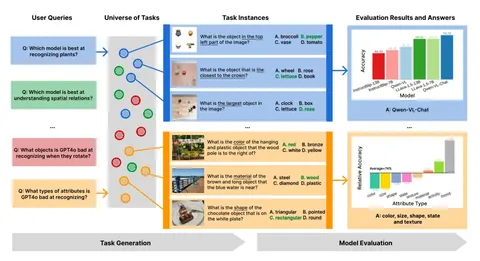
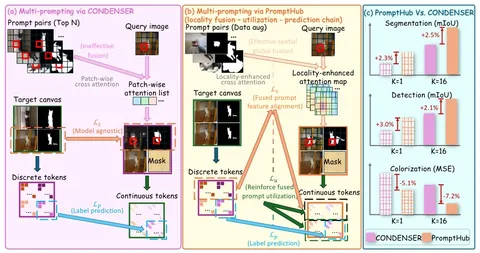
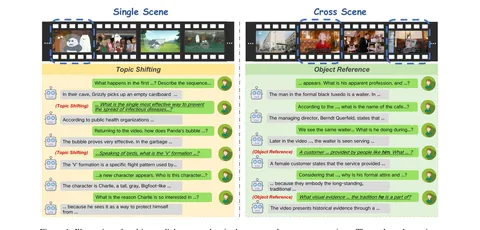
Habits that show up in ICML Figure 1s
- 1
Previous method left, yours right
The shared input sits in the middle column, the previous approach on the left under an orange header marked Previous, and the new method on the right under a green header marked Ours. Red cross icons mark where the old approach fails.
- 2
Shape and color both encode one property
A key at the top shows INT8 as a green rounded box and FP16 as a red rectangle, and three transformer blocks are drawn side by side in that code. Readers see at once which layers each variant keeps in low precision.
- 3
Equations written inside the diagram
Each row puts its update rule in a box, writes what is learned under it and shows the composed result on the right. Readers who think in notation can follow the method from the figure alone, without hunting for the equation.
- 4
Black and white line art for a theory idea
Two mirrored loops of agent, environment and policy boxes are drawn in plain black lines, with the two role names set vertically on the outer sides. With no color to decode, the symmetry between the two players carries the message.
- 5
The attack drawn in its own band
A red dashed band at the top holds the attacker and the poisoned sample, and a green dashed band below holds the normal user, retriever and model. One arrow shows where the poison enters, so the threat model reads at a glance.
- 6
A checklist table with an Ours column
Beside a sample image and two model answers, a small table lists properties as rows and approach families as columns, filled with red crosses and green checks. The column for the new method is tinted green and shows checks where the others show crosses.
Questions about ICML paper figures
What makes a good Figure 1 for an ICML paper?
One clear message that a reader gets before the method section. In this collection the strongest figures show the setting, the previous approach and the new one in a fixed reading order, and they put the key equation or loss right next to the block it belongs to. Use few colors, give each one a meaning, and keep the labels short.
Should an ICML Figure 1 include equations?
Only the ones that carry the idea. Many figures here place an update rule, a loss or a distribution under the block it describes, which helps readers who think in notation. Keep the symbols identical to the paper, define them in the caption, and leave derivations to the text. A figure crowded with formulas is harder to read than the section it summarizes.
Should Figure 1 have panel labels?
Label panels when the caption or text refers to the parts separately. Figures here use (a), (b) and (c) for method variants, and bold lowercase letters for dense grids of results. A single flow diagram needs no letters, but numbered steps help when arrows turn back.
Are ICML papers licensed under CC BY 4.0?
Not every one, so check each paper. This gallery includes only ICML papers whose license was verified as CC BY 4.0 from the license shown on the paper's OpenReview record, and every figure links to its paper. Papers that could not be verified are left out, so their absence says nothing about their quality.
Can I reuse these ICML figures?
Copyright stays with the authors. These papers are under CC BY 4.0, which allows reuse, including commercial use, if you credit the authors, link to the paper and to the license, and note any changes you made. For your own paper it is usually better to borrow the layout idea and draw your own figure. If you start from an AI draft, check your venue's policy on AI-generated images before you submit.
Draft your own ICML Figure 1
Describe your method, the baseline it improves on and the key equation, and SciFigure's AI figure tools draft a first version. Then check every label, symbol and arrow against your paper.
Open the AI figure generatorData and license
Every figure here is Figure 1 of a paper released under CC BY 4.0, cropped and resized, and each one credits its title, authors, venue and year with links to the paper and the license. Listing a figure does not mean its authors endorse SciFigure. How the licenses were checked.