Nitrogen Cycle Diagram AI

Nitrogen Cycle Diagram Generator

Draw a labeled nitrogen cycle with fixation, nitrification, assimilation, ammonification, and denitrification, every bacterium named and every formula checked. Ask for a simple version or a blank one for students to label.

Every stage namedNitrite vs nitrate checkedLabeled or blank

AI Nitrogen Cycle Diagram Generator

Describe how detailed the cycle should be and what to label.

Costs 5 credits535 / 2000 characters

Generate a publication-ready PNG from your description.

Preview

Nitrogen Cycle Diagram Example Previews

Target aspect ratio: 16:9

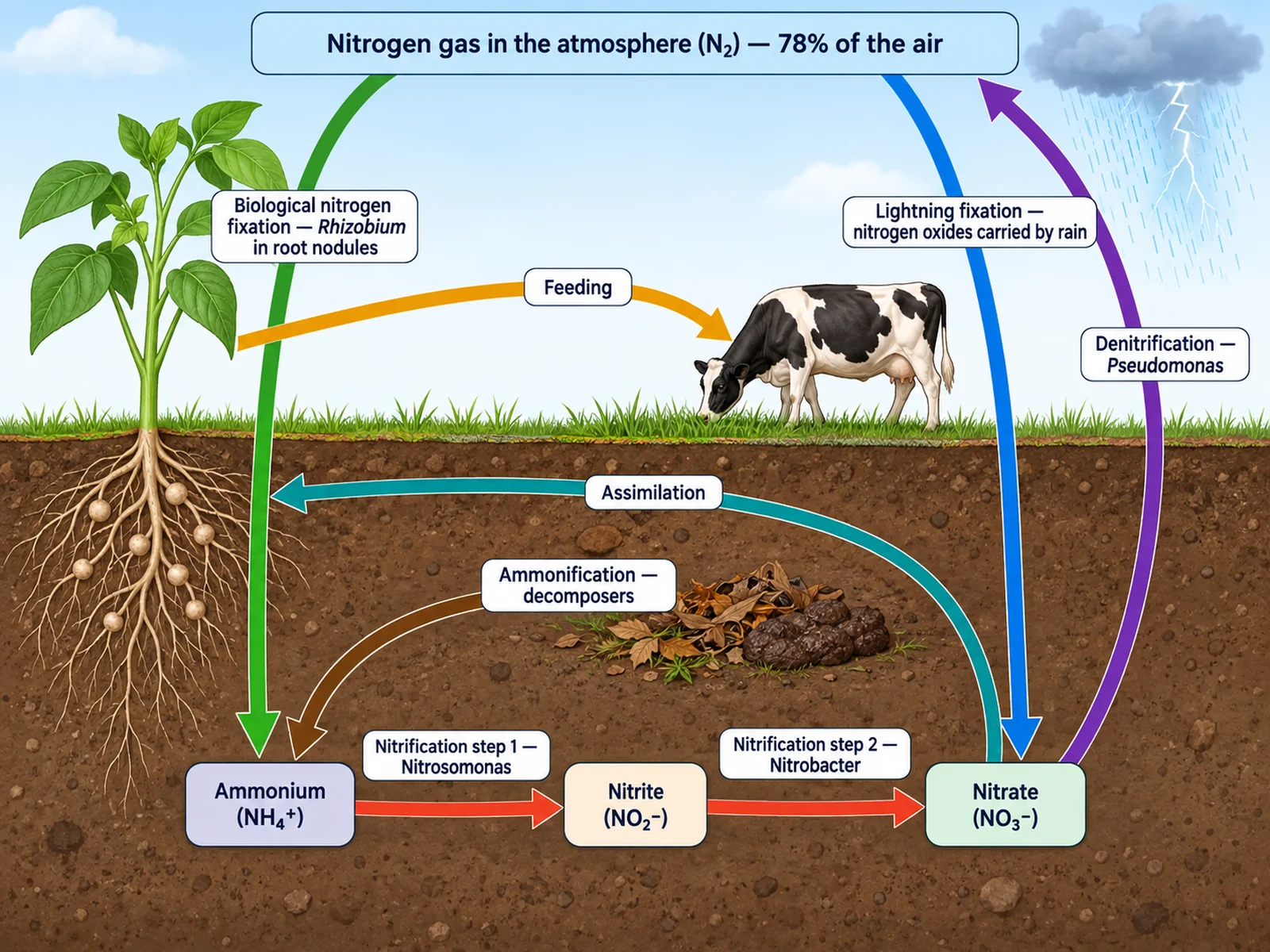
Labeled nitrogen cycle diagram showing fixation, nitrification by Nitrosomonas and Nitrobacter, assimilation, ammonification, and denitrification with correct formulas
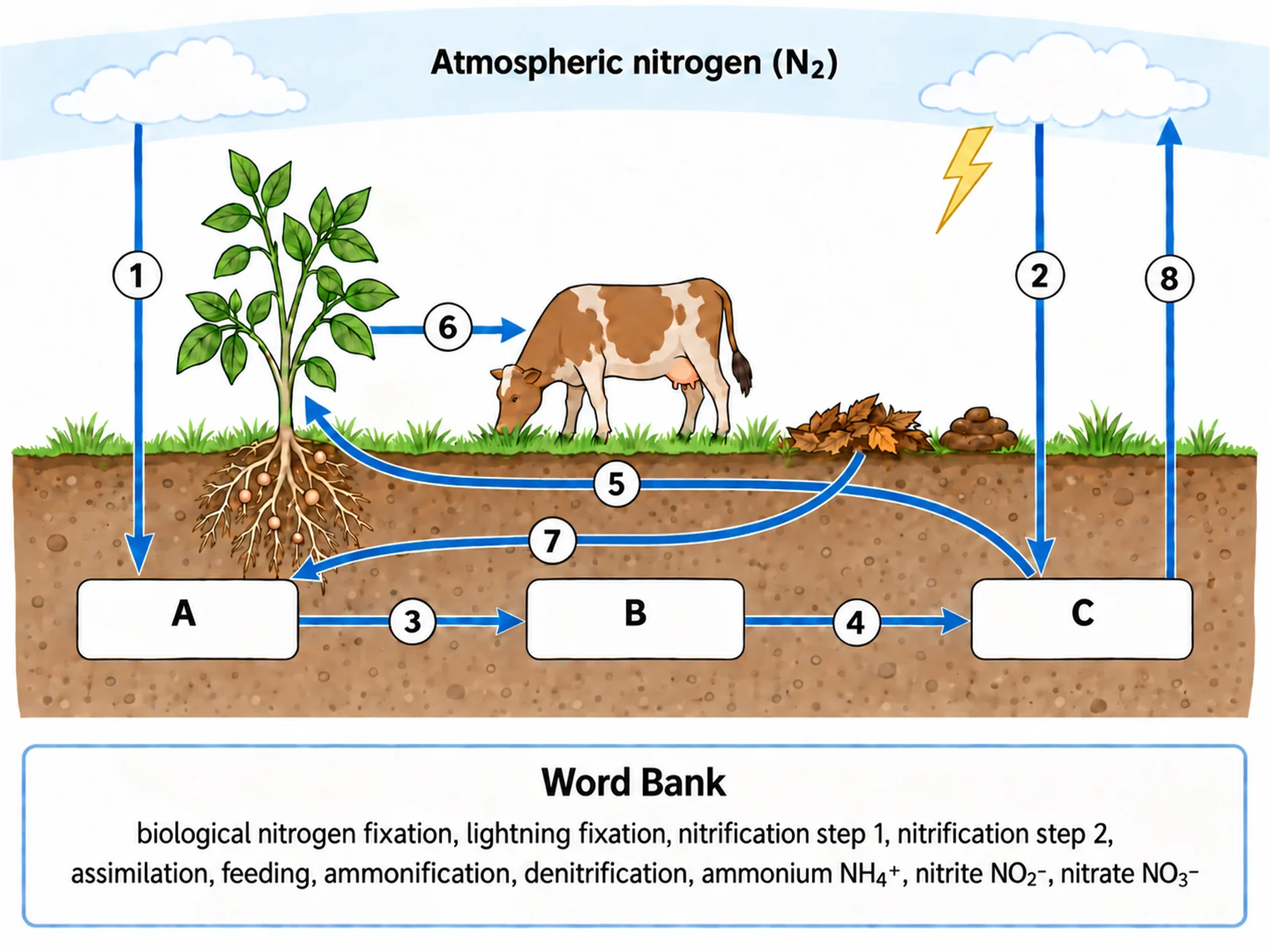
Blank unlabeled nitrogen cycle diagram with numbered empty label lines and a word bank for students to complete
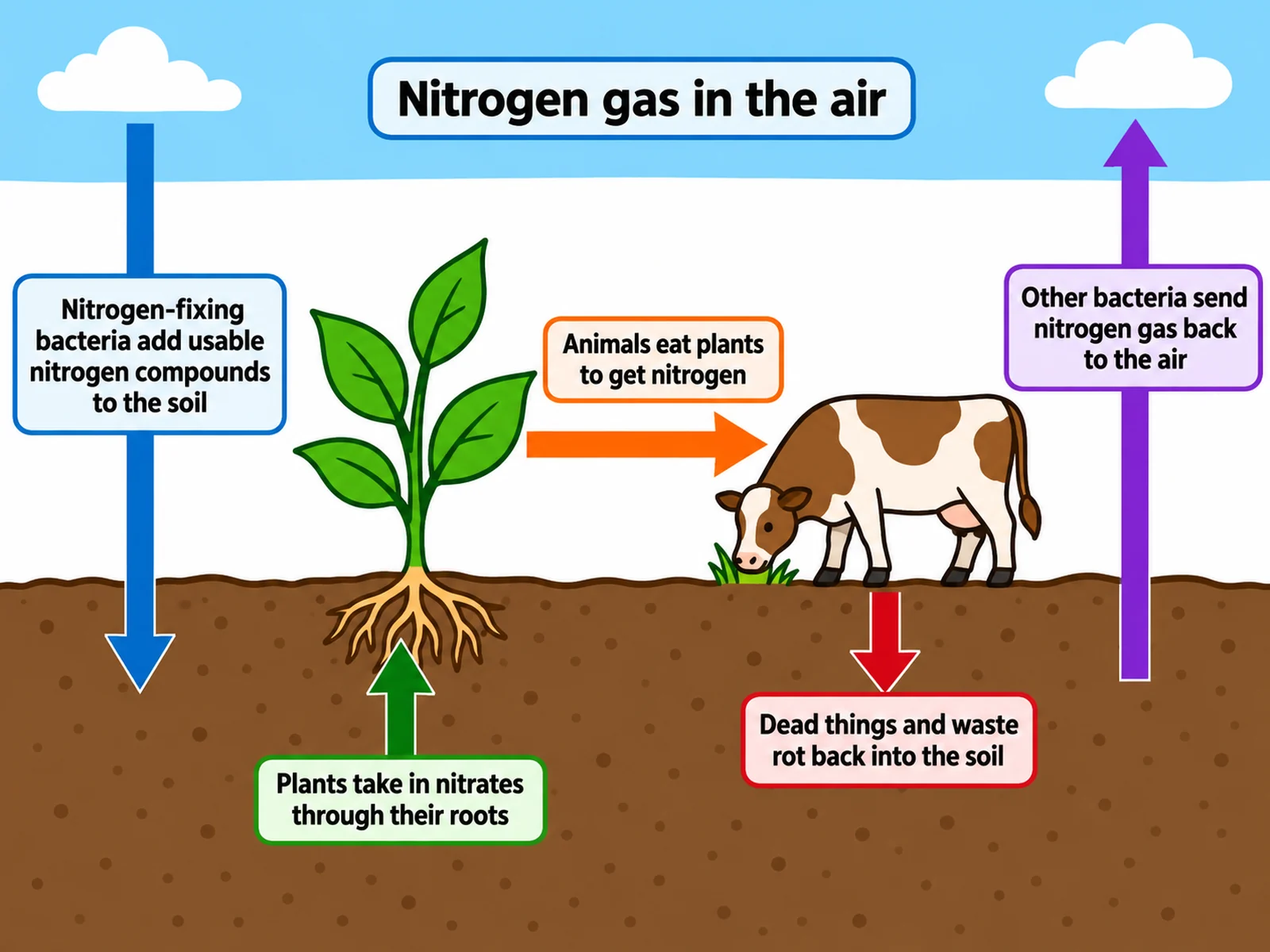
Simple easy-to-draw nitrogen cycle for younger students with four plain-wording labeled arrows

Sample previews. Describe your diagram to generate your own nitrogen cycle figure.

Nitrogen Cycle Diagram Examples

Use these as visual directions for labeled cycles, blank worksheets, simple versions for younger classes, root nodule close-ups, bacteria flow charts, and human-impact figures.

Labeled nitrogen cycle diagram showing fixation, nitrification by Nitrosomonas and Nitrobacter, assimilation, ammonification, and denitrification with correct formulas

Prompt

Create a fully labeled nitrogen cycle diagram on a white background with a pale sky band across the top labeled "Nitrogen gas in the atmosphere (N2) — 78% of the air". Below it draw a bean plant with visible root nodules on the left, a grazing cow on the right, and a soil cross-section beneath both. Draw eight thick curved arrows with short labels in white pills: "Biological nitrogen fixation — Rhizobium in root nodules" from atmospheric N2 down to a soil box reading "Ammonium (NH4+)"; a separate "Lightning fixation — nitrogen oxides carried by rain" arrow from atmospheric N2 down to a soil box reading "Nitrate (NO3-)"; "Nitrification step 1 — Nitrosomonas" from ammonium to a box reading "Nitrite (NO2-)"; "Nitrification step 2 — Nitrobacter" from nitrite to nitrate; "Assimilation" from nitrate up into the plant roots; "Feeding" from plant to cow; "Ammonification — decomposers" from dead matter and waste back to ammonium; and "Denitrification — Pseudomonas" running from nitrate up to atmospheric N2. Thin dark leader lines, readable sans-serif text. Never point the lightning arrow to ammonium.
Labeled Nitrogen Cycle

Blank unlabeled nitrogen cycle diagram with numbered empty label lines and a word bank for students to complete

Prompt

Create a blank nitrogen cycle worksheet. Draw the same scientifically correct scene — atmosphere band, legume plant with root nodules, grazing animal, dead matter, and a soil cross-section with three empty compound boxes — in clean line art with pale flat fills and no process answers on the diagram. Draw exactly eight arrows with empty white numbered pills: 1 biological nitrogen fixation from atmosphere to the ammonium box, 2 lightning fixation from atmosphere to the nitrate box, 3 ammonium to nitrite, 4 nitrite to nitrate, 5 nitrate to plant, 6 plant to animal, 7 dead matter and waste to ammonium, and 8 nitrate back to atmosphere. Mark the three empty compound boxes A, B, and C. Add a word bank box below reading exactly "biological nitrogen fixation, lightning fixation, nitrification step 1, nitrification step 2, assimilation, feeding, ammonification, denitrification, ammonium NH4+, nitrite NO2-, nitrate NO3-". Generous white space, no answer key, no bacteria names printed anywhere.

Blank Nitrogen Cycle Worksheet

Simple easy-to-draw nitrogen cycle for younger students with four plain-wording labeled arrows

Prompt

Create a simple, easy-to-draw nitrogen cycle diagram for lower-secondary students. Use bold flat colours, thick clean outlines, and large readable text. Show only four elements: a nitrogen gas band at the top, one plant, one animal, and the soil. Draw five thick labeled arrows in plain wording: "Nitrogen-fixing bacteria add usable nitrogen compounds to the soil", "Plants take in nitrates through their roots", "Animals eat plants to get nitrogen", "Dead things and waste rot back into the soil", and "Other bacteria send nitrogen gas back to the air". Plenty of white space, no chemical formulas, no bacteria names.

Simple Nitrogen Cycle

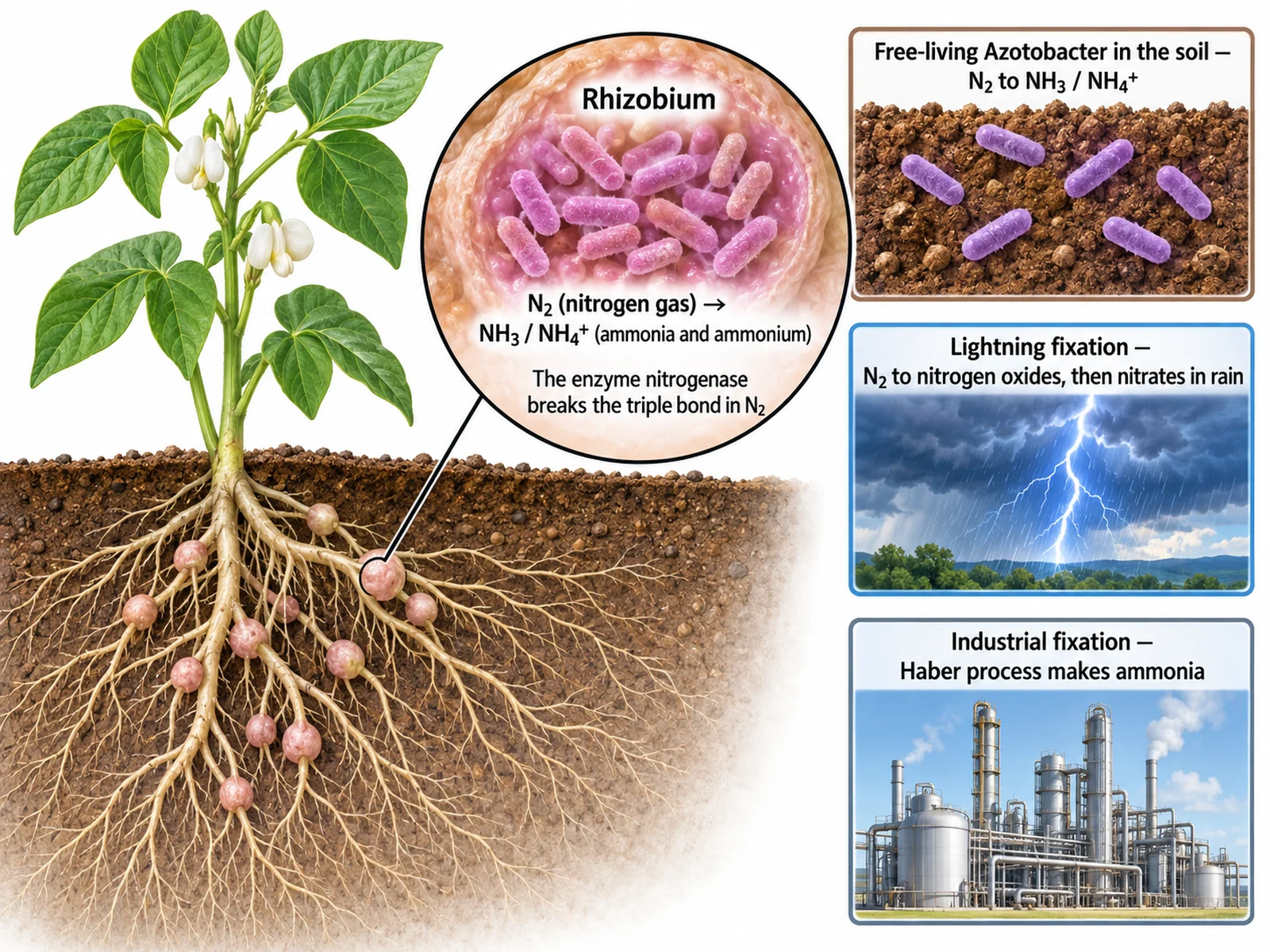
Close-up diagram of a legume root system with Rhizobium bacteria inside root nodules converting nitrogen gas to ammonium

Prompt

Create a labeled close-up of biological nitrogen fixation in a legume. Draw a clover or bean plant with its root system prominent below the soil line and several round pink nodules attached to the ROOTS only, never to the stem or leaves. Add a magnified callout circle from one nodule showing rod-shaped bacteria labeled "Rhizobium". Inside the callout write the conversion as "N2 (nitrogen gas) to NH3 / NH4+ (ammonia and ammonium)" with an arrow, and add a caption reading "The enzyme nitrogenase breaks the triple bond in N2". To one side draw three clearly separate smaller panels: "Free-living Azotobacter in the soil — N2 to NH3 / NH4+", "Lightning fixation — N2 to nitrogen oxides, then nitrates in rain", and "Industrial fixation — Haber process makes ammonia". Clean textbook style on white. Never show lightning producing ammonium.

Nitrogen Fixation in Root Nodules

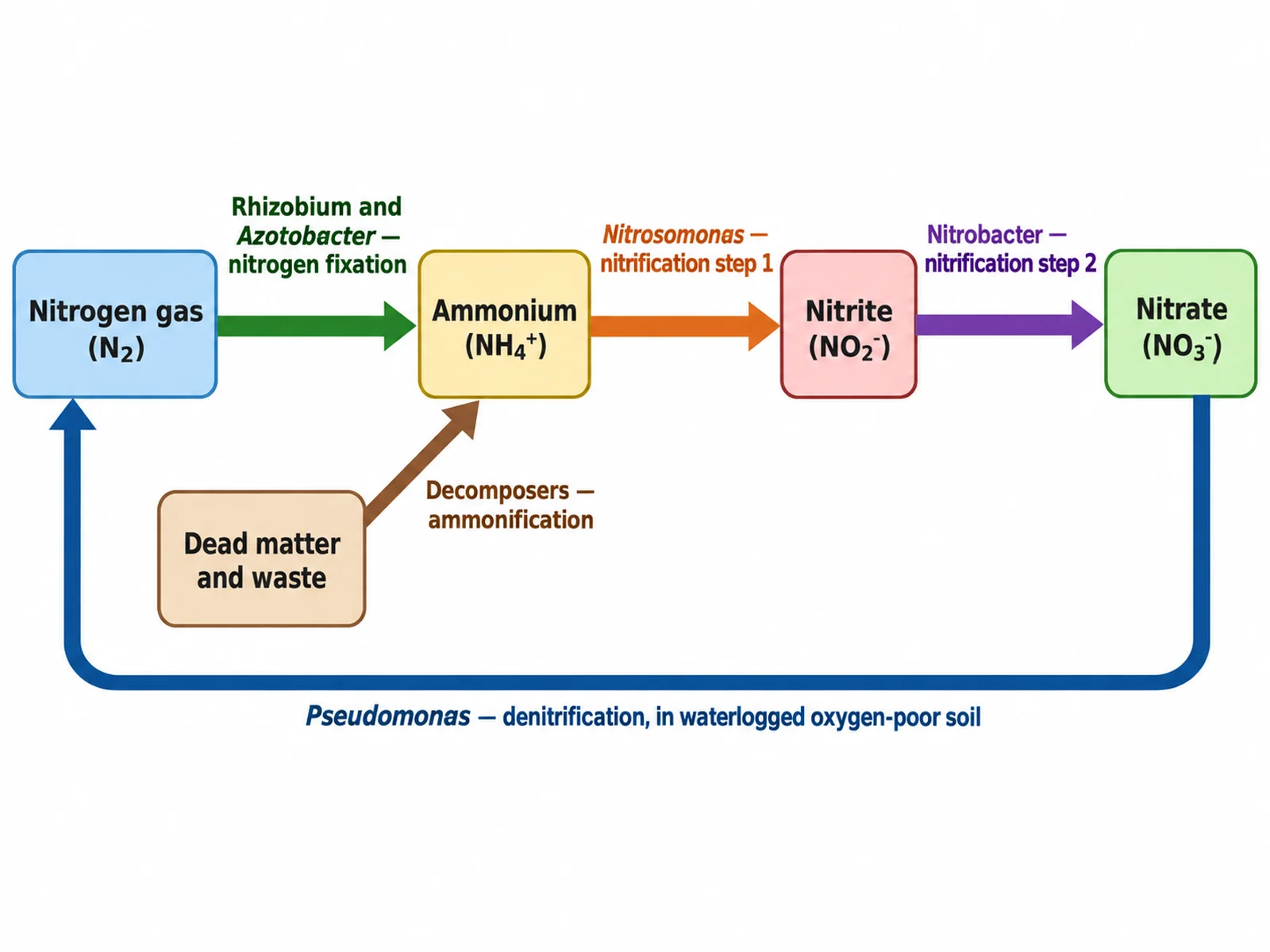
Flow chart naming Rhizobium, Nitrosomonas, Nitrobacter, decomposers, and Pseudomonas against the step each one performs

Prompt

Create a nitrogen cycle bacteria flow chart on a white background, running left to right as a chain of rounded compound boxes joined by labeled arrows: "Nitrogen gas (N2)" then "Ammonium (NH4+)" then "Nitrite (NO2-)" then "Nitrate (NO3-)". Label the arrow into ammonium "Rhizobium and Azotobacter — nitrogen fixation", the arrow into nitrite "Nitrosomonas — nitrification step 1", and the arrow into nitrate "Nitrobacter — nitrification step 2". Add a long return arrow beneath, running from the nitrate box back to the nitrogen gas box, labeled "Pseudomonas — denitrification, in waterlogged oxygen-poor soil". Add one more arrow from a "Dead matter and waste" box into ammonium labeled "Decomposers — ammonification". Give each bacterium a distinct colour and keep every formula exact.

The Bacteria of the Nitrogen Cycle

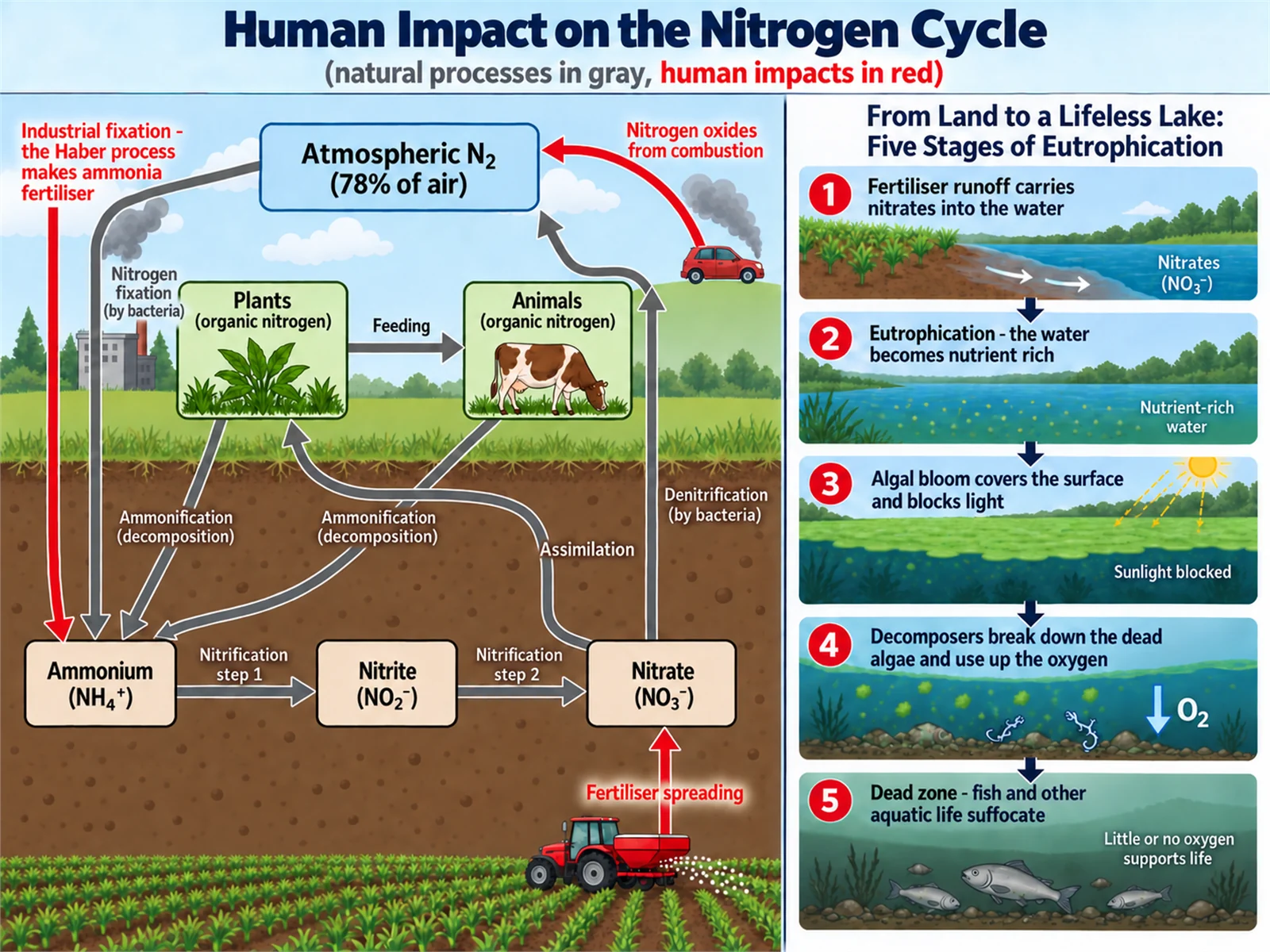
Nitrogen cycle diagram highlighting fertiliser runoff, eutrophication, algal bloom, and an oxygen-depleted dead zone

Prompt

Create a nitrogen cycle diagram that highlights human impact. Draw the standard cycle in muted grey tones on the left, then pick out the human additions in strong red: a factory labeled "Industrial fixation — the Haber process makes ammonia fertiliser", a tractor spreading fertiliser on a field, and a car and chimney labeled "Nitrogen oxides from combustion". On the right draw a five-stage chain of labeled panels leading into a lake: "1 Fertiliser runoff carries nitrates into the water", "2 Eutrophication — the water becomes nutrient rich", "3 Algal bloom covers the surface and blocks light", "4 Decomposers break down the dead algae and use up the oxygen", "5 Dead zone — fish and other aquatic life suffocate". Keep the text short and readable.

Human Impact on the Nitrogen Cycle

How to draw a labeled nitrogen cycle

1

Choose the level of detail

Four plain-wording arrows for a simple class drawing, the full five-stage cycle with every bacterium and formula named, or a close-up of fixation in the root nodules.

2

Generate the diagram

The generator lays out the atmosphere, plant, animal, and soil layers, then attaches the right process, bacterium, and chemical formula to each arrow.

3

Check the formulas, then export

Confirm Nitrosomonas points at nitrite and Nitrobacter at nitrate, and that denitrification runs toward the atmosphere, then download the PNG.

What is the nitrogen cycle?

The nitrogen cycle describes how nitrogen atoms move between the atmosphere, the soil, living things, and back again. Nitrogen gas makes up 78% of the air, but its triple bond is so stable that almost nothing can use it directly, so nearly every step of the cycle is carried out by a specific group of bacteria. Like the carbon cycle, nothing is used up: the same atoms pass from N2 into ammonium, through nitrite to nitrate, into a plant root, along a food chain, back into the soil, and eventually into the air as N2 again. A good diagram draws one labeled arrow per process and names the organism responsible.

The five stages to label

  • Biological nitrogen fixation: atmospheric nitrogen gas (N2) becomes ammonia (NH3) and ammonium (NH4+) through Rhizobium in legume root nodules or free-living Azotobacter. Lightning instead forms nitrogen oxides that enter the soil in rain and contribute nitrate; industry uses the Haber process to make ammonia.
  • Nitrification, step 1: Nitrosomonas converts ammonium (NH4+) into nitrite (NO2-).
  • Nitrification, step 2: Nitrobacter converts nitrite (NO2-) into nitrate (NO3-), the form plants can actually use.
  • Assimilation: plants absorb nitrate, and some ammonium, through their roots and build amino acids and proteins. Animals get their nitrogen by eating plants.
  • Ammonification: decomposers break down dead matter, urine, and faeces, returning nitrogen to the soil as ammonium.
  • Denitrification: Pseudomonas and other denitrifying bacteria convert nitrate (NO3-) back into N2 gas and release it to the atmosphere, mostly in waterlogged, oxygen-poor soil.

Common errors to check before you print

  • Nitrosomonas and Nitrobacter swapped. This is the single most common error on this figure. NitrosoMONAS makes nitrITE; NitroBACTER makes nitrATE.
  • Nitrite written for nitrate. NO2- and NO3- differ by one oxygen and belong to different steps, so read every formula character by character.
  • Plants shown absorbing N2 from the air. They cannot. Only legumes benefit from atmospheric nitrogen, and only indirectly through the Rhizobium in their nodules.
  • Denitrification drawn backwards. The arrow runs from nitrate in the soil to N2 in the atmosphere, never from the atmosphere to nitrate.
  • Root nodules drawn on the stem or the leaves. They belong on the roots, which is where the bacteria live.

How humans change the cycle

  • The Haber process fixes nitrogen industrially to make ammonia fertiliser, adding more usable nitrogen than every natural route combined.
  • Fertiliser runoff washes nitrates into rivers and lakes, causing eutrophication.
  • Eutrophication triggers an algal bloom that covers the surface and blocks light from the plants below.
  • Decomposers break down the dead algae and consume the dissolved oxygen, creating a dead zone where fish suffocate.
  • Burning fuel releases nitrogen oxides, which contribute to smog and acid rain.

Nitrogen Cycle Diagram Generator FAQ

Five stages, in order. Nitrogen fixation turns atmospheric nitrogen gas (N2) into ammonia (NH3) and ammonium (NH4+). Nitrification converts that ammonium first to nitrite (NO2-) and then to nitrate (NO3-). Assimilation is plants absorbing nitrate through their roots to build amino acids and proteins, which animals then get by eating plants. Ammonification returns nitrogen from dead matter and waste to ammonium. Denitrification converts nitrate back to N2 gas and releases it to the air.

Need other science figures?

Generate earth science cycles, biology diagrams, pathway figures, and worksheet-ready illustrations with the same SciFigure AI workflow.