
Free biology tool
Cladogram maker that builds the tree from your character table
Enter a table of taxa and shared characters and this cladogram maker works out which groups nest inside which, draws the tree, and labels every branch with the characters that define it. It names the outgroup, flags characters that carry no information, and reports conflicts that cannot fit on one tree.
| Taxon | Vertebral column | Four limbs | Amniotic egg | Hair | Placenta |
|---|---|---|---|---|---|
| Lamprey | |||||
| Frog | |||||
| Lizard | |||||
| Kangaroo | |||||
| Human |
Click a cell to flip the character on or off.
First row: character names. First column: taxon names. Cells: 1 or 0. Tabs, commas, or a spreadsheet paste all work.
How this tree was built
- Outgroup:
- Lamprey — fewest derived characters, so it branches first
- Clade 1:
- Frog, Lizard, Kangaroo, Human — share Four limbs
- Clade 2:
- Lizard, Kangaroo, Human — share Amniotic egg
- Clade 3:
- Kangaroo, Human — share Hair
Uninformative: Vertebral column, Placenta — present in every taxon or in only one, so they cannot group anything.
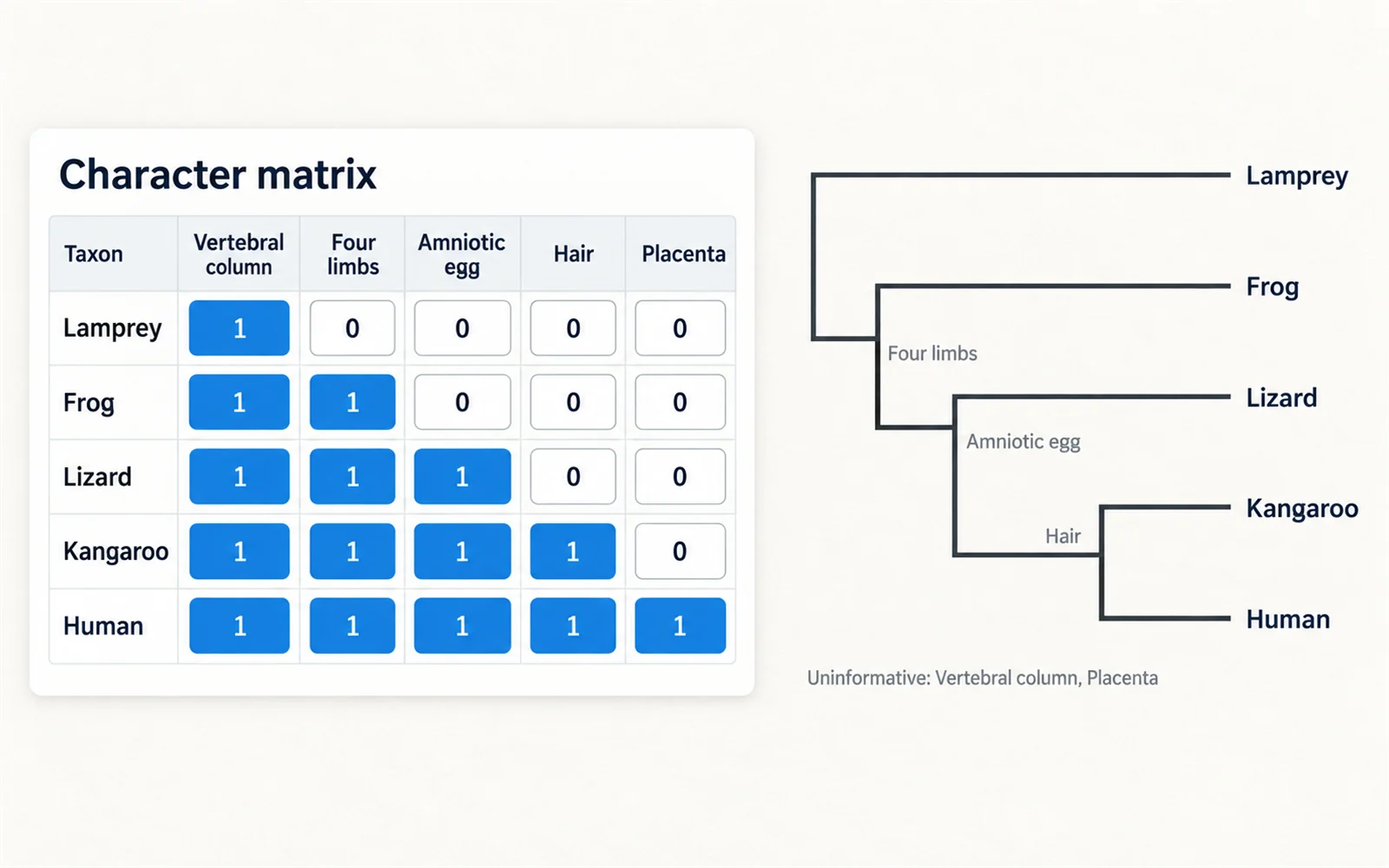
How to make a cladogram from a table
A cladogram groups organisms by shared derived characters. The table you start from lists taxa down the side and characters across the top, with a 1 where the character is present. The nesting falls out of the table once you sort the characters by how many taxa share them.
- List your taxa, including an outgroup: something related but outside the group you are classifying. The outgroup is what makes "derived" mean anything.
- Choose characters that are either present or absent, and score each taxon 1 or 0. Vertebral column, four limbs, amniotic egg, hair.
- Count how many taxa share each character. A character shared by every taxon, or by only one, cannot group anything and is uninformative.
- Order the remaining characters from most widely shared to least. Each one defines a clade, and the smaller clades nest inside the larger ones.
- Draw the branches so each clade splits off after the character that defines it appears. The tool above does the sorting, nesting, and drawing.
Shared derived characters are what count
Not every similarity is evidence of relatedness. Cladistics only uses shared derived characters, because they are the ones that mark a common ancestor unique to the group.
- A shared derived character (synapomorphy) appeared in the common ancestor of one group and nowhere else. Hair marks mammals; it is the evidence that groups them.
- A shared ancestral character (symplesiomorphy) was inherited from further back and is shared with the outgroup too, so it cannot separate anything inside the group. A vertebral column does not tell you how mammals relate to lizards, because both have one.
- A unique character found in only one taxon (autapomorphy) also groups nothing, because a group needs at least two members.
- Analogous characters evolved independently and look alike without shared ancestry. The wings of birds and bats are the standard example.
- The tool separates these for you: characters shared by all or by one are listed as uninformative, and characters that contradict an accepted clade are reported as conflicts.
Reading a cladogram
A cladogram shows branching order, not time and not amount of change. That distinction is where most exam marks are lost.
- Each branch point (node) is the most recent common ancestor of everything above it.
- Two taxa are more closely related when their most recent common ancestor is more recent, which means counting nodes back, not measuring distance along the page.
- Branch lengths carry no meaning in a cladogram. A phylogram uses branch length to show genetic change or time; a cladogram does not.
- Rotating a branch about its node changes nothing. Two trees that look different can be identical if the same taxa hang off the same nodes.
- A clade is a node plus everything descended from it. A group that leaves out some descendants, such as "reptiles" excluding birds, is not a clade.
When characters conflict
Real data rarely fits one tree perfectly. When two characters pick out groups that overlap only partially, both cannot be true on the same tree, and one of them must have evolved more than once or been lost.
- Homoplasy is the general term for a character that appears in taxa without coming from their common ancestor. It covers convergent evolution, parallel evolution, and reversal.
- Parsimony resolves the conflict by choosing the tree that requires the fewest character changes overall. The tool applies a simple version: characters that contradict an already-accepted larger clade are set aside and reported.
- A conflict is information, not an error. It usually means the character is a poor marker, or that it really did evolve twice.
- If you get many conflicts, check whether your characters are truly independent. Several traits that all follow from one underlying change will pull the tree in the same direction and overstate the evidence.
Frequently asked questions
Is this cladogram maker free?
Yes. It runs entirely in your browser, needs no account, and exports PNG, SVG, Newick, and the matrix itself. Nothing you type is uploaded to a server.
How do I make a cladogram from a table of characters?
Paste the table with taxa down the first column and characters across the first row, marking presence with 1 and absence with 0. The tool sorts the characters by how many taxa share them, nests the resulting groups, and draws the tree. You can also click any cell to flip it and watch the tree change.
What is the difference between a cladogram and a phylogenetic tree?
A cladogram shows only branching order: which groups share a more recent common ancestor. A phylogenetic tree, specifically a phylogram, also uses branch length to represent time or amount of evolutionary change. Cladogram branches are all drawn the same length because the length means nothing.
Why do I need an outgroup?
Because "derived" only has meaning relative to something. The outgroup is a taxon outside the group being studied but related to it, and any character it also has is ancestral rather than derived. Without an outgroup you cannot tell which state came first. The tool treats the taxon with the fewest derived characters as the outgroup.
What does it mean when a character is called uninformative?
It is present in every taxon, or in only one. A character shared by all of them, like a vertebral column in a table of vertebrates, cannot separate them. A character unique to one taxon cannot group it with anything, because a group needs two or more members.
Can I export the tree to another program?
Yes. The Newick export gives a standard parenthetical tree string that FigTree, iTOL, MEGA, and R packages such as ape all read. The matrix export gives a tab-separated file for a spreadsheet, and SVG keeps the text editable in Illustrator or Inkscape.
What if I already have a tree rather than a table?
Use the phylogenetic tree maker instead. It takes a Newick string and draws it as a rectangular phylogram, a cladogram, or a circular tree, with branch lengths and support values.
Related tools
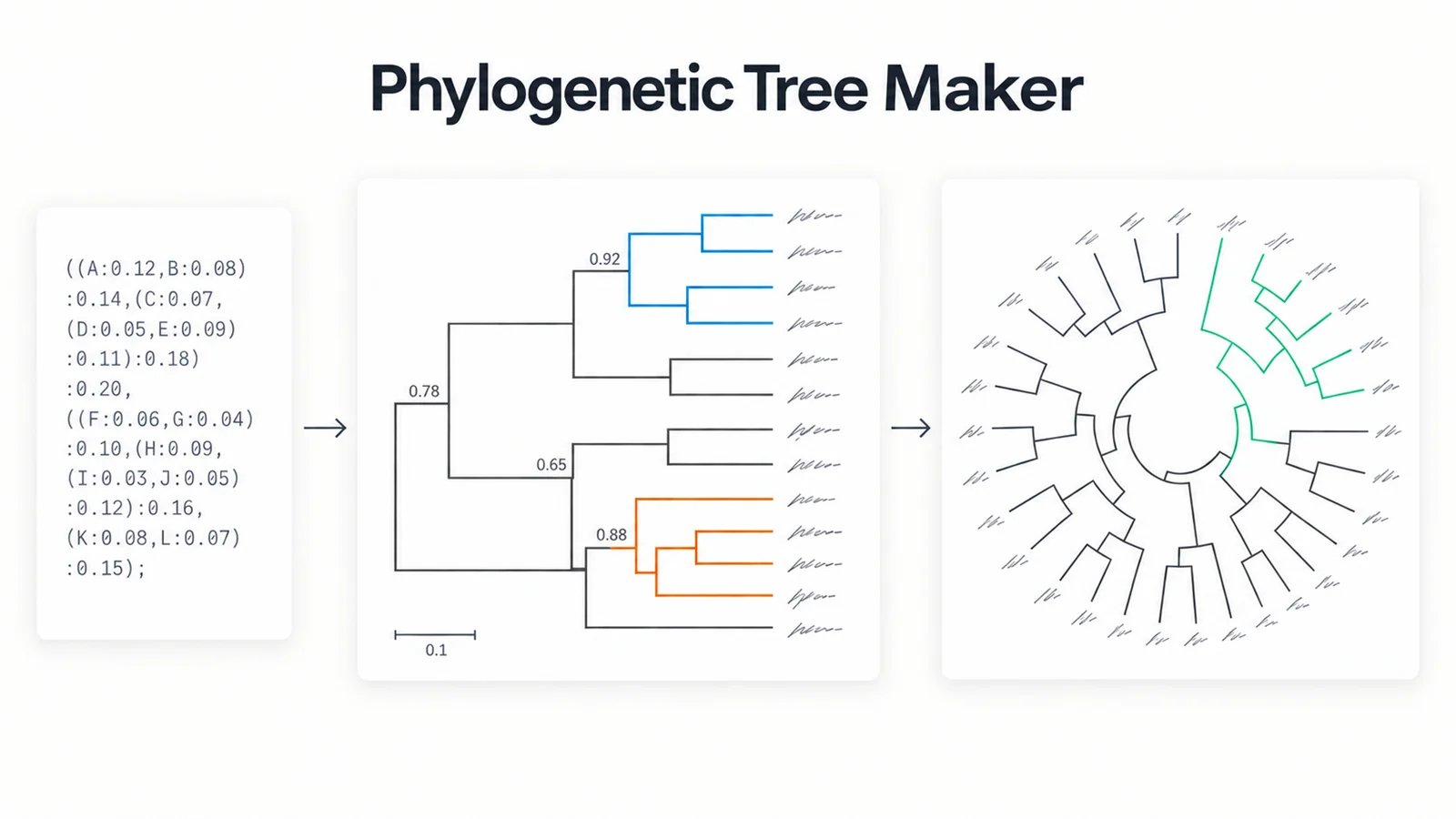
Phylogenetic Tree Maker
Paste a Newick tree and draw it as a phylogram, cladogram, or circular tree.
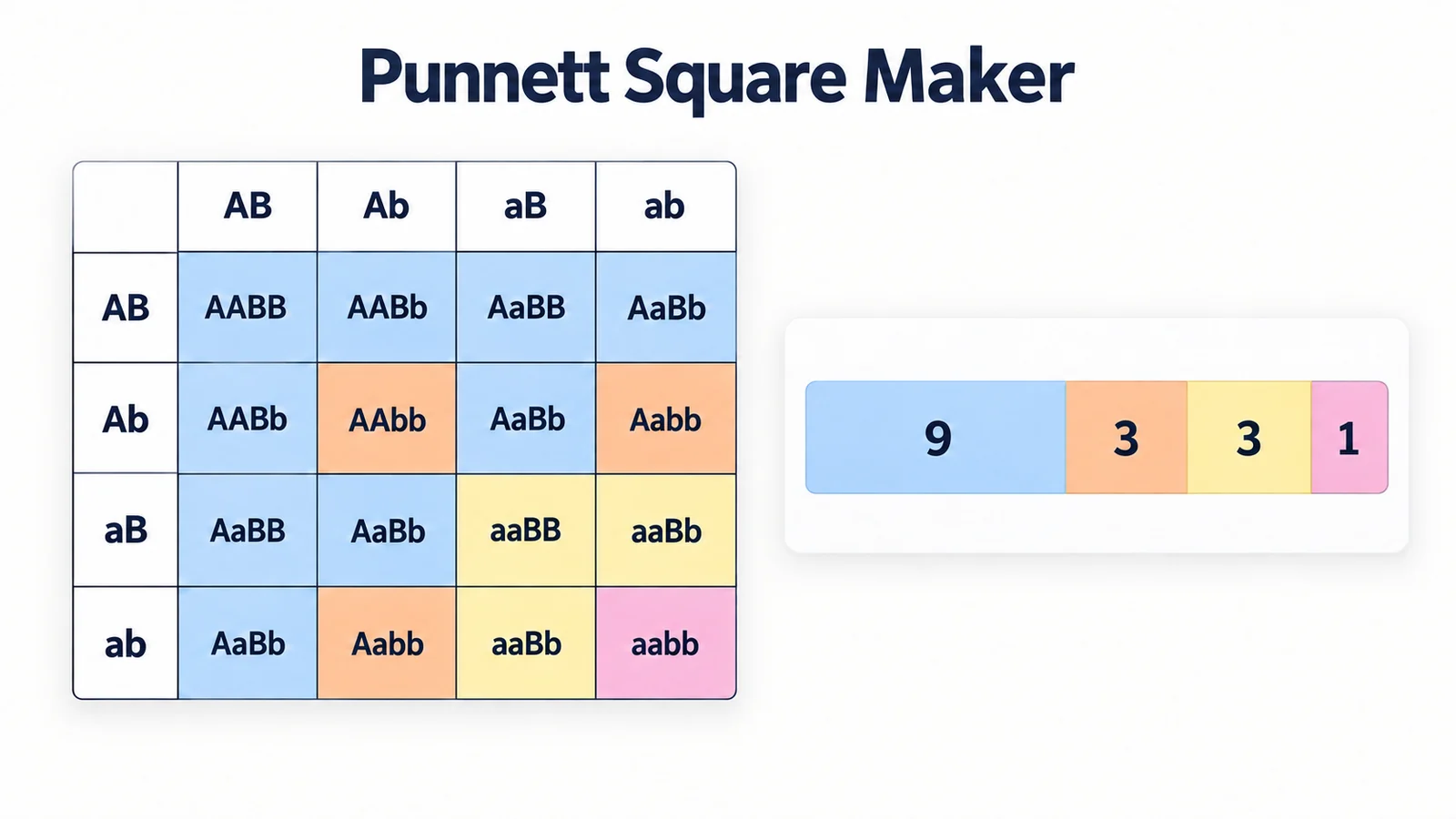
Punnett Square Maker
Build genetics crosses with genotype and phenotype ratios.
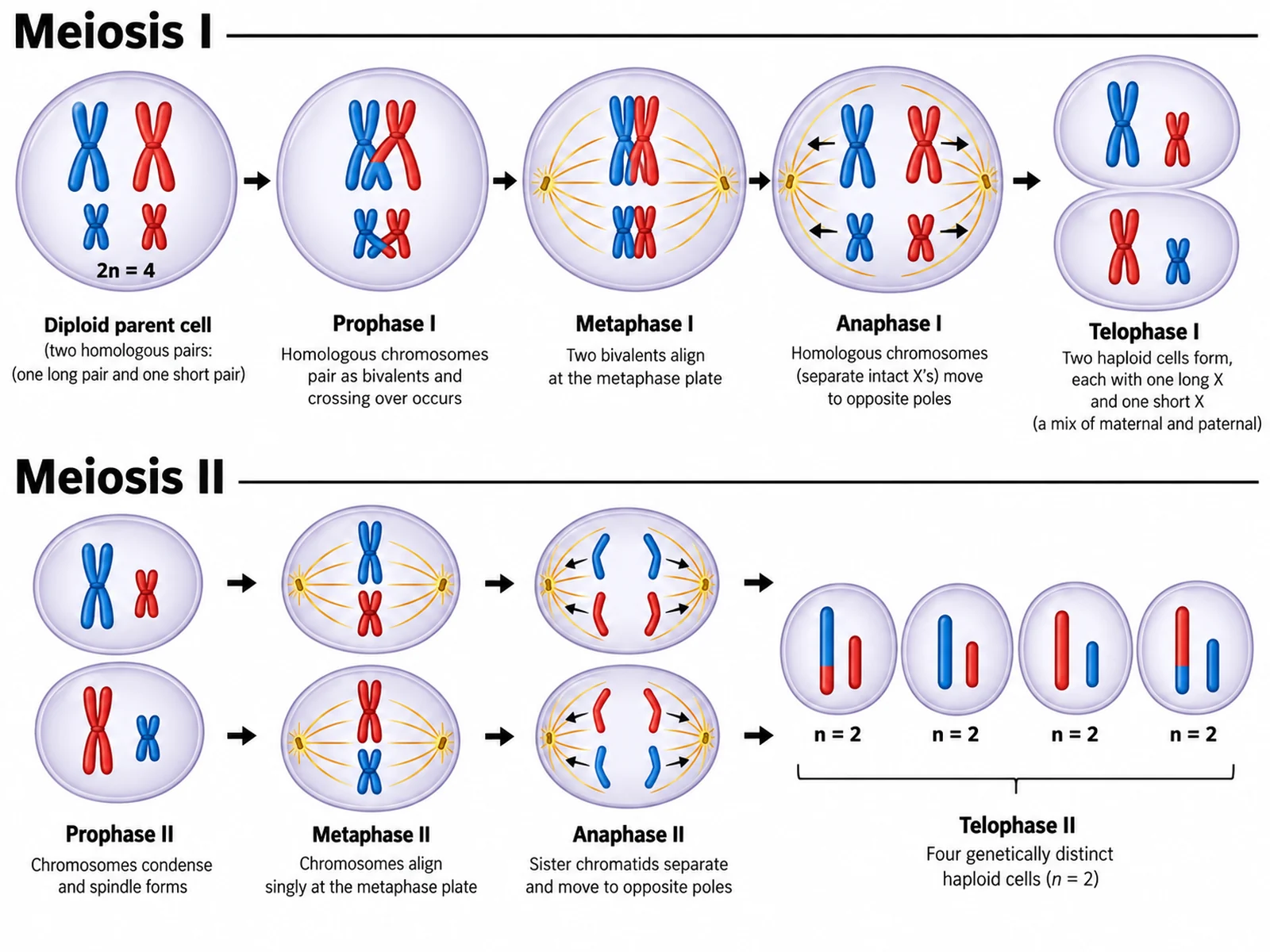
Meiosis Diagram Generator
Draw meiosis I and II, crossing over, and four haploid cells.
Biology Diagram Maker
Generate labelled cell, pathway, and anatomy diagrams with AI.
Need a full biology figure?
SciFigure AI turns evolutionary relationships, mechanisms, and results into publication-ready figures for papers and slides.
Explore the biology toolsLast checked: September 20, 2026. Sources: UC Berkeley Understanding Evolution: Building the Tree; Newick tree format specification.