
Free physics tool
Free body diagram generator with resolved components
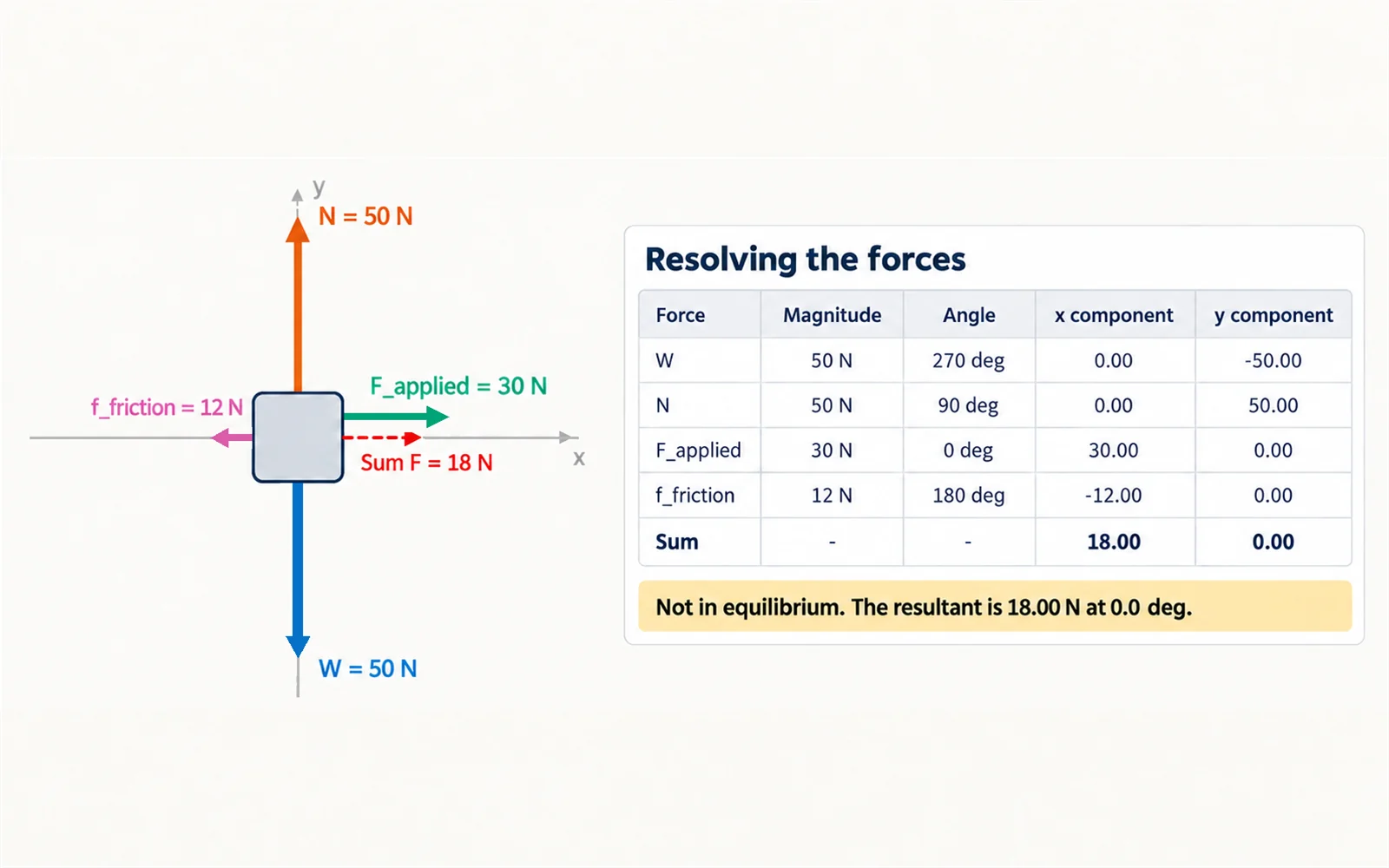
Add each force with a magnitude and an angle and this free body diagram maker draws the arrows to scale, resolves every force into x and y components, sums them, and tells you whether the body is in equilibrium. Export the diagram as PNG or SVG for homework, a lab report, or a lecture slide.
Angles run counter-clockwise from the +x axis: 0° right, 90° up, 180° left, 270° down.
Resolving the forces
| Force | Magnitude | Angle | x component | y component |
|---|---|---|---|---|
| W | 50 N | 270° | 0.00 | -50.00 |
| N | 50 N | 90° | 0.00 | 50.00 |
| F_applied | 30 N | 0° | 30.00 | 0.00 |
| f_friction | 12 N | 180° | -12.00 | 0.00 |
| Σ | 18.00 | 0.00 | ||
Not in equilibrium. The resultant is 18.00 N at 0.0°, so the body accelerates in that direction.
How to draw a free body diagram
A free body diagram isolates one object and shows every external force acting on it, and nothing else. Getting that isolation right is most of the work; the arithmetic that follows is straightforward.
- Choose the body. Draw it as a simple block, circle, or point. Detail in the drawing adds nothing and hides the arrows.
- Remove everything else. Surfaces, ropes, and neighbouring objects are replaced by the forces they exert, not drawn.
- Draw one arrow per external force, starting at the body and pointing the way the force acts. Arrow length should be proportional to magnitude, which the tool above does for you.
- Label each arrow: W or mg for weight, N for the normal force, T for tension, f for friction, and F with a subscript for anything applied.
- Pick axes. Aligning the x axis with the direction of motion, or with the slope on an incline, turns a two-dimensional problem into two one-dimensional ones.
- Resolve each force into components, sum them, and apply Newton’s second law: ΣF = ma in each direction.
What belongs on the diagram, and what does not
Most marks are lost for drawing forces that are not there, not for arithmetic.
- Include only forces acting ON the body. A force the body exerts on something else belongs on that other object’s diagram.
- Weight always acts downward from the centre of mass, whatever the surface is doing.
- The normal force is perpendicular to the contact surface, so on an incline it is not vertical.
- Friction acts parallel to the surface, opposing relative motion or the tendency to move.
- Do not draw ma. Mass times acceleration is the result of the forces, not one of them. Drawing it double-counts.
- Do not draw centrifugal force in an inertial frame. Circular motion is produced by a net inward force, which is already the resultant of the real forces.
- Internal forces cancel and never appear. Only external forces go on the diagram.
Resolving forces into components
Once the arrows are drawn, every force becomes a pair of numbers. The angle convention used here is the standard one in mechanics: degrees measured counter-clockwise from the positive x axis.
- Fx = F cos θ and Fy = F sin θ, with θ measured from the +x axis.
- 0° points right, 90° points up, 180° points left, and 270° points down. Weight is therefore at 270°.
- Sum the x components to get ΣFx, and the y components to get ΣFy. The table under the diagram shows both.
- The resultant magnitude is √(ΣFx² + ΣFy²) and its direction is atan2(ΣFy, ΣFx).
- If both sums are zero the body is in equilibrium: at rest or moving at constant velocity. If not, it accelerates along the resultant.
The block on an incline
This is the case that separates students who understand free body diagrams from those who have memorised one. Work it once with axes tilted along the slope and it becomes routine.
- Tilt the axes so x runs down the slope and y is perpendicular to it. The normal force then lies entirely along y and friction entirely along x.
- Weight is the only force that needs resolving: its component along the slope is mg sin θ and its component into the surface is mg cos θ, where θ is the incline angle.
- Perpendicular to the slope there is no acceleration, so N = mg cos θ. The normal force is smaller than the weight on any incline, which surprises people the first time.
- Along the slope, ΣF = mg sin θ − f. The block stays put while static friction can supply that much; it slides once mg sin θ exceeds μs N.
- Load the "Block on an incline" example above to see a balanced version with N = 51.96 N and f = 30 N for a 60 N weight on a 30° slope.
Frequently asked questions
Is this free body diagram generator free?
Yes. It runs entirely in your browser, needs no account, and exports PNG and SVG without a watermark. Nothing you enter is uploaded to a server.
What is a free body diagram?
A simplified drawing of one object showing every external force acting on it as a labelled arrow, with everything else in the problem removed. It is the standard first step in any mechanics problem, because it turns a physical situation into a set of vectors you can add.
What angle convention does the tool use?
Degrees counter-clockwise from the positive x axis, the usual convention in introductory mechanics. 0° points right, 90° up, 180° left, and 270° down, so weight is entered at 270°.
Why should I not include ma on the diagram?
Because mass times acceleration is not a force. It is the outcome of the forces, so drawing it alongside them counts the same physics twice. Draw only real forces, sum them, then set that sum equal to ma.
Is the normal force always equal to the weight?
No, and assuming so is a common error. On a horizontal surface with no vertical applied force they happen to be equal. On an incline N = mg cos θ, which is less than mg. If something presses down on the object or pulls it up, N changes accordingly.
How do I know if the body is in equilibrium?
When ΣFx and ΣFy are both zero. The tool computes both and states the result under the diagram. Equilibrium means no linear acceleration, which includes an object moving at constant velocity, not just one at rest.
Can I use the diagram in a lab report or homework?
Yes. Export the PNG for a document or slide, or the SVG if you want to edit the labels later in Illustrator, Inkscape, or PowerPoint. There is no watermark and no attribution requirement.
Related tools
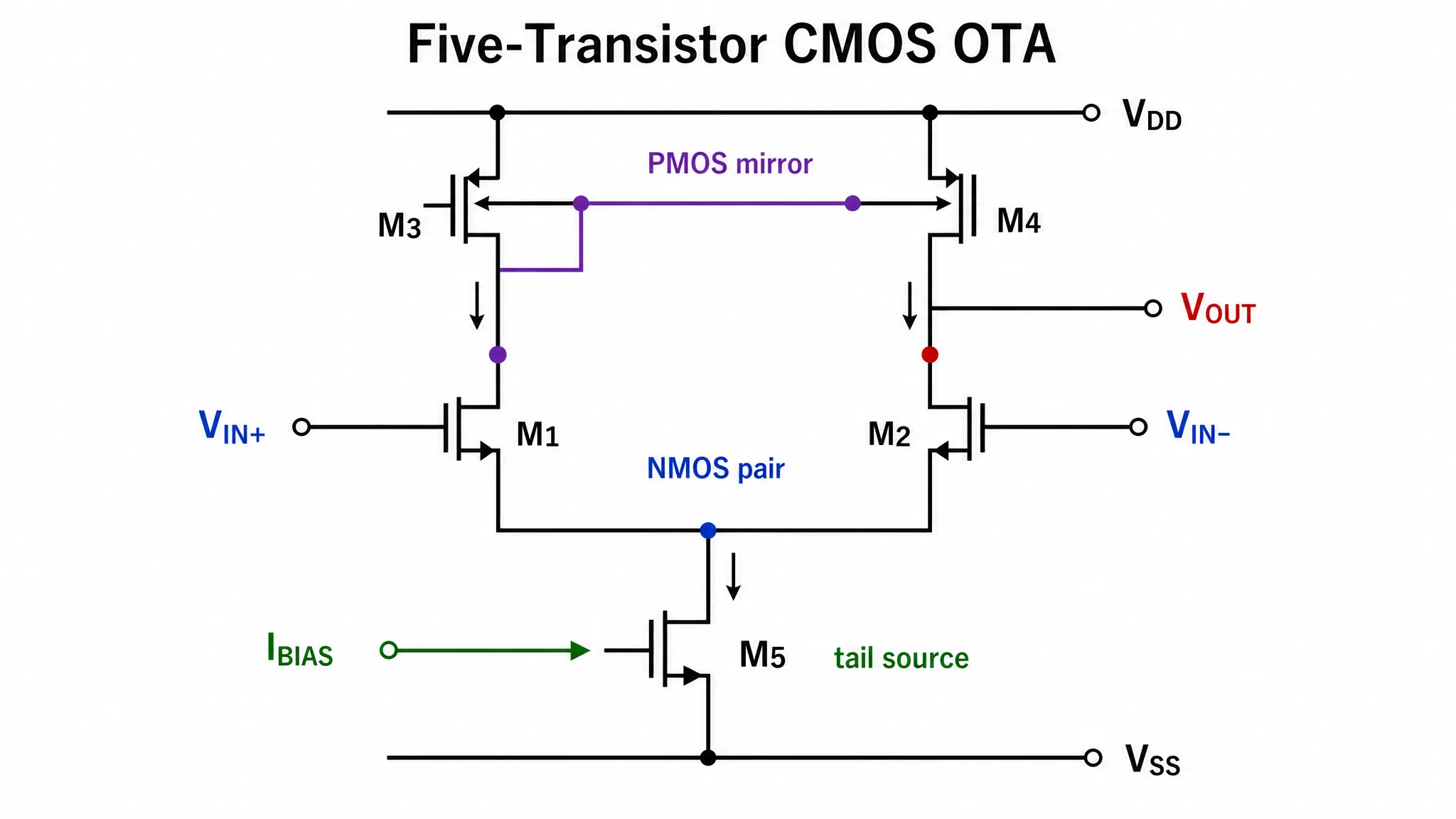
Circuit Diagram Maker
Generate clean circuit schematics with standard symbols and labels.
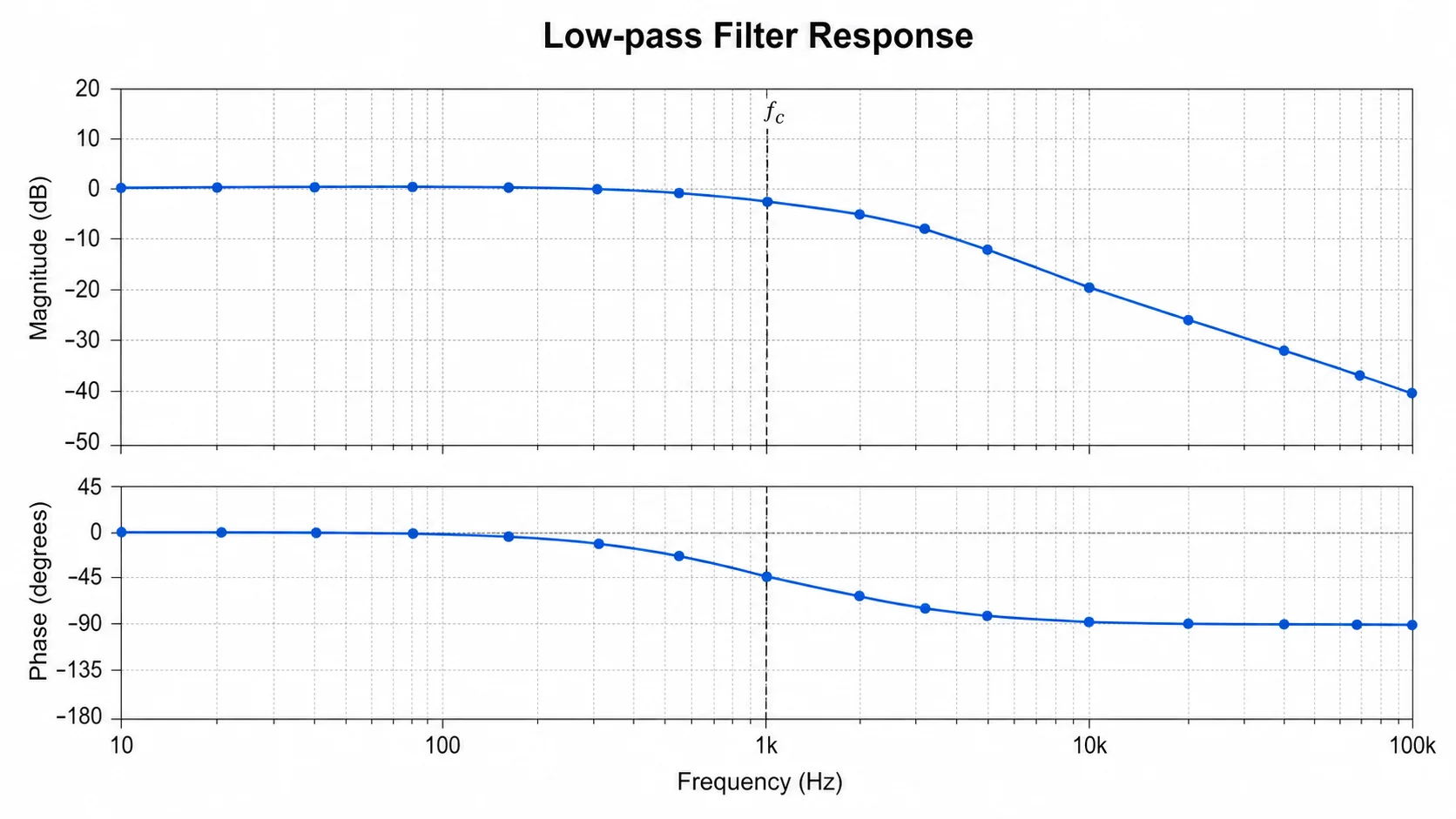
Bode Plot Generator
Plot magnitude and phase response from a transfer function.

Scientific Diagram Maker
Draw mechanism schematics, flowcharts, and labelled physics figures.
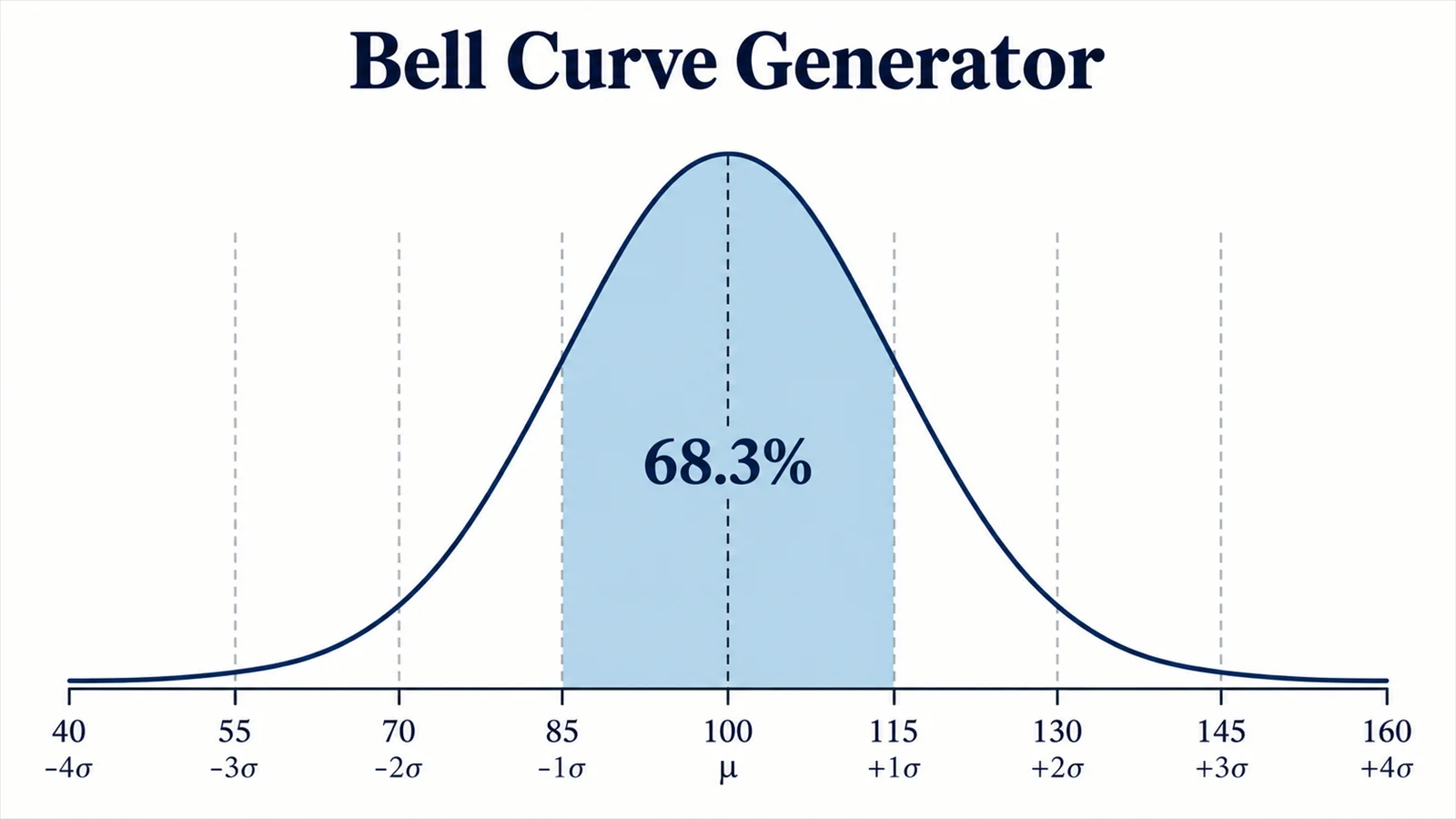
Bell Curve Generator
Draw a normal distribution with shaded regions and z-scores.
Need a full physics figure?
SciFigure AI turns mechanisms, apparatus, and experimental setups into publication-ready figures for papers and slides.
Explore the figure toolsLast checked: September 20, 2026. Sources: OpenStax University Physics: Drawing Free-Body Diagrams; Okabe & Ito, colour-blind safe palette.