
Free atomic orbital diagram maker
Orbital diagram generator: box diagrams and electron configurations for all 118 elements
Type an element or an ion and get its orbital box diagram, drawn by the Aufbau principle, the Pauli exclusion principle and Hund’s rule, with the exact ground-state electron configuration from NIST, including chromium, copper and the eighteen other exceptions. See the unpaired electrons, the quantum numbers of the last electron and the filling order, then export SVG, PNG or PDF, or print a blank worksheet with its answer key.
Hover or tap a box for its quantum numbers.
Electron configuration of Fe
- Full configuration
- 1s2 2s2 2p6 3s2 3p6 4s2 3d6
- Noble-gas (shorthand) notation
- [Ar] 4s2 3d6
Electrons
26
26 protons
Unpaired electrons
4
in 3d
Magnetism
paramagnetic
unpaired spins are attracted by a magnet
Valence electrons
8
ns + (n−1)d electrons, the usual count for transition metals
Electrons per shell
2, 8, 14, 2
n = 1, 2, 3 … as in a Bohr model
Position
d-block · period 4
group 8
Noble-gas core
[Ar]
18 core electrons
Quantum numbers of the last electron
n principal
3
shell 3
ℓ angular momentum
2
d subshell
mℓ magnetic
−2
one of 5 orbitals
mₛ spin
−½
spin down
The 6th electron in 3d, the last placed when the configuration is filled in Aufbau order. Convention: boxes run mℓ = −ℓ to +ℓ left to right and each box takes spin up (+½) first, so a course using the other direction gets the opposite sign of mℓ.
Orbital filling order for Fe
Follow each arrow from top right to bottom left, then start the next one: 1s, 2s, 2p, 3s, 3p, 4s, 3d, 4p, 5s, 4d, 5p, 6s, 4f, 5d, 6p, 7s, 5f, 6d, 7p. Subshells fill by increasing n + ℓ, and by n when two are tied (the Madelung rule).
Shell counts for a planetary picture of the same atom are in the Bohr model maker; valence dots for bonding are in the Lewis dot structure generator.
Free, no sign-up, nothing uploaded: the diagrams are computed and drawn in your browser. Undo with Ctrl+Z.
The three rules, drawn
Aufbau, Pauli and Hund in one orbital diagram
Every box diagram this generator draws follows three rules. The first decides which subshell gets the next electron, the second how many fit in a box, and the third how electrons share a subshell. Here is each one, with the mistakes students most often make.
1. Aufbau: lowest energy first
Follow the diagonals from top right to bottom left. The numbers give the filling order, 1s through 7p.
2. Pauli: two electrons per box, opposite spins
Two electrons in one orbital share n, ℓ and mℓ, so their spins must differ: one up (+½), one down (−½).
Paired spins: allowed
Same spin in one box: never allowed
3. Hund: spread out before pairing
Carbon’s two 2p electrons take separate boxes with parallel spins, leaving two unpaired electrons.
Separate boxes, parallel spins
Paired too early
Separate boxes but opposite spins
Worked example
Orbital diagram of iron, then Fe²⁺ and Fe³⁺
Iron has atomic number 26, so a neutral atom has 26 electrons. Filling the subshells in Aufbau order, with the running total after each one:
That is 1s2 2s2 2p6 3s2 3p6 4s2 3d6, or [Ar] 4s2 3d6 in noble-gas notation. Everything up to 4s is paired. The six 3d electrons follow Hund’s rule: five go one per box with parallel spins, and the sixth pairs in the first box, so iron has 4 unpaired electrons and is paramagnetic.
To make the ions, take electrons from the highest shell first. Fe²⁺ loses both 4s electrons and keeps 3d⁶, still with 4 unpaired electrons. Fe³⁺ loses one more, from 3d, leaving a half-filled 3d⁵ with 5 unpaired electrons, one in every box. That half-filled shell is part of why iron(III) is so common.
Exceptions to the Aufbau principle
The twenty elements that break the filling order
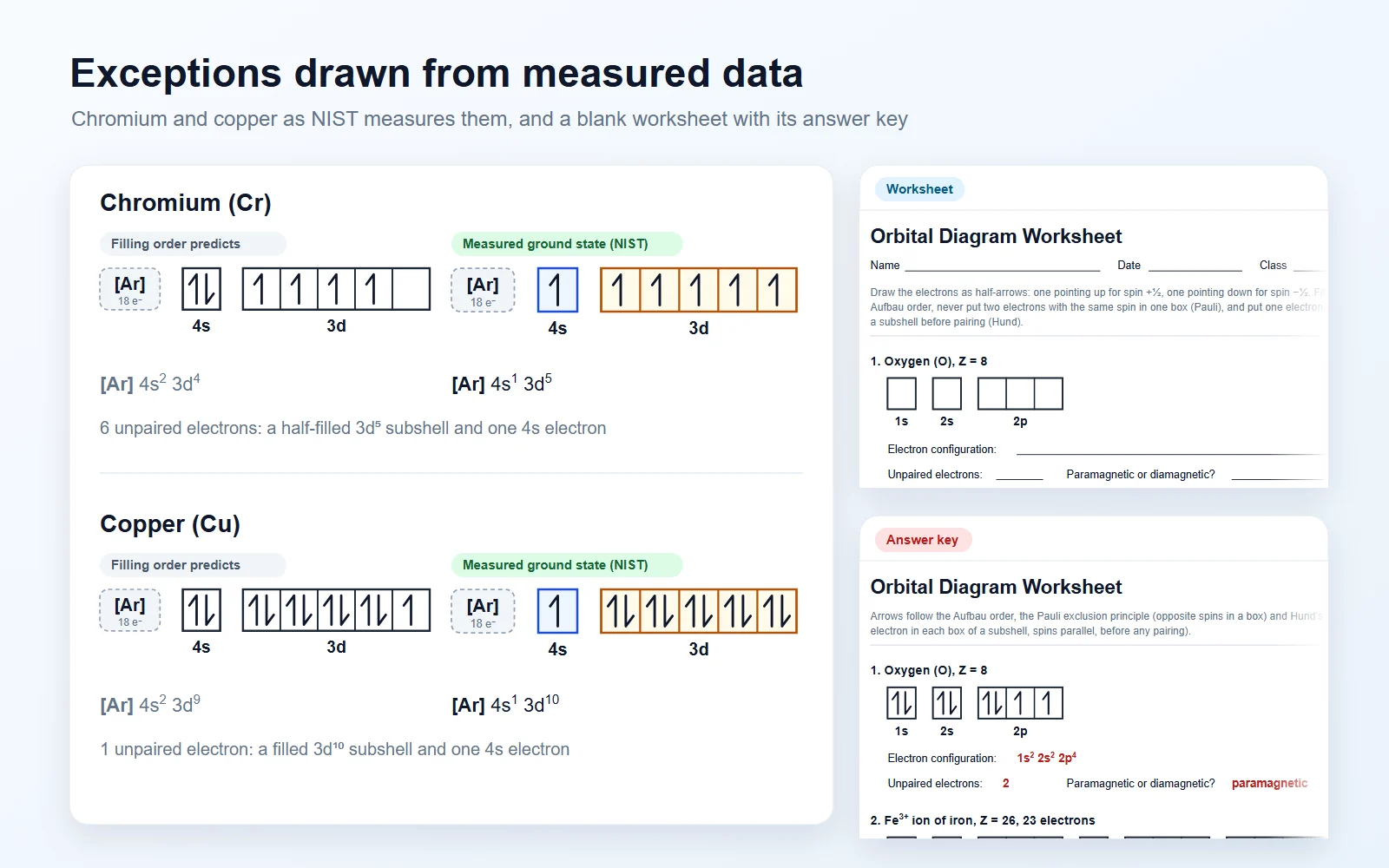
Each row compares what the filling order predicts with the ground state NIST measured. Click an element to draw it.
| Element | Filling order predicts | Measured (NIST) | Why |
|---|---|---|---|
| [Ar] 4s2 3d4 | [Ar] 4s1 3d5 | One 4s electron moves into 3d, giving a half-filled 3d⁵ subshell. Six unpaired electrons with parallel spins gain more exchange energy than the small 4s–3d gap costs. | |
| [Ar] 4s2 3d9 | [Ar] 4s1 3d10 | One 4s electron moves into 3d to complete it. A filled 3d¹⁰ subshell is lower in energy than 3d⁹ 4s². | |
| [Kr] 5s2 4d3 | [Kr] 5s1 4d4 | No half-filled or filled subshell explains this one. 5s and 4d are so close in energy that the repulsion saved by not pairing two electrons in 5s outweighs the gap. | |
| [Kr] 5s2 4d4 | [Kr] 5s1 4d5 | Like chromium above it: a half-filled 4d⁵ subshell and a single 5s electron, six unpaired electrons in all. | |
| [Kr] 5s2 4d6 | [Kr] 5s1 4d7 | An electron avoids pairing in 5s because 4d is barely higher in energy. The iron directly above it keeps 4s², so group trends do not predict this. | |
| [Kr] 5s2 4d7 | [Kr] 5s1 4d8 | Like ruthenium, one 5s electron sits in 4d instead. Cobalt, above it, keeps 4s². | |
| [Kr] 5s2 4d8 | [Kr] 4d10 | Both 5s electrons move into 4d, leaving 5s empty: the only neutral atom with a filled d subshell and no electron in the next s orbital. | |
| [Kr] 5s2 4d9 | [Kr] 5s1 4d10 | Like copper above it: a filled 4d¹⁰ subshell and one 5s electron. | |
| [Xe] 6s2 4f1 | [Xe] 6s2 5d1 | At lanthanum the 4f orbitals are still higher in energy than 5d, so the differentiating electron goes into 5d. 4f drops sharply in energy from cerium on. | |
| [Xe] 6s2 4f2 | [Xe] 6s2 4f1 5d1 | 4f and 5d are nearly equal in energy here, and one electron occupies each. | |
| [Xe] 6s2 4f8 | [Xe] 6s2 4f7 5d1 | The eighth f electron goes into 5d instead, keeping the half-filled 4f⁷ subshell, the same stability that shapes europium (4f⁷ 6s²). | |
| [Xe] 6s2 4f14 5d8 | [Xe] 6s1 4f14 5d9 | One 6s electron moves into 5d. Relativistic effects and the near-equal energies of 5d and 6s make 5d⁹ 6s¹ the lowest level. | |
| [Xe] 6s2 4f14 5d9 | [Xe] 6s1 4f14 5d10 | Like copper and silver: one 6s electron completes the 5d¹⁰ subshell. | |
| [Rn] 7s2 5f1 | [Rn] 7s2 6d1 | Like lanthanum: at actinium 5f is still above 6d, so the electron goes into 6d. | |
| [Rn] 7s2 5f2 | [Rn] 7s2 6d2 | Thorium has no 5f electron at all in its ground state: both electrons beyond radon’s core and 7s² occupy 6d. | |
| [Rn] 7s2 5f3 | [Rn] 7s2 5f2 6d1 | 5f and 6d are nearly equal in energy in the early actinides, so one electron stays in 6d. | |
| [Rn] 7s2 5f4 | [Rn] 7s2 5f3 6d1 | As in protactinium, one electron sits in 6d rather than 5f because the two subshells are so close in energy. | |
| [Rn] 7s2 5f5 | [Rn] 7s2 5f4 6d1 | The last of the early actinides with a 6d electron; plutonium returns to the expected 5f⁶ 7s². | |
| [Rn] 7s2 5f8 | [Rn] 7s2 5f7 6d1 | Like gadolinium above it: the eighth f electron goes into 6d, keeping the half-filled 5f⁷ subshell. | |
| [Rn] 7s2 5f14 6d1 | [Rn] 7s2 5f14 7p1 | Relativistic effects lower the 7p orbital below 6d, so the last electron goes into 7p, not 6d. Lawrencium’s low measured ionization energy supports this. |
Choosing a representation
Orbital diagram vs electron configuration vs Lewis dot structure vs Bohr model
All four describe where an atom’s electrons are, at different levels of detail. Oxygen in each:
| Representation | What it shows | Best for | Oxygen |
|---|---|---|---|
| Orbital diagram | Every orbital as a box and every electron as a spin arrow | Unpaired electrons, magnetism, Hund’s rule, quantum numbers | 1s ↑↓ · 2s ↑↓ · 2p ↑↓ ↑ ↑ |
| Electron configuration | How many electrons are in each subshell | A compact written answer; the periodic table position | 1s² 2s² 2p⁴ |
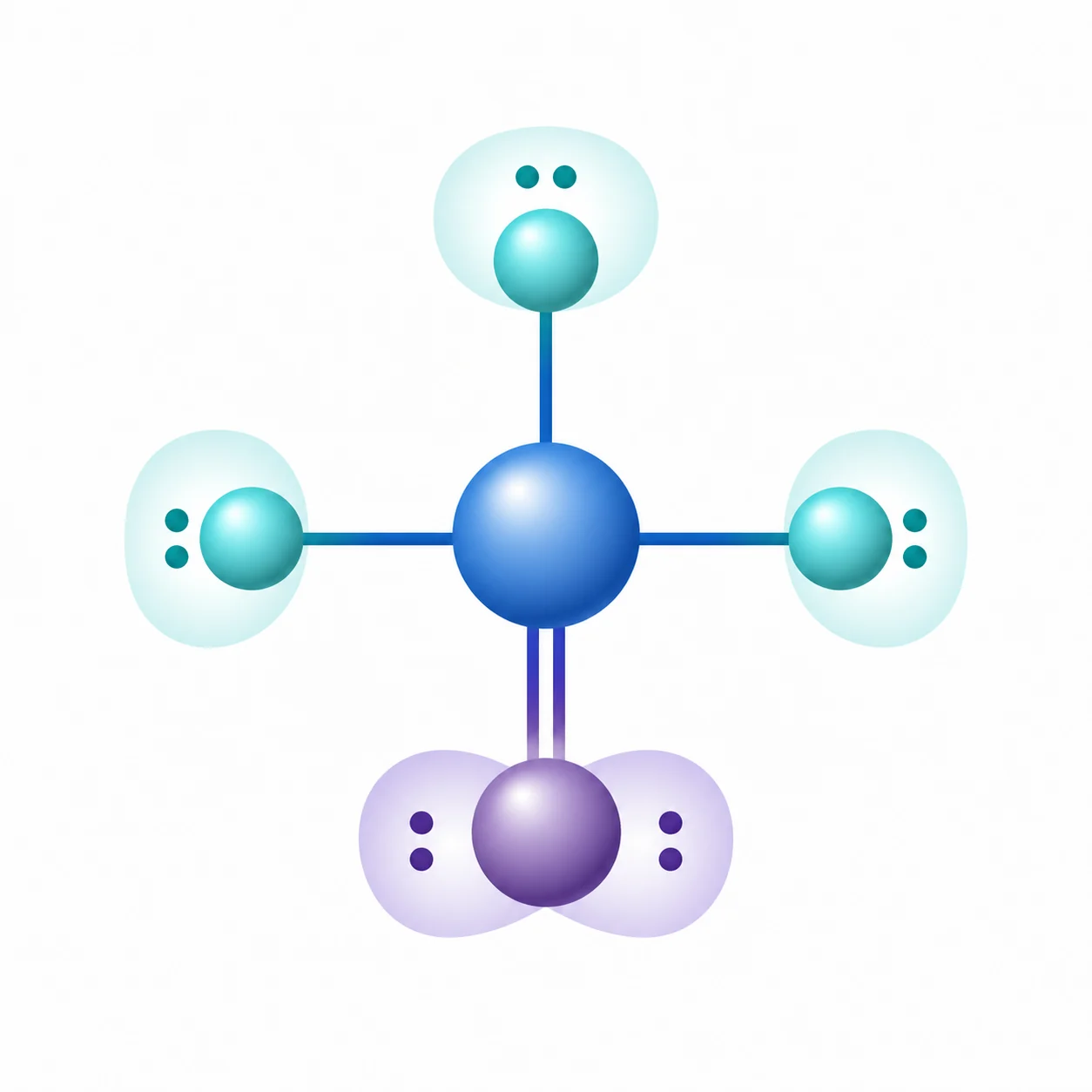
| Lewis dot structure | Valence electrons only, as dots around the symbol | Bonding, lone pairs and molecular shape | O with six dots |
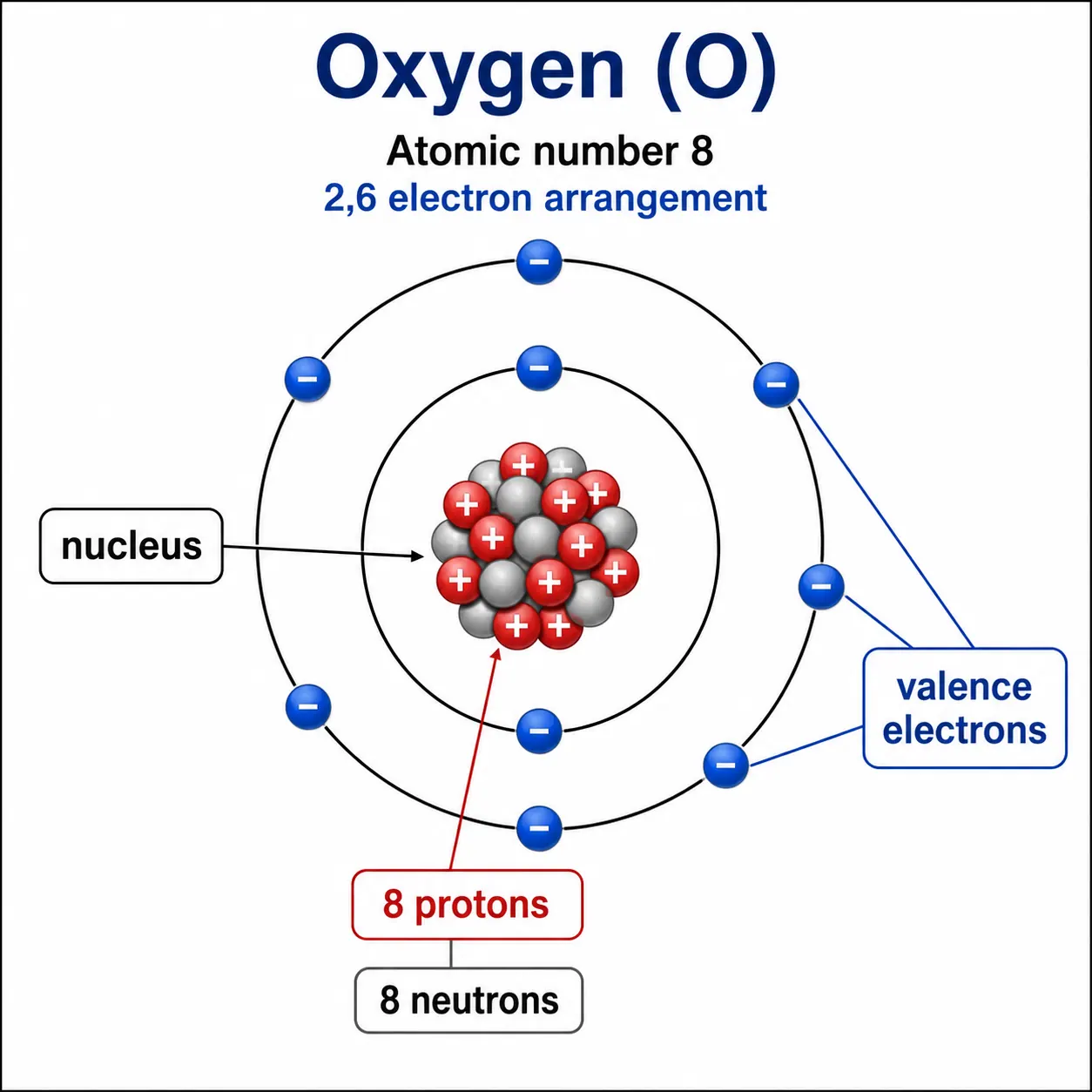
| Bohr model | Electrons on circular shells around the nucleus | Shell counts and a first picture of the atom | 2 electrons, then 6 |
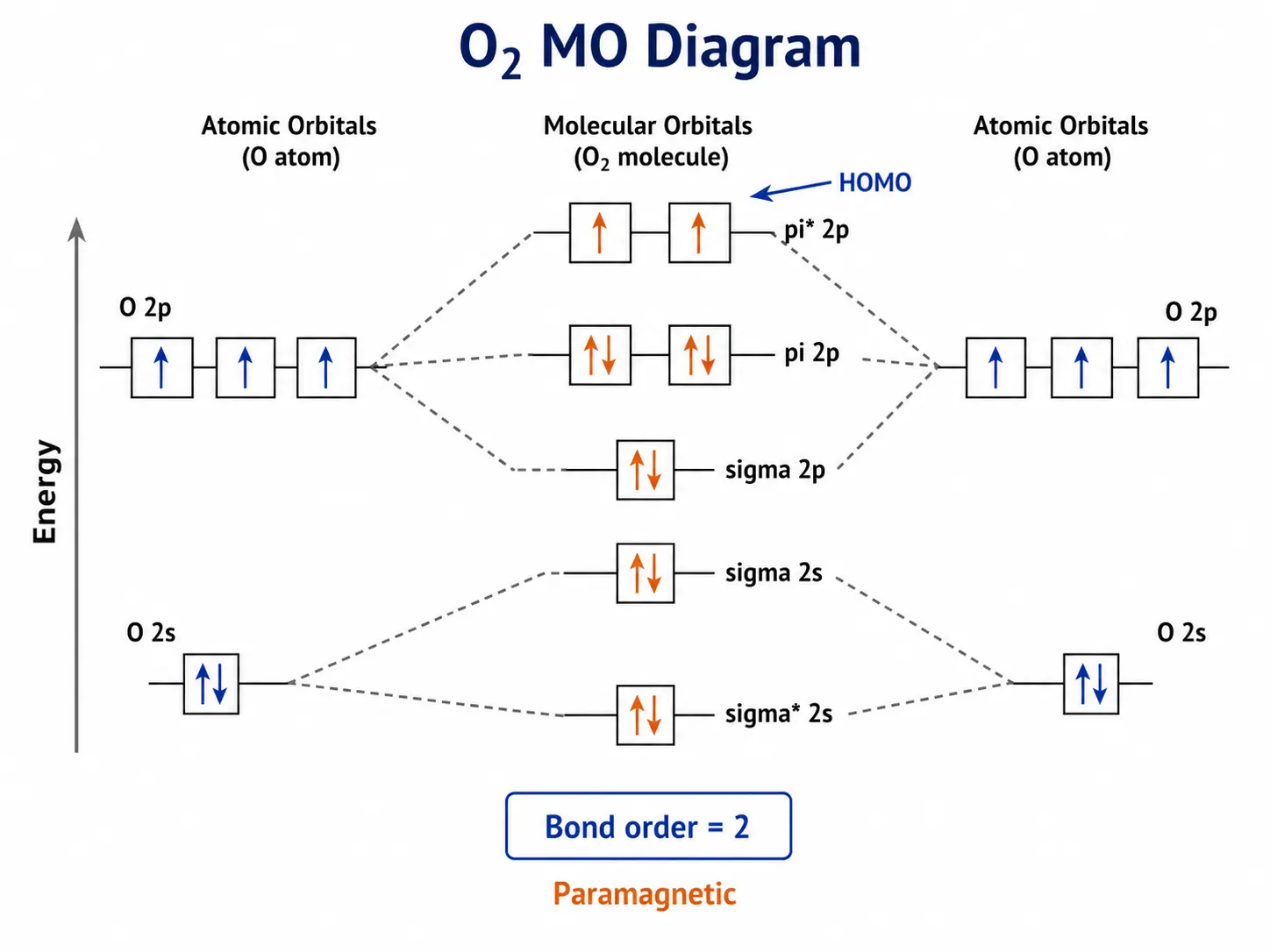
| Molecular orbital diagram | Orbitals of a whole molecule, bonding and antibonding | Bond order and the magnetism of molecules such as O₂ | O₂: two unpaired π* electrons |
The orbital diagram is the only one of the four that shows spin, which is why unpaired-electron and magnetism questions need it. For the same atom drawn as shells, use the Bohr model maker; for its valence electrons in bonds, the Lewis dot structure generator; for molecules, a molecular orbital diagram. Reaction schemes and energy profiles for a paper or poster are in the chemistry diagram generator, and states of matter drawn as particles in the particle diagram generator.
How to use this orbital diagram generator
Everything updates as you type, and nothing is sent anywhere: the configuration is worked out and the diagram drawn by code running in your browser.
- Type a symbol, a name or an atomic number (Fe, iron or 26), or open the periodic table and click an element. For an ion, add the charge after the symbol (Fe3+, Cu+, O2-, Cl-) or use the charge buttons.
- Choose a layout under Diagram: boxes in a row, as most textbooks draw them; energy levels, with each subshell stacked in filling order so 4s sits below 3d; or one row per shell.
- Switch Electrons shown to Valence + [core] to fold the noble-gas core into one tag and draw only the outer electrons, the usual shorthand for heavier atoms.
- Read the results under the diagram: the full and noble-gas configurations, unpaired electrons, paramagnetism or diamagnetism, valence electrons, the four quantum numbers of the last electron, and the filling-order chart for that atom.
- Export the diagram as SVG for editing, PNG for slides, or PDF through the print dialog. Blank (worksheet) prints the empty boxes for practice, and Worksheet + key builds a whole printable sheet with a matching answer key.
What an atomic orbital diagram shows
An atomic orbital diagram, also called an orbital box diagram or orbital notation, draws each orbital of an atom as a box and each electron as a half-arrow. It carries the same information as the electron configuration and adds two things the configuration leaves out: how the electrons in a subshell are spread over its orbitals, and which way their spins point.
- Each box is one orbital, which holds at most two electrons. Boxes are grouped by subshell and labelled with the shell number n and the subshell letter: 1s, 2p, 3d.
- An s subshell has one orbital, p has three, d five and f seven, so they hold 2, 6, 10 and 14 electrons. The number of boxes is 2ℓ + 1, where ℓ is 0, 1, 2 and 3 for s, p, d and f.
- An arrow pointing up is an electron with spin quantum number mₛ = +½; pointing down, mₛ = −½. Two arrows in the same box always point in opposite directions.
- A box with a single arrow holds an unpaired electron. Counting those boxes tells you whether the atom is paramagnetic.
- Some courses draw the same orbital notation with short lines instead of boxes, with the subshell label under each group. It is the same diagram; the Subshell labels option can leave blanks under the boxes for students to fill in.
How to draw an orbital diagram, step by step
Every orbital diagram follows from the electron count and three rules. Sulfur, atomic number 16, shows each step.
- Count the electrons: the atomic number for a neutral atom, minus the charge for an ion. Sulfur has 16.
- Write the subshells in filling order (1s, 2s, 2p, 3s, 3p, 4s, 3d …) and give each its boxes: one for s, three for p, five for d, seven for f.
- Fill the boxes in that order with at most two electrons per box, spins opposite. 1s², 2s², 2p⁶ and 3s² take twelve of sulfur’s electrons.
- In a partly filled subshell, put one up arrow in every box before pairing any. Sulfur’s last four electrons go into 3p as three single up arrows, then the fourth pairs with the first, leaving two unpaired electrons.
- Check the result: the arrows add up to the electron count, no box holds two arrows pointing the same way, and the configuration reads 1s² 2s² 2p⁶ 3s² 3p⁴.
- Twenty elements, chromium and copper among them, have a measured ground state that breaks the simple order. The generator draws those from NIST data and shows what the filling order would have predicted.
The Aufbau principle and the order orbitals fill
Aufbau is German for building up. Electrons go into the lowest-energy orbitals available, so the configuration of each element can be built from the one before it by adding a single electron. For neutral atoms the order is predicted well by the Madelung rule, also called the n + ℓ rule or diagonal rule.
- Subshells fill in order of increasing n + ℓ: 4s (4 + 0 = 4) fills before 3d (3 + 2 = 5), and 5s before 4d.
- When two subshells have the same n + ℓ, the one with the lower n fills first: 3d (n = 3) before 4p (n = 4), although both have n + ℓ = 5.
- The full order is 1s, 2s, 2p, 3s, 3p, 4s, 3d, 4p, 5s, 4d, 5p, 6s, 4f, 5d, 6p, 7s, 5f, 6d, 7p. The chart in the tool draws it as diagonal arrows across a table of subshells.
- The order says which subshell takes the next electron as the atomic number rises. It does not fix the energies inside one atom: in the transition metals, once 3d holds electrons it lies below 4s, which is why 4s electrons are the first to go when those metals form ions.
- Of the 108 elements whose ground states NIST lists, 88 follow the order exactly; the other twenty are the exceptions described below.
The Pauli exclusion principle
No two electrons in an atom can have the same set of four quantum numbers n, ℓ, mℓ and mₛ. Two electrons in the same box already share n, ℓ and mℓ, so they must differ in spin.
- A box holds at most two electrons, one spin up and one spin down. Two arrows pointing the same way in one box is never allowed.
- This caps every subshell at twice its number of orbitals: 2 electrons in s, 6 in p, 10 in d and 14 in f. Each shell holds at most 2n² electrons: 2, 8, 18, 32.
- The same caps set the widths of the s, p, d and f blocks of the periodic table: 2, 6, 10 and 14 columns.
Hund’s rule
When electrons enter a subshell whose orbitals have the same energy (p, d or f), they spread out over separate orbitals with parallel spins before any orbital takes a second electron. That arrangement, with the most unpaired electrons, is the lowest-energy one: electrons in different orbitals keep further apart, and parallel spins lower the energy further through exchange.
- Carbon, 2p²: one up arrow in each of two boxes is correct. Putting both electrons in one box, or drawing them with opposite spins in separate boxes, breaks Hund’s rule.
- Nitrogen, 2p³: one electron in each 2p box, all spin up, so three unpaired electrons.
- Oxygen, 2p⁴: the fourth p electron has to pair, which leaves two unpaired electrons.
- Iron, 3d⁶: five up arrows across the 3d boxes, then the sixth pairs in the first box, leaving four unpaired electrons.
- IUPAC states Hund’s rules for the terms of a configuration; maximum multiplicity, the one an orbital diagram shows, is the first of them.
Exceptions: chromium, copper and eighteen more
Twenty elements have a measured ground state that differs from the filling order. The generator draws the measured configuration, marks those elements in its periodic table, and lists all twenty in the table above with the reason for each.
- Chromium, [Ar] 3d⁵ 4s¹, and molybdenum, [Kr] 4d⁵ 5s¹: one s electron moves into d, giving a half-filled d subshell and six unpaired electrons.
- Copper, [Ar] 3d¹⁰ 4s¹, silver, [Kr] 4d¹⁰ 5s¹, and gold, [Xe] 4f¹⁴ 5d¹⁰ 6s¹: one s electron completes the d subshell.
- Palladium, [Kr] 4d¹⁰, has no 5s electron at all.
- Niobium, ruthenium, rhodium and platinum also move an s electron into d (4d⁴ 5s¹, 4d⁷ 5s¹, 4d⁸ 5s¹ and 5d⁹ 6s¹) with no half-filled or filled subshell to explain it: the s–d gap is simply smaller than the cost of pairing.
- Lanthanum, cerium and gadolinium, and actinium, thorium, protactinium, uranium, neptunium and curium, put an electron in d where the order predicts f.
- Lawrencium ends in 7p¹ rather than 6d¹, a relativistic effect of its very heavy nucleus, which pulls the 7p orbital below 6d.
- Most courses only test chromium and copper. Draw the others from the generator when you need them.
Orbital diagrams for ions
Start from the neutral atom, then remove electrons for a positive ion or add them for a negative one.
- Cations lose electrons from the highest shell first, p before s within that shell. Transition metals therefore lose 4s before 3d: Fe, [Ar] 3d⁶ 4s², becomes Fe²⁺, [Ar] 3d⁶, and Fe³⁺, [Ar] 3d⁵.
- Inner d and f electrons go only after the outer s and p electrons have gone: Sn²⁺ is [Kr] 4d¹⁰ 5s² because tin loses its two 5p electrons first, and Eu³⁺ is [Xe] 4f⁶.
- Anions gain electrons in filling order: O²⁻ is 1s² 2s² 2p⁶ and Cl⁻ is [Ne] 3s² 3p⁶, each with the configuration of the next noble gas.
- Atoms and ions with the same configuration are isoelectronic. Na⁺, Mg²⁺, F⁻ and O²⁻ all match neon, and the tool says so when it happens.
- Removing electrons changes the count of unpaired ones: Fe²⁺ has four, Fe³⁺ five and Zn²⁺ none.
- For a few free gas-phase ions, such as V⁺, Co⁺, Ni⁺ and some lanthanide and actinide ions, NIST measures a ground state that differs from the rule. The tool shows both and draws either one.
Unpaired electrons, paramagnetism and diamagnetism
Magnetism is the quickest real-world check of an orbital diagram, because unpaired spins respond to a magnetic field and paired ones cancel.
- An atom or ion with at least one unpaired electron is paramagnetic: it is drawn into a magnetic field. If every electron is paired it is diamagnetic, and a field pushes it away very weakly.
- Count the unpaired electrons straight from the diagram: they are the boxes holding a single arrow. Nitrogen has 3, oxygen 2, iron 4, chromium 6 and gadolinium 8.
- As free atoms, the noble gases, the alkaline earth metals, zinc, cadmium, mercury and palladium are diamagnetic.
- In compounds the count can change. Surrounding ligands split the d orbitals, and low-spin iron(II) complexes have no unpaired electrons at all. The diagrams here are for free atoms and ions.
- Molecules need a molecular orbital diagram instead: O₂ is paramagnetic because two of its electrons sit unpaired in π* orbitals, which neither a Lewis structure nor an atomic orbital diagram shows.
Quantum numbers in an orbital diagram
Every box and every arrow corresponds to a set of quantum numbers, so an orbital diagram is also a way to read them.
- n, the principal quantum number, is the shell: the number in the subshell label.
- ℓ, the angular momentum quantum number, is the subshell type: 0 for s, 1 for p, 2 for d and 3 for f. It runs from 0 to n − 1, which is why there is no 1p or 2d.
- mℓ, the magnetic quantum number, picks one orbital in the subshell: the 2ℓ + 1 values from −ℓ to +ℓ, one per box.
- mₛ, the spin quantum number, is +½ for an up arrow and −½ for a down arrow.
- Questions about the last electron depend on a convention for which box fills first. The tool fills left to right with mℓ running from −ℓ to +ℓ and spin up first, and the direction can be flipped. For oxygen’s last electron, the fourth in 2p, that gives n = 2, ℓ = 1, mℓ = −1, mₛ = −½.
Noble-gas notation and valence orbital diagrams
Writing every subshell of a heavy atom gets long, so the inner electrons are usually replaced by the symbol of the previous noble gas in brackets.
- Selenium, 1s² 2s² 2p⁶ 3s² 3p⁶ 4s² 3d¹⁰ 4p⁴, shortens to [Ar] 4s² 3d¹⁰ 4p⁴. Its valence orbital diagram shows 4s, 3d and 4p after an [Ar] tag, and 4p⁴ leaves two unpaired electrons.
- The core is the previous noble gas. Everything outside it is written out, including filled d and f subshells such as selenium’s 3d¹⁰.
- For main-group elements the valence electrons are the s and p electrons of the outermost shell: six for selenium. For transition metals the ns and (n−1)d electrons are counted together: eight for iron.
- Textbooks order subshells either by filling order ([Ar] 4s² 3d¹⁰ 4p⁴) or by shell ([Ar] 3d¹⁰ 4s² 4p⁴), as NIST does. Both are correct, and the Subshell order switch changes the diagram and the text together.
Printable orbital diagram worksheets
Worksheet + key turns any list of atoms and ions into a printable practice sheet and a matching answer key, laid out for US Letter or A4.
- Type the list or start from a ready-made set: period 2, period 3, the first-row transition metals, common ions, or the exceptions.
- Each item gets empty boxes for its subshells, with the subshell labels printed or left blank for students to write, a line for the electron configuration, and blanks for the number of unpaired electrons and paramagnetic or diamagnetic.
- The answer key is drawn from the same layout with every arrow in place and the answers in red, so the two pages line up item for item.
- Print both as one PDF, or download each page as PNG or SVG to drop into a slide or a learning platform.
Frequently asked questions
Is this orbital diagram generator free?
Yes. There is no sign-up, no watermark and no limit. Everything runs in your browser, so nothing you type is uploaded, and your last settings are kept on your own device so they are still there when you come back.
What is an orbital diagram?
An orbital diagram draws each orbital of an atom as a box (or a line) and each electron as an arrow, up for spin +½ and down for spin −½. The boxes are grouped into subshells such as 1s, 2p and 3d. It shows the same electron configuration as 1s² 2s² 2p⁴, plus how the electrons are spread over orbitals and which ones are unpaired.
What is the difference between an orbital diagram and an electron configuration?
The electron configuration only counts the electrons in each subshell: 2p⁴ means four electrons in 2p. The orbital diagram shows where those four go: one pair and two single electrons with parallel spins. That is what you need to count unpaired electrons, predict magnetism or read off quantum numbers.
How do you make an orbital diagram?
Count the electrons, list the subshells in filling order (1s, 2s, 2p, 3s, 3p, 4s, 3d …), draw one box for s, three for p, five for d and seven for f, then fill them: two electrons per box at most with opposite spins (Pauli), and one electron in every box of a subshell before any pairing (Hund). The generator does all of this for any element or ion and shows the result.
What is the orbital diagram for oxygen?
Oxygen has eight electrons: 1s² 2s² 2p⁴. The 1s and 2s boxes each hold a pair. In 2p, three electrons go one per box with spin up, and the fourth pairs with the first, so the 2p boxes read ↑↓, ↑, ↑. That leaves two unpaired electrons, and an oxygen atom is paramagnetic.
What is the orbital diagram for selenium?
Selenium (Z = 34) is [Ar] 4s² 3d¹⁰ 4p⁴, in full 1s² 2s² 2p⁶ 3s² 3p⁶ 4s² 3d¹⁰ 4p⁴. Every box up to 3d is paired; the three 4p boxes read ↑↓, ↑, ↑, so selenium has two unpaired electrons, like oxygen and sulfur above it in group 16.
Why is chromium 3d⁵ 4s¹ and not 3d⁴ 4s²?
Because 4s and 3d are very close in energy, and moving one 4s electron into 3d gives a half-filled 3d⁵ subshell with six unpaired electrons whose parallel spins lower the energy more than the move costs. Copper is the same idea with a filled 3d¹⁰ subshell. Both are measured ground states, listed by NIST.
Why do transition metals lose 4s electrons before 3d?
The filling order describes which subshell gains the next electron as the atomic number rises, not the energies inside the finished atom. In a transition metal the occupied 3d orbitals lie below 4s, and the outer 4s electrons are removed first. Iron, [Ar] 3d⁶ 4s², becomes Fe²⁺, [Ar] 3d⁶, not [Ar] 3d⁴ 4s².
How many unpaired electrons does iron have?
A neutral iron atom, [Ar] 3d⁶ 4s², has four: five 3d electrons spread one per box and the sixth pairs. Fe²⁺ (3d⁶) also has four, and Fe³⁺ (3d⁵) has five, one in each 3d box. All three are paramagnetic as free atoms or ions.
Which way should the first arrow in a box point?
Up, by convention: the first electron in each box is drawn spin up (mₛ = +½) and the second spin down. Physically either direction is the same energy, so the convention only matters for answer keys, such as questions on the quantum numbers of the last electron.
What is orbital notation?
Orbital notation is another name for an orbital diagram, used especially in US high school chemistry: a line or box for each orbital, arrows for electrons, and the subshell label under each group. Electron configuration notation (1s² 2s² …) and noble-gas notation ([Ne] 3s² 3p⁴) are the written forms of the same information.
Can I make a blank orbital diagram worksheet?
Yes, two ways. Set Boxes to Blank to print one element’s empty boxes as a template, or switch to Worksheet + key and type a list of atoms and ions to get a printable sheet with configuration lines and questions, plus a matching answer key, as one PDF.
Does it draw orbital diagrams for ions?
Yes. Type Fe3+, Cu+, O2- or Cl-, or use the charge buttons, from −4 up to +8. Cations lose electrons from the highest shell first, anions gain them in filling order, and the tool lists every electron added or removed. Where NIST measures a different ground state for a free ion, it shows that too.
How is an atomic orbital diagram different from a molecular orbital diagram?
An atomic orbital diagram shows one atom’s own orbitals: 1s, 2s, 2p and so on. A molecular orbital diagram shows how the orbitals of two or more atoms combine into bonding and antibonding orbitals of a molecule, which is how it explains bond order and why O₂ is paramagnetic. Use the molecular orbital diagram tool for molecules.
How are the configurations of superheavy elements known?
NIST’s Atomic Spectra Database lists ground states up to hassium (Z = 108); for the heaviest of these the values come from relativistic calculations, because only a handful of atoms have ever been made. Elements 109 to 118 have predicted configurations only, and all of them follow the filling order. From Z = 104 up the tool labels the configuration as calculated rather than measured.
Is the energy-level layout drawn to scale?
No. Energy levels stacks the subshells in filling order to show why 4s comes before 3d, which is how textbooks draw it. Real orbital energies depend on the atom and shift as electrons are added, so the heights are a schematic, not measured values.
Related tools
Bohr Model Maker
Draw the same atom as a nucleus with electron shells: 2, 8, 8 and so on.
Lewis Dot Structure Generator
Turn valence electrons into dot structures for atoms, molecules and ions.
Molecular Orbital Diagram
Bonding and antibonding orbitals for O₂, N₂, CO and other molecules.
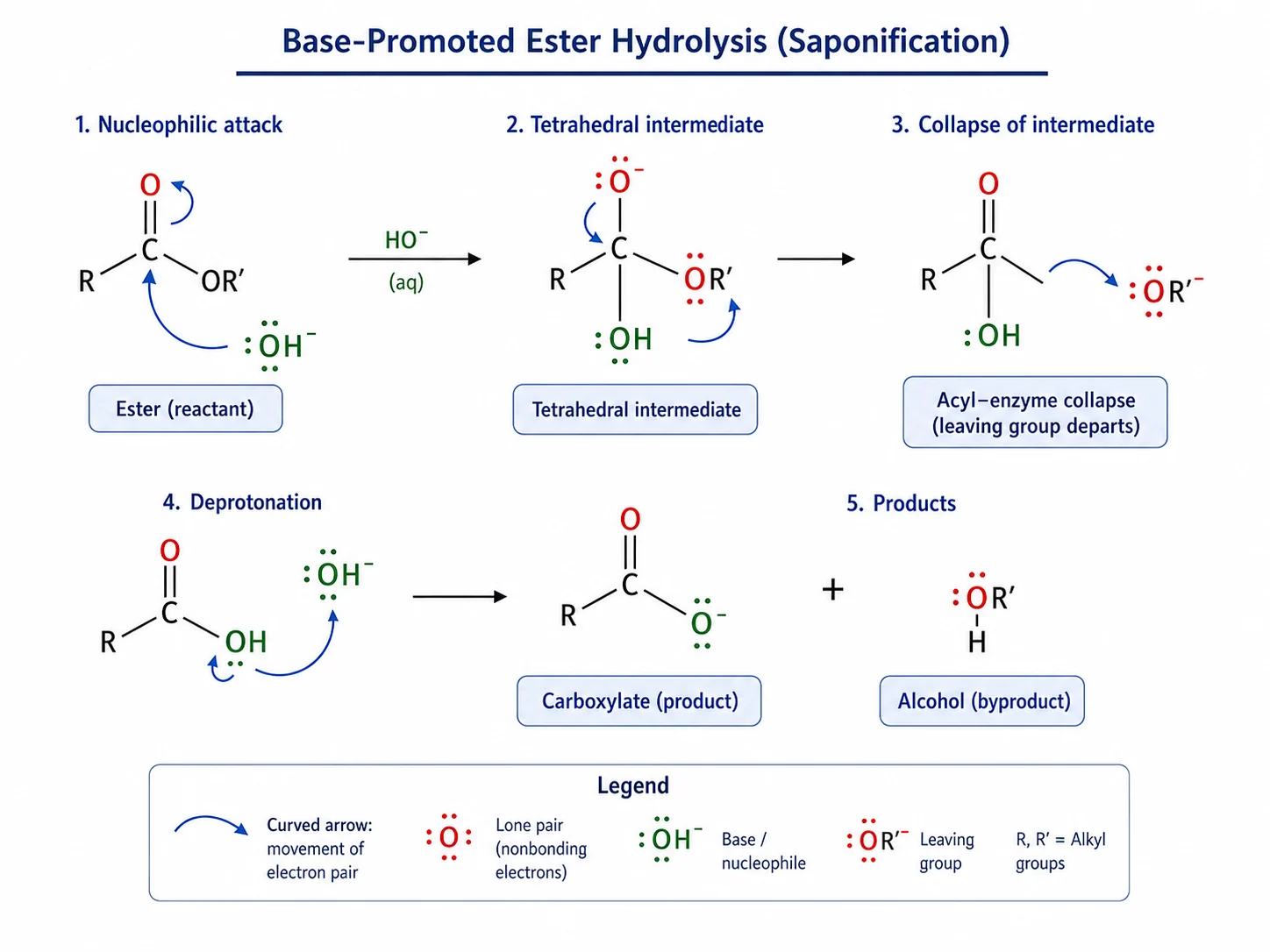
Chemistry Diagram Generator
Reaction mechanisms, energy profiles and other chemistry figures.
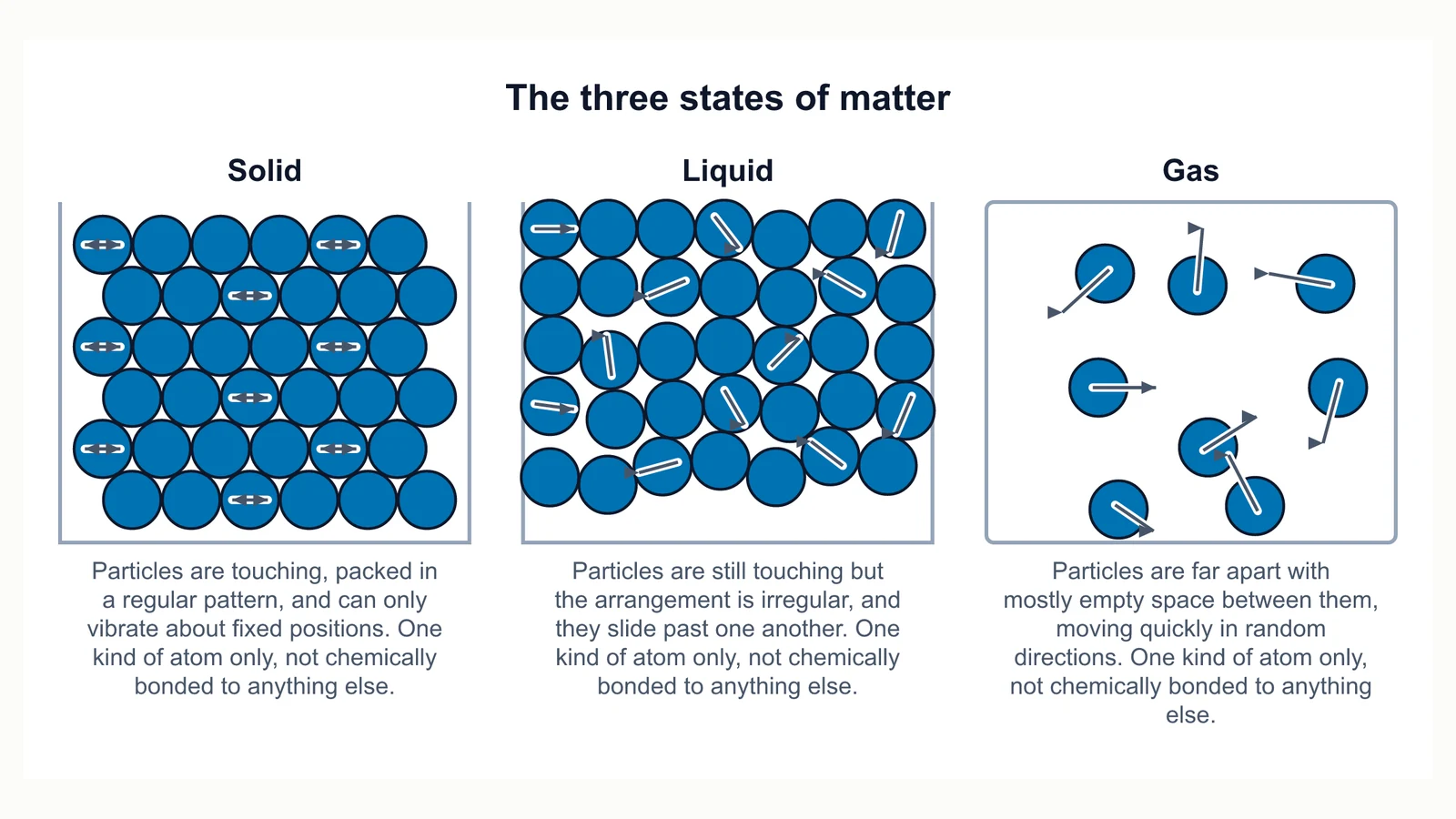
Particle Diagram Generator
Solids, liquids, gases, mixtures and reactions drawn as particles.
Need a full chemistry figure?
SciFigure AI draws reaction schemes, energy diagrams and molecular orbital figures for papers, slides and worksheets.
Explore the chemistry toolsLast checked: November 8, 2026. Ground states for Z = 1–108 and the ion exceptions are from the NIST Atomic Spectra Database; Z = 109–118 are theoretical predictions. Sources: NIST Atomic Spectra Database: ground states and ionization energies; NIST: Ground Levels and Ionization Energies for the Neutral Atoms; IUPAC Gold Book: aufbau principle; IUPAC Gold Book: Pauli exclusion principle; IUPAC Gold Book: Hund rules; OpenStax Chemistry 2e, 6.4 Electronic Structure of Atoms; OpenStax Chemistry 2e, 6.3 Development of Quantum Theory; Hoffman, Lee & Pershina, Transactinide Elements and Future Elements.