Rock Cycle Diagram AI

Rock Cycle Diagram Generator

Generate a labeled rock cycle diagram with igneous, sedimentary, and metamorphic rock and every process arrow named. Ask for a blank version and students can label the cycle themselves.

Labeled and unlabeledAll three rock typesCycle or flow chart

AI Rock Cycle Diagram Generator

Describe which rock types and processes to label and the style you need.

Costs 5 credits363 / 2000 characters

Generate a publication-ready PNG from your description.

Preview

Rock Cycle Diagram Example Previews

Target aspect ratio: 4:3

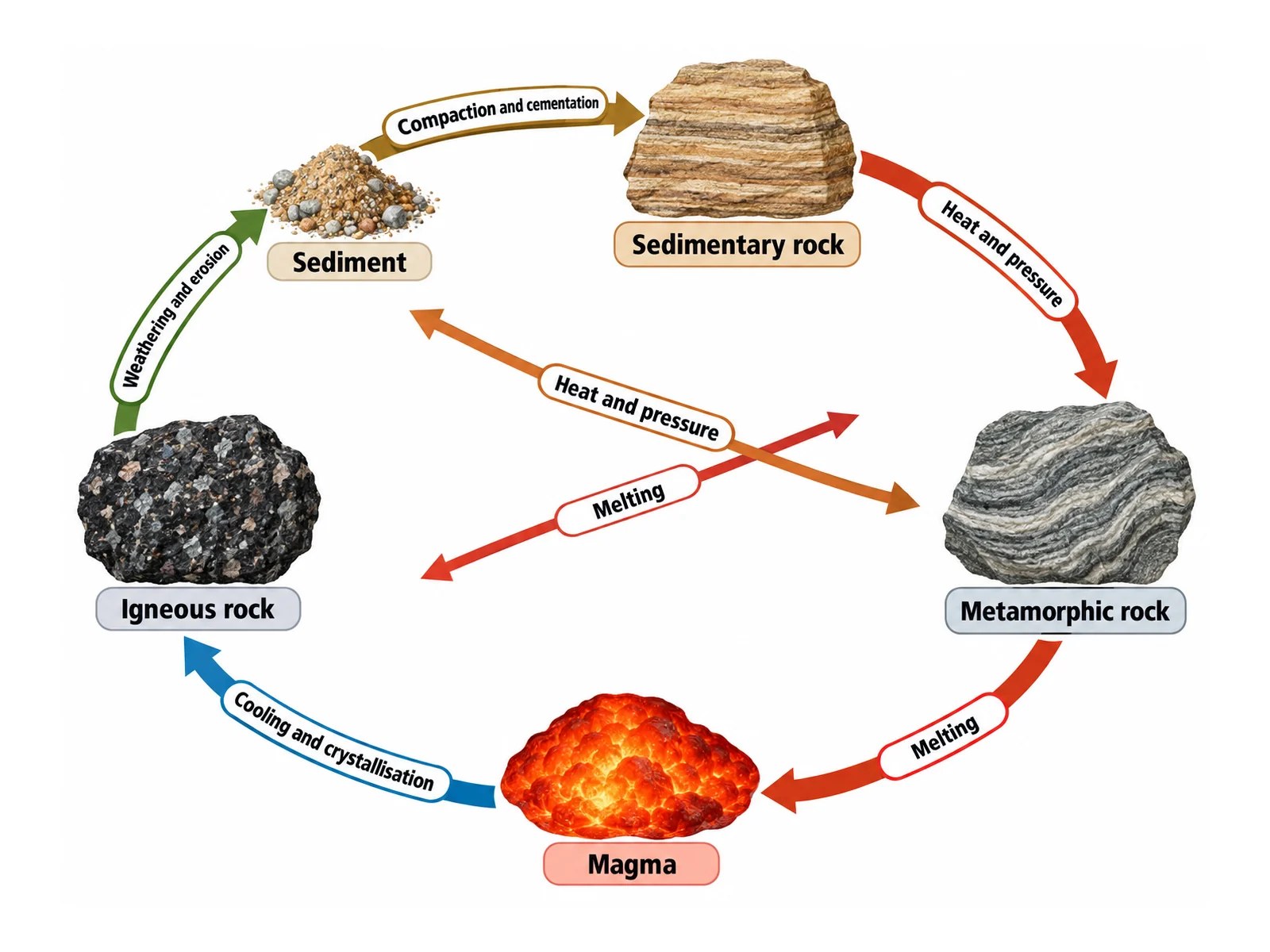
Labeled rock cycle diagram showing magma, igneous, sedimentary, and metamorphic rock connected by arrows for cooling, weathering and erosion, compaction and cementation, heat and pressure, and melting
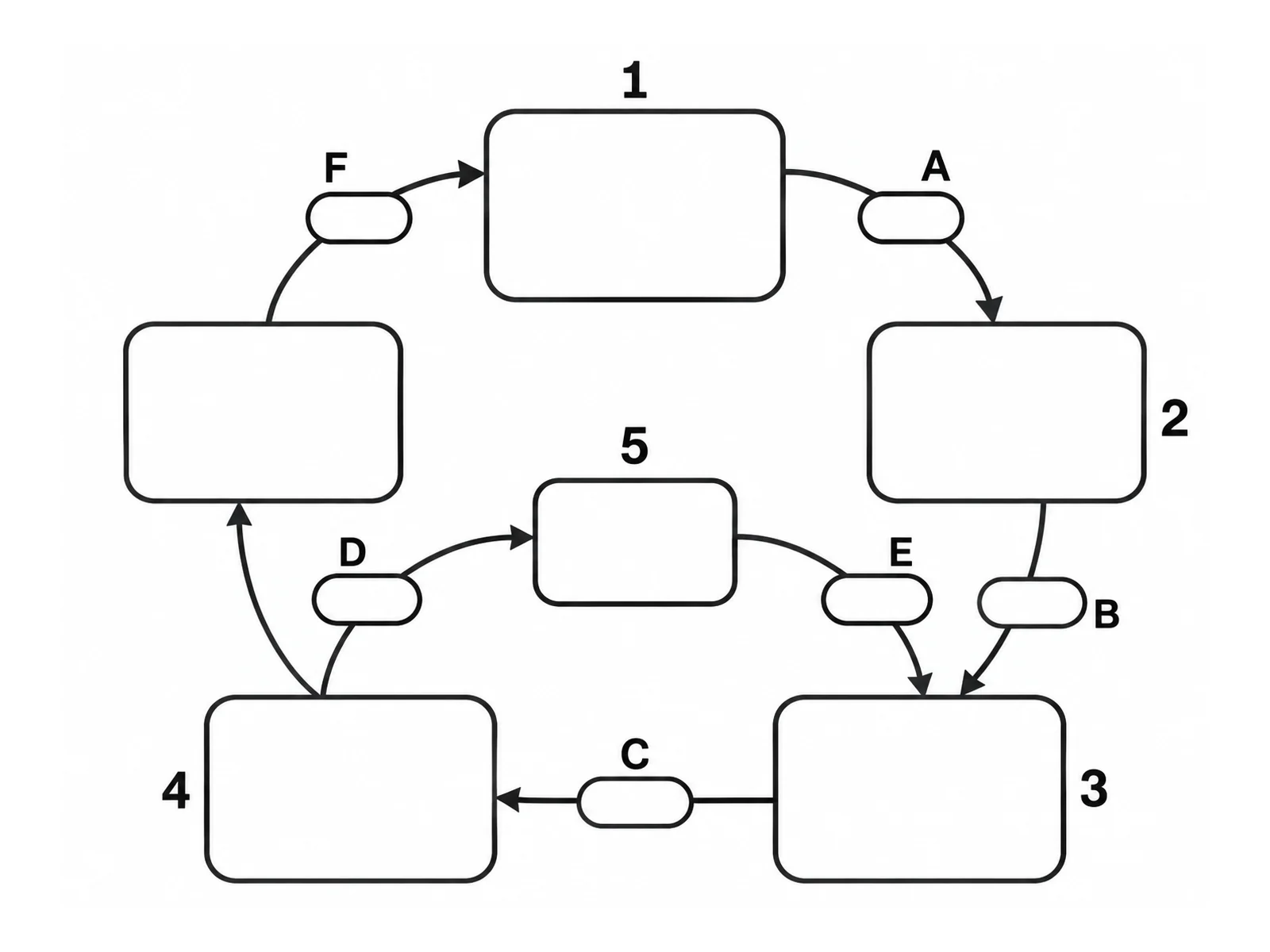
Blank unlabeled rock cycle diagram with empty boxes and empty arrow labels for students to complete
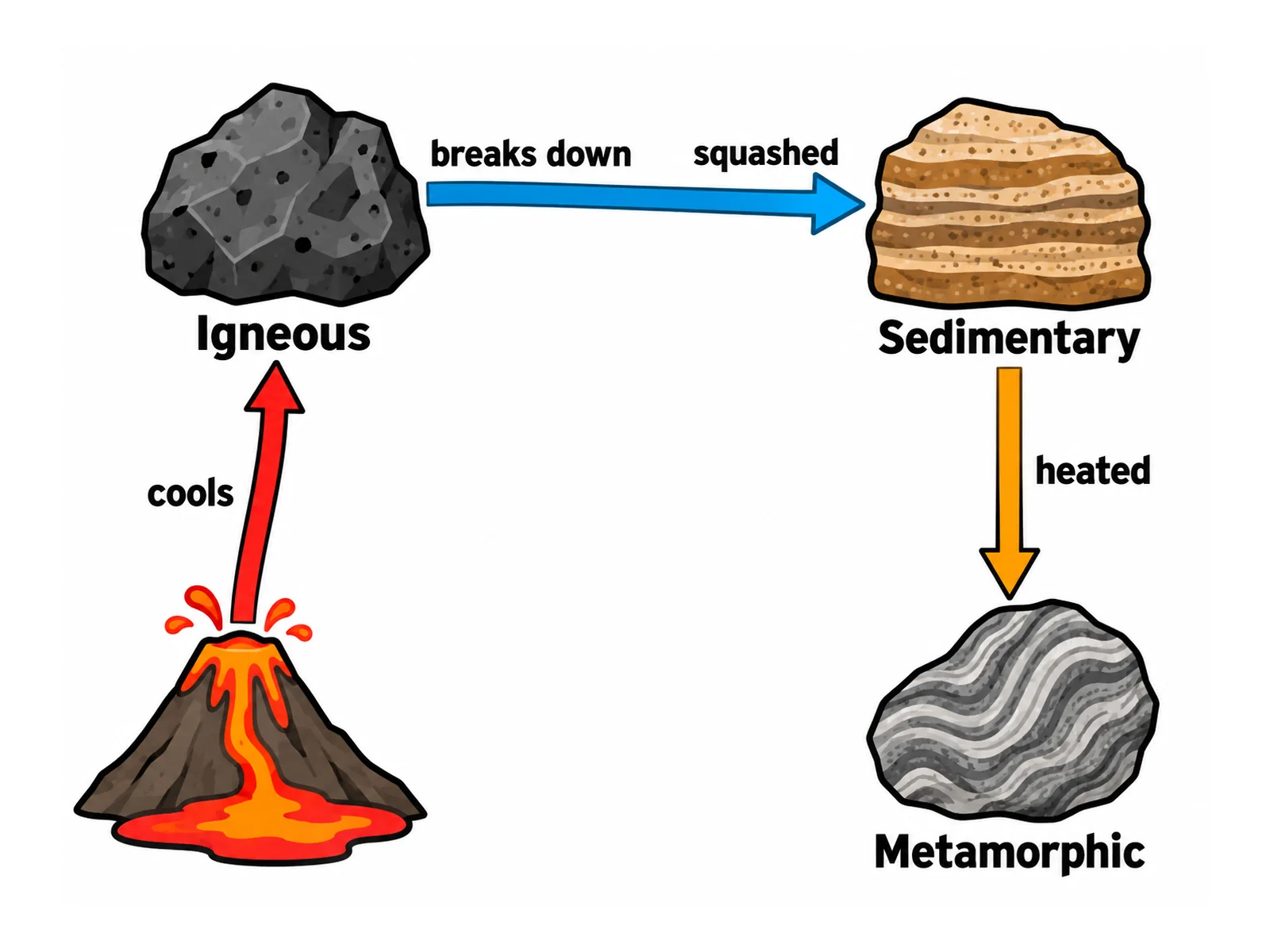
Simple rock cycle drawing for younger students labeling only igneous, sedimentary, and metamorphic rock with plain process arrows

Sample previews. Describe your diagram to generate your own rock cycle figure.

Labeled Rock Cycle Diagram Examples

Use these as visual directions for the labeled cycle, blank worksheets, simple drawings, flow charts, and landscape cross-sections.

Labeled rock cycle diagram showing magma, igneous, sedimentary, and metamorphic rock connected by arrows for cooling, weathering and erosion, compaction and cementation, heat and pressure, and melting

Prompt

Create a fully labeled rock cycle diagram on a white background. Place four labeled nodes around a circular loop: orange-red Magma at the bottom, dark speckled Igneous rock at the left, layered tan Sedimentary rock at the top, and banded grey Metamorphic rock at the right, with a small pile of loose Sediment between sedimentary and igneous. Draw a recognisable rock sample illustration beside each label. Connect the nodes with thick curved arrows, each carrying a process label in a small white pill: "Cooling and crystallisation" from magma to igneous, "Weathering and erosion" from igneous to sediment, "Compaction and cementation" from sediment to sedimentary, "Heat and pressure" from sedimentary to metamorphic, and "Melting" from metamorphic back to magma. Add two thinner cross-arrows through the middle also labeled "Heat and pressure" and "Melting" to show that any rock can take those routes.
Labeled Rock Cycle

Blank unlabeled rock cycle diagram with empty boxes and empty arrow labels for students to complete

Prompt

Create a blank rock cycle worksheet. Draw the same circular loop with four empty rounded boxes at the node positions and one smaller empty box for sediment, each box outlined in dark grey with nothing written inside. Draw the connecting arrows with an empty white pill on each one where the process name would go. Number the boxes 1 to 5 and the arrow pills A to F. Include generous white space and no answer key.

Blank Rock Cycle Worksheet

Simple rock cycle drawing for younger students labeling only igneous, sedimentary, and metamorphic rock with plain process arrows

Prompt

Create a simple rock cycle drawing for primary or lower-secondary students. Show only three labeled rock types in a triangle — Igneous, Sedimentary, Metamorphic — with magma drawn as a small volcano at the centre. Connect them with thick plain arrows carrying short everyday labels: "cools", "breaks down", "squashed", "heated". Use bold flat colors, thick outlines, large readable text, and plenty of white space.

Simple Rock Cycle Drawing

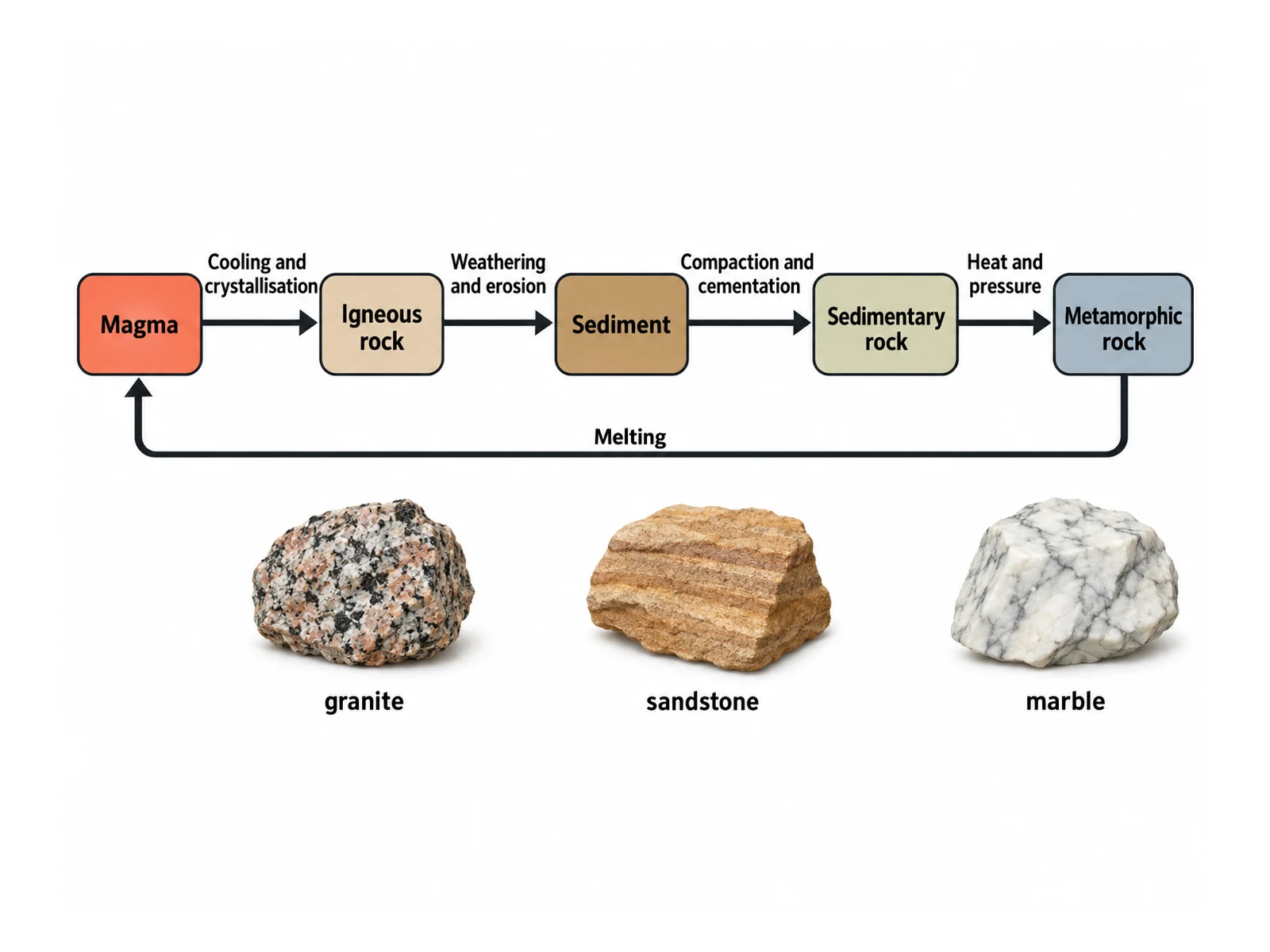
Rock cycle drawn as a flow chart of boxes and arrows rather than a circular loop

Prompt

Create a rock cycle flow chart on a white background. Draw the stages as rounded boxes connected by straight arrows in a left-to-right chain that loops back: Magma, Igneous rock, Sediment, Sedimentary rock, Metamorphic rock, and a return arrow to Magma. Label each arrow with its process in small bold text. Below the chain, add a short row of three labeled example rocks: granite under Igneous, sandstone under Sedimentary, and marble under Metamorphic.

Rock Cycle Flow Chart

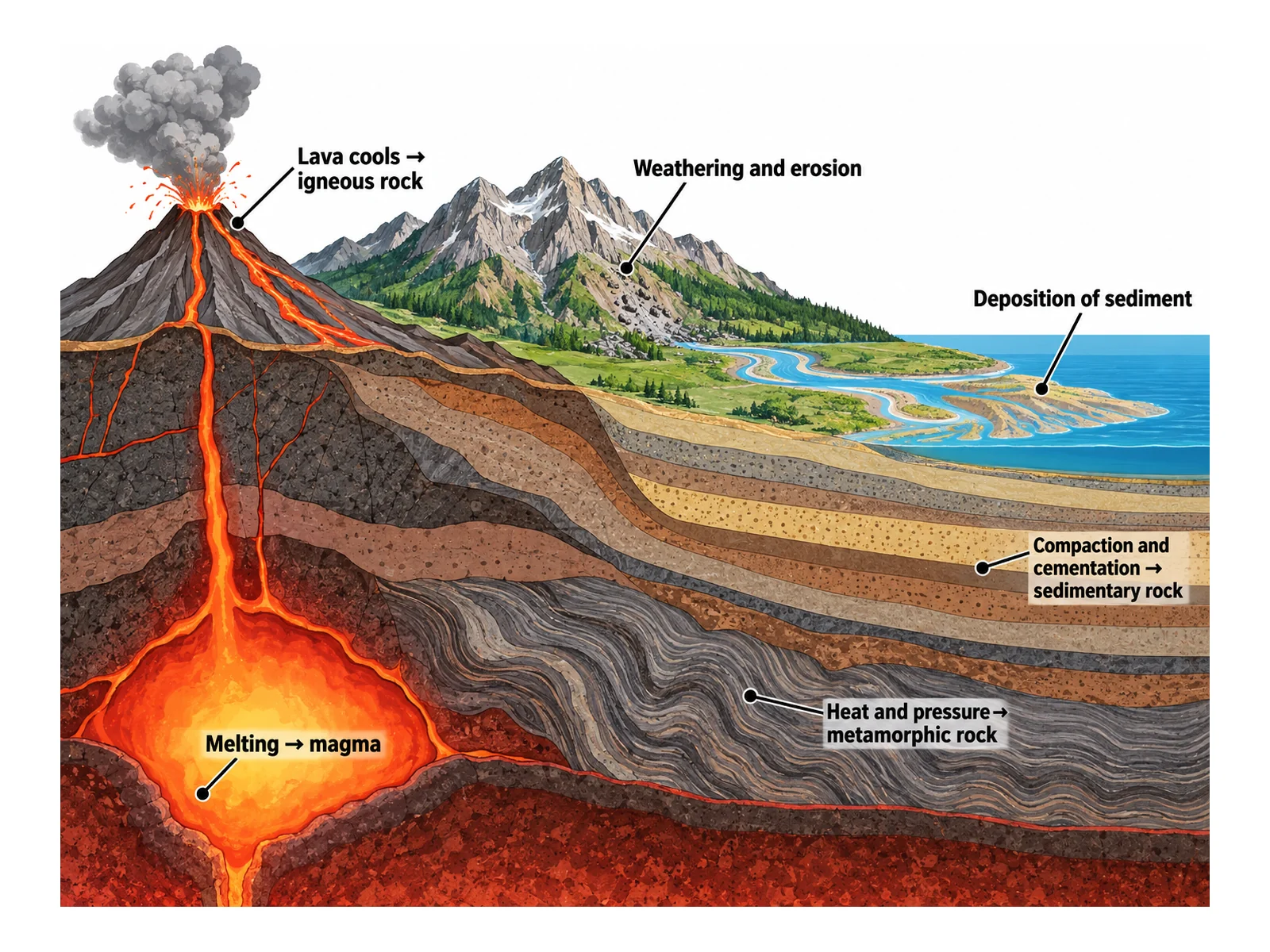
Rock cycle shown in a cross-section landscape with a volcano, eroding mountains, a river delta, and rock forming underground

Prompt

Create a rock cycle landscape cross-section on a white background. Draw a cutaway of the Earth’s crust with a volcano erupting on the left, mountains weathering in the centre, a river carrying sediment to a delta on the right, and layers beneath the surface. Label in place: "Lava cools → igneous rock" at the volcano, "Weathering and erosion" on the mountains, "Deposition of sediment" at the delta, "Compaction and cementation → sedimentary rock" in the buried layers, "Heat and pressure → metamorphic rock" deeper down beside the magma chamber, and "Melting → magma" in the chamber itself.

Rock Cycle in a Landscape

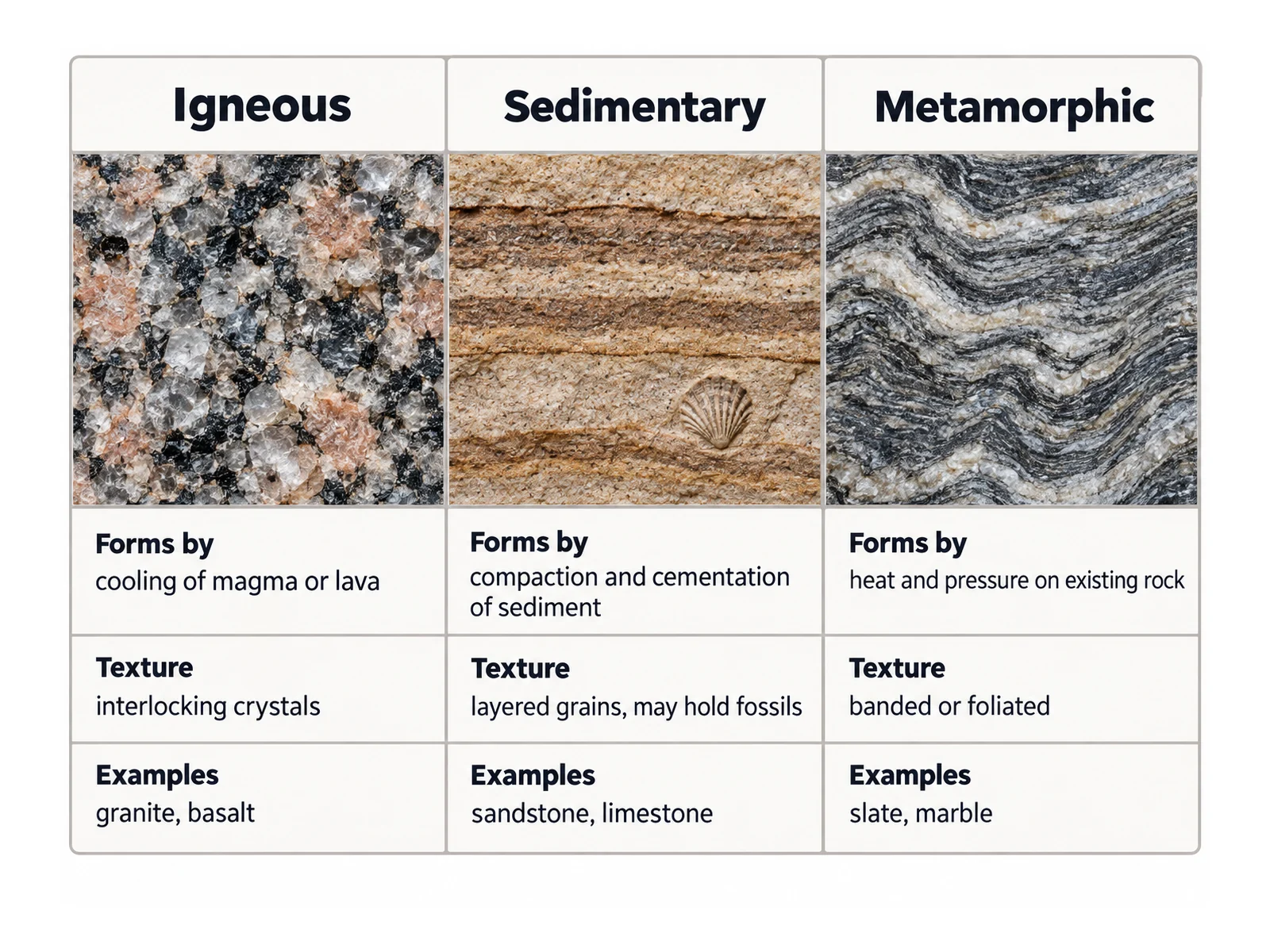
Comparison card of igneous, sedimentary, and metamorphic rock showing how each forms, its texture, and example rocks

Prompt

Create a three-column comparison figure of the rock types on a white background. Head the columns Igneous, Sedimentary, and Metamorphic. In each column draw a close-up of a characteristic rock texture — interlocking crystals, visible layers with a small fossil, and wavy bands — then list three labeled rows beneath: "Forms by" reading "cooling of magma or lava", "compaction and cementation of sediment", and "heat and pressure on existing rock"; "Texture" reading "interlocking crystals", "layered grains, may hold fossils", and "banded or foliated"; and "Examples" reading "granite, basalt", "sandstone, limestone", and "slate, marble".

Three Rock Types Compared

How to draw a labeled rock cycle diagram

1

Choose the layout

A circular loop for the classic cycle, a flow chart for revision notes, or a landscape cross-section to show where each process happens in the real world.

2

Generate the diagram

The generator places the rock types around the loop and attaches the correct process label to each arrow.

3

Check the arrows, then export

Confirm each arrow points the right way and carries the right process, then download the PNG for a worksheet, slide, or revision sheet.

What is the rock cycle?

The rock cycle describes how the three rock types continuously change into one another over geological time. Rock is never destroyed, only transformed: magma cools into igneous rock, any exposed rock weathers into sediment that compacts into sedimentary rock, burial under heat and pressure produces metamorphic rock, and deep enough burial melts rock back into magma. A rock cycle diagram draws these routes as a loop so that no single starting point is implied.

The processes to label on every arrow

  • Cooling and crystallisation: magma or lava solidifies into igneous rock; slow cooling underground gives large crystals, fast cooling at the surface gives small ones.
  • Weathering and erosion: physical, chemical, and biological breakdown of exposed rock into loose sediment.
  • Transport and deposition: wind, water, and ice carry sediment and drop it in layers, usually in a lake, river delta, or sea.
  • Compaction and cementation: the weight of overlying layers squeezes the sediment and dissolved minerals glue the grains together into sedimentary rock.
  • Heat and pressure: existing rock is altered without melting, producing metamorphic rock with new crystals or banding.
  • Melting: rock buried deep enough returns to magma, closing the cycle.

The three rock types at a glance

  • Igneous: formed from cooled magma or lava; interlocking crystals; granite (slow, coarse) and basalt (fast, fine).
  • Sedimentary: formed from compacted and cemented sediment; visible layers; may contain fossils; sandstone, limestone, shale.
  • Metamorphic: formed by heat and pressure on existing rock; often banded or foliated; slate from shale, marble from limestone, schist from mudstone.

Rock Cycle Diagram Generator FAQ

The three rock types — igneous, sedimentary, and metamorphic — plus magma, and the processes that convert each into the next: weathering and erosion, transport and deposition, compaction and cementation, heat and pressure, melting, and cooling and crystallisation. A complete diagram labels every rock type and every process arrow between them.

Need other science figures?

Generate earth science cycles, biology diagrams, pathway figures, and worksheet-ready illustrations with the same SciFigure AI workflow.