Generate a labeled Calvin cycle diagram with the three stages in order — carbon fixation by RuBisCO, reduction of 3-PGA to G3P, and regeneration of RuBP — and the counts that go with them: 3 CO₂, 9 ATP, and 6 NADPH for every G3P the cycle exports. Pick a simple version with five labels, full carbon counting, or a blank worksheet with its matching answer key.
Fixation, reduction, regeneration9 ATP + 6 NADPH per 3 CO₂Labeled, simple, or blank
Checked against OpenStax Biology 2e
Counted per 3 CO₂
Labeled, numbered, or blank
Print-ready PNG
AI Calvin Cycle Diagram Generator
Describe the stages, molecules, and level of detail you need, or ask for a blank worksheet.
534 / 2000 characters
Generate a publication-ready PNG from your description.
Preview
Calvin Cycle Diagram Example Previews
Target aspect ratio: 4:3
Sample previews. Describe your diagram to generate your own Calvin cycle figure.
Calvin Cycle Diagram Examples
Use these as visual directions for a labeled Calvin cycle, carbon counting over three turns, a simple diagram for younger classes, the light reactions and the Calvin cycle together, C3 vs C4 vs CAM, and a blank worksheet.
Prompt
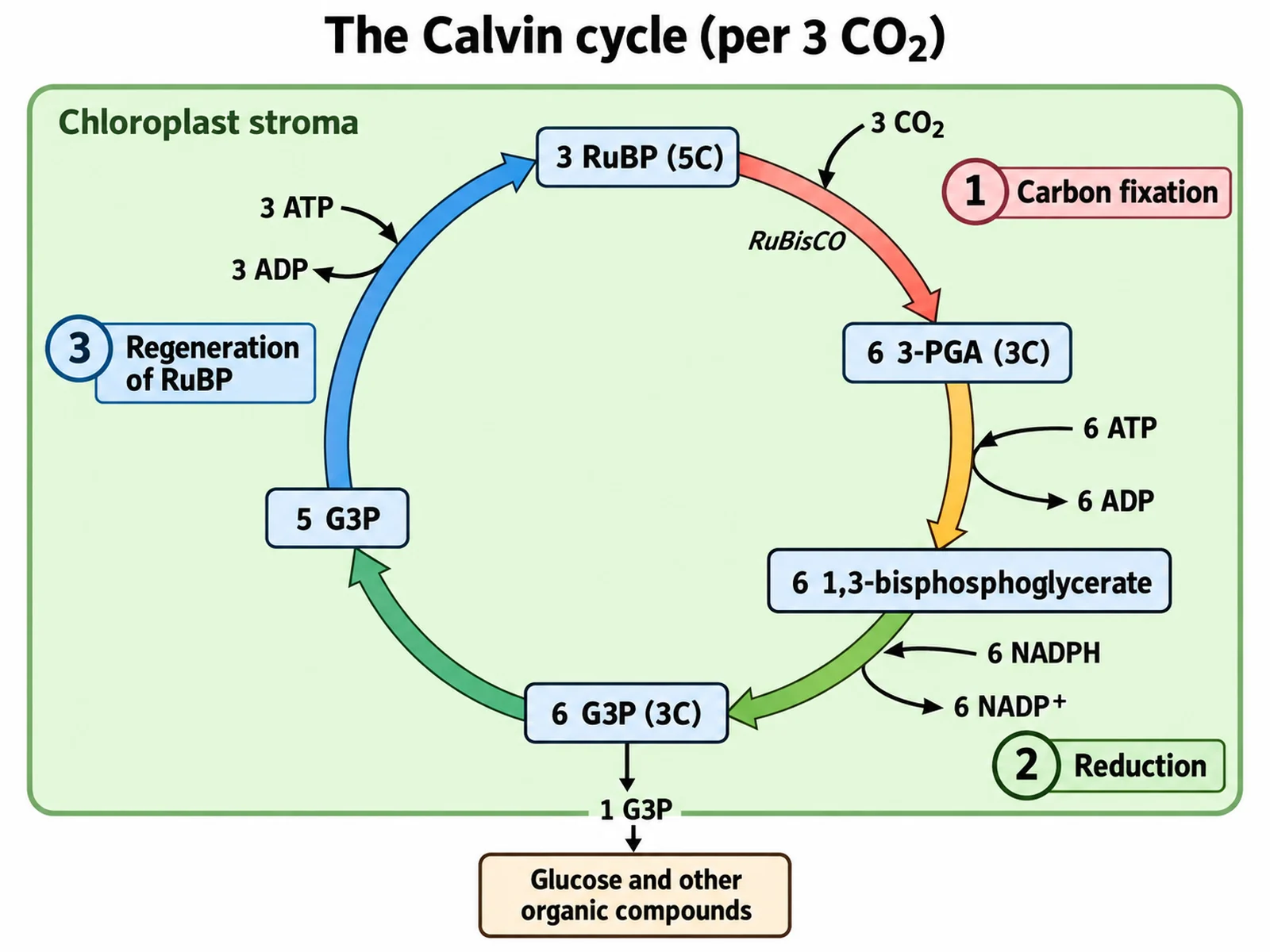
Create a fully labeled Calvin cycle diagram on a white background in clean biology textbook style. Draw one large clockwise loop inside a pale green rounded panel labeled "Chloroplast stroma", split into three coloured arcs labeled "1 Carbon fixation" at the upper right, "2 Reduction" at the bottom, and "3 Regeneration of RuBP" at the left. Put molecule boxes around the loop: "3 RuBP (5C)" at the top, "6 3-PGA (3C)" at the right, "6 1,3-bisphosphoglycerate" at the lower right, "6 G3P (3C)" at the bottom, and "5 G3P" at the lower left. Draw "3 CO2" entering between RuBP and 3-PGA with "RuBisCO" on that arrow; "6 ATP" in and "6 ADP" out before 1,3-bisphosphoglycerate; "6 NADPH" in and "6 NADP+" out before G3P; "1 G3P" leaving the loop downward to a box reading "Glucose and other organic compounds"; and "3 ATP" in, "3 ADP" out on the regeneration arc. No oxygen anywhere.
Use this example
Prompt
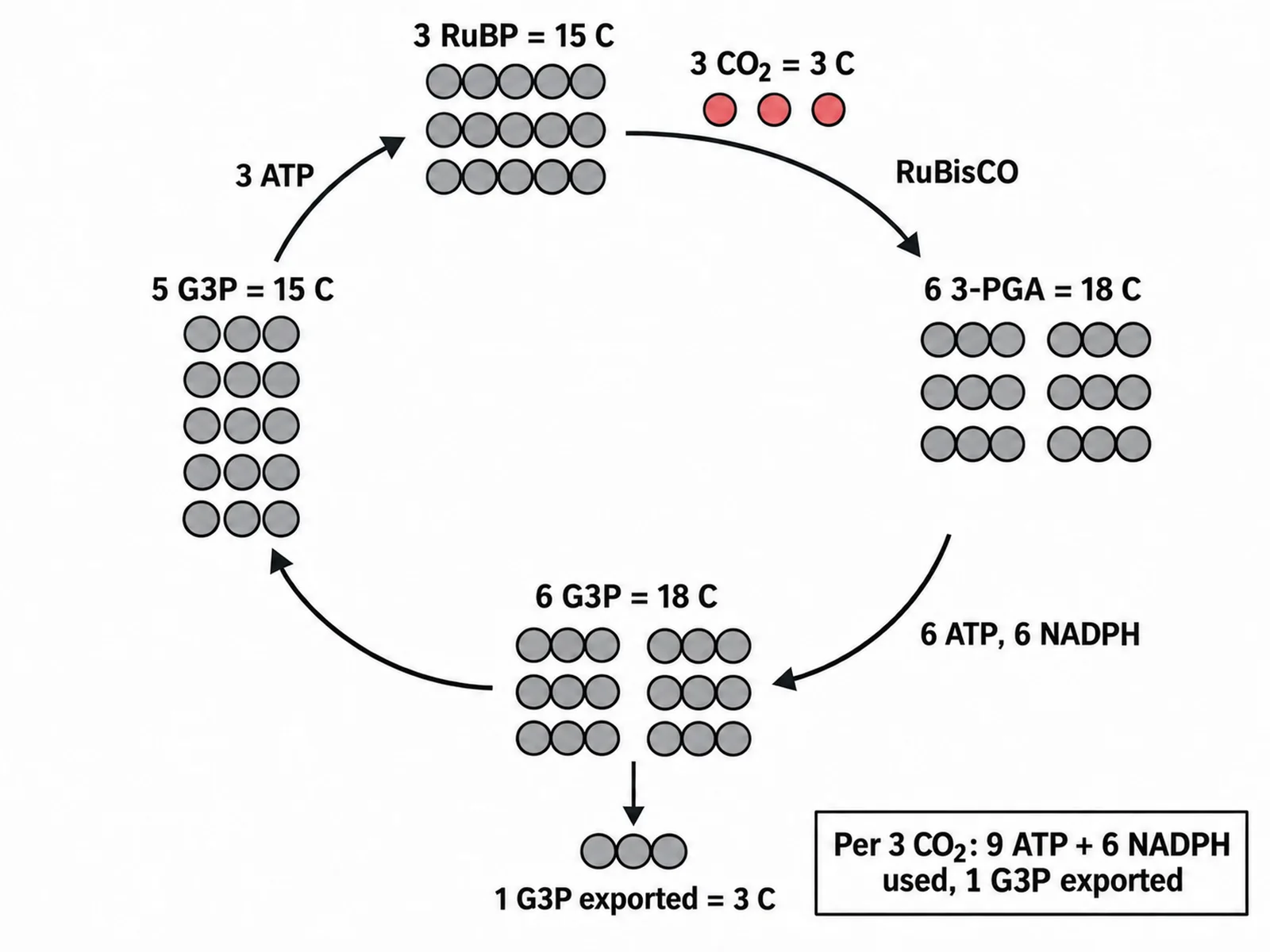
Create a Calvin cycle carbon counting diagram on a white background that tracks every carbon atom over three turns. Draw each molecule as a short chain of small grey circles, one circle per carbon. Top: three chains of five circles labeled "3 RuBP = 15 C" plus three single circles labeled "3 CO2 = 3 C". Arrow labeled "RuBisCO" to six chains of three circles labeled "6 3-PGA = 18 C". Arrow labeled "6 ATP, 6 NADPH" to six chains of three labeled "6 G3P = 18 C". Split: one chain of three goes out of the loop labeled "1 G3P exported = 3 C"; five chains of three go round labeled "5 G3P = 15 C", then an arrow labeled "3 ATP" back to "3 RuBP = 15 C". Add a summary box: "Per 3 CO2: 9 ATP + 6 NADPH, 1 G3P out".
Use this example
Prompt
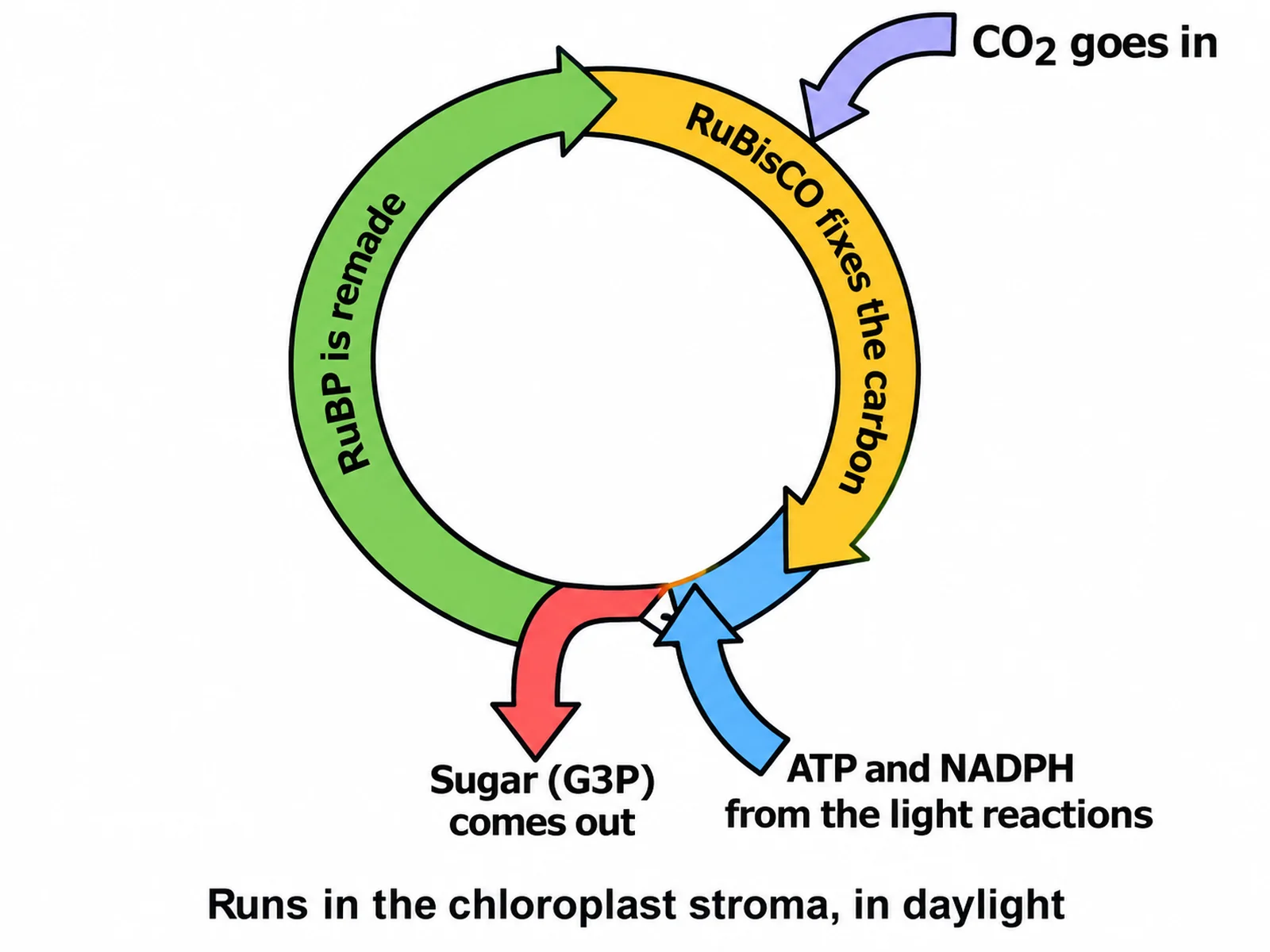
Create a simple Calvin cycle diagram for younger students, easy to copy by hand. Draw one thick circular arrow running clockwise in bold flat colours with dark outlines, large text, and plenty of white space. Use exactly five labels: "CO2 goes in" with an arrow entering at the top right, "RuBisCO fixes the carbon" on the first part of the loop, "ATP and NADPH from the light reactions" with an arrow entering at the bottom, "Sugar (G3P) comes out" with an arrow leaving at the bottom, and "RuBP is remade" on the left side of the loop. Add a small caption: "Runs in the chloroplast stroma, in daylight". No oxygen arrow, no glucose leaving the loop, and no other labels.
Use this example
Prompt
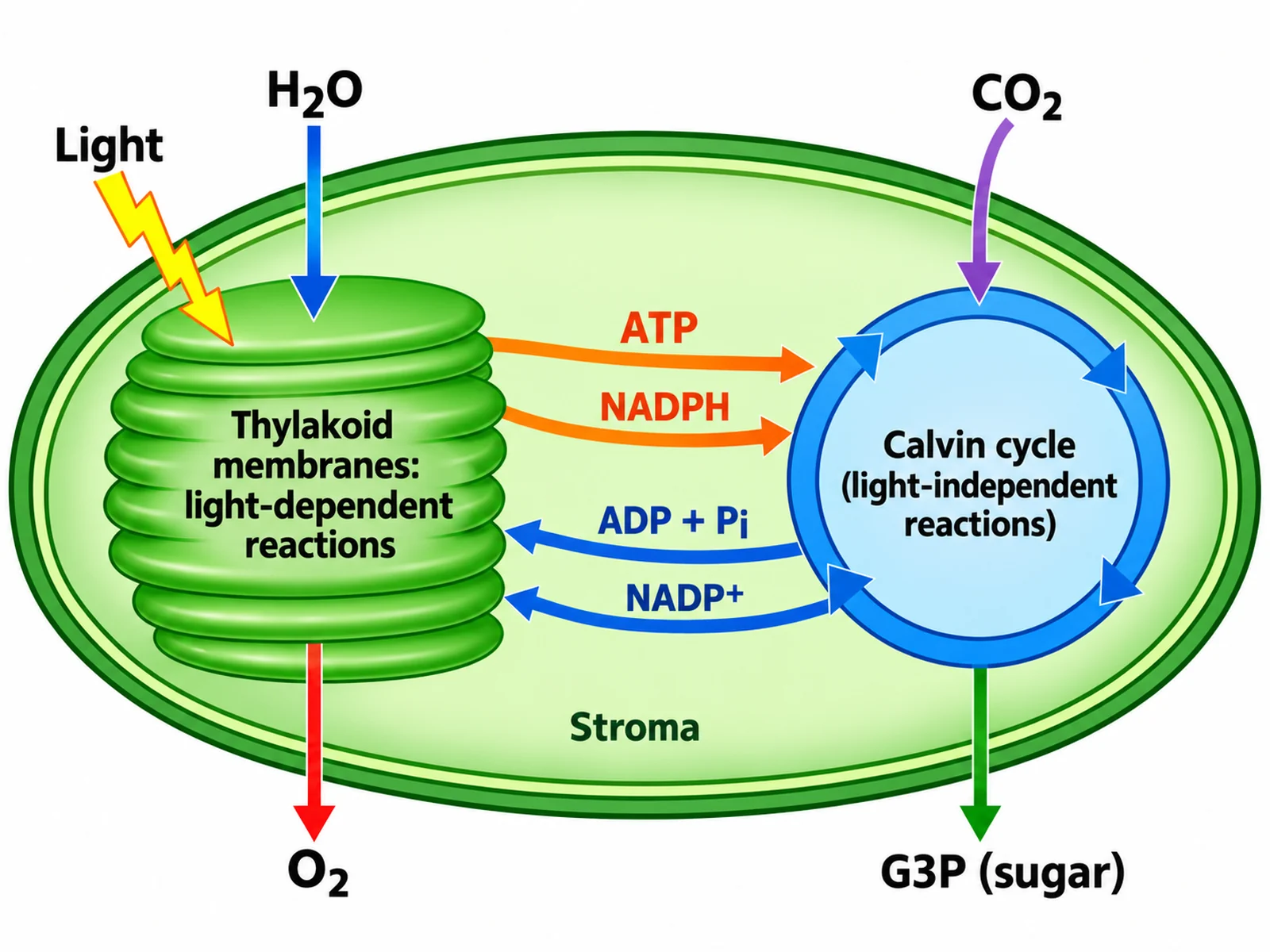
Create a labeled diagram linking the two stages of photosynthesis inside one chloroplast on a white background. On the left draw a stack of thylakoids labeled "Light-dependent reactions (thylakoid membranes)" with sunlight arriving, "H2O" going in, and "O2" leaving from the water-splitting side. On the right, in the surrounding fluid labeled "Stroma", draw the Calvin cycle as a loop labeled "Calvin cycle (light-independent reactions)" with "CO2" entering and "G3P (sugar)" leaving. Between them draw two arrows from the thylakoids to the cycle labeled "ATP" and "NADPH", and two arrows back labeled "ADP + Pi" and "NADP+". The O2 must leave the light reactions, never the Calvin cycle.
Use this example
Prompt
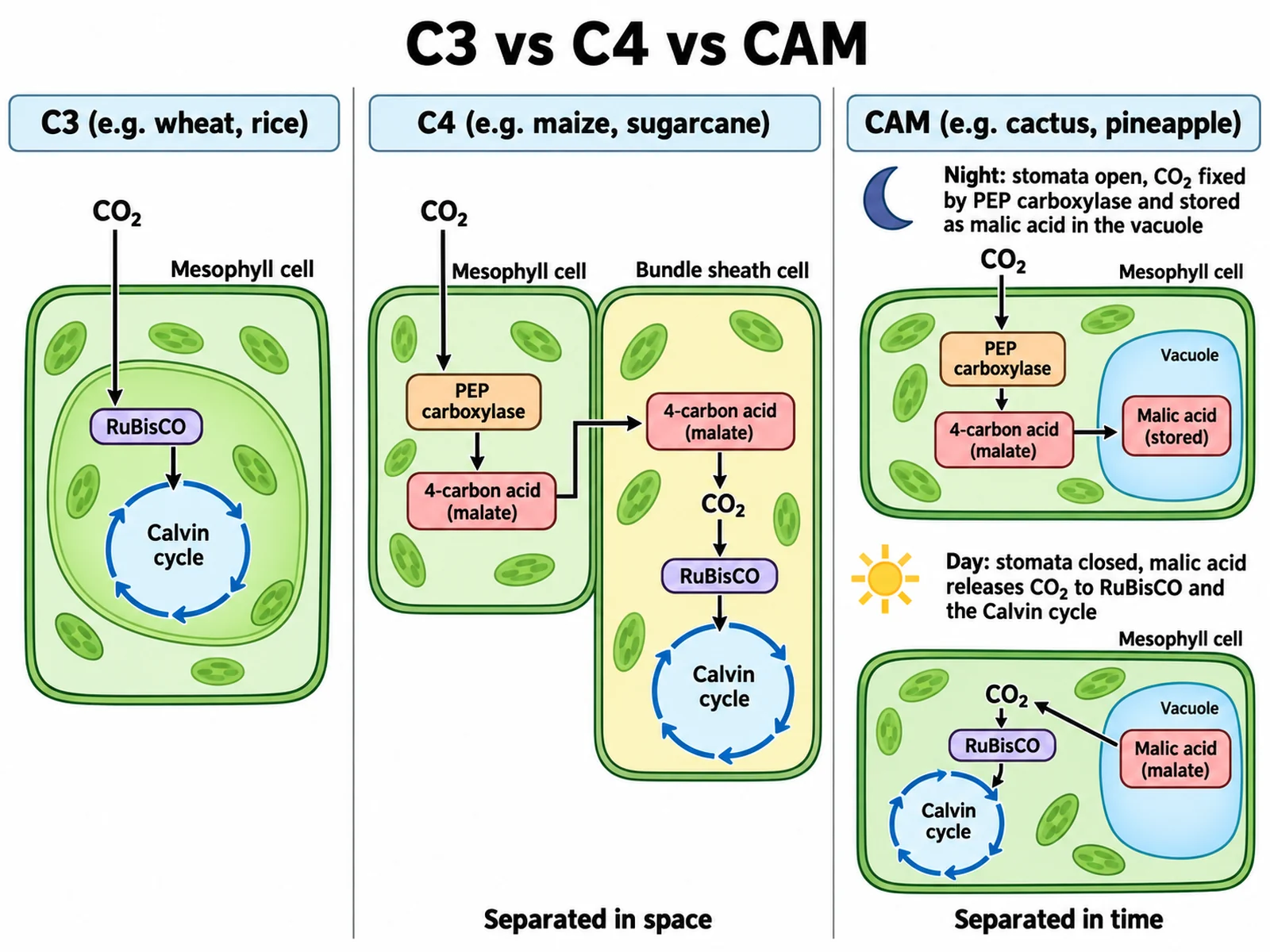
Create a three-panel comparison on a white background titled "C3 vs C4 vs CAM". Panel "C3 (e.g. wheat, rice)": one mesophyll cell where CO2 goes straight to RuBisCO and the Calvin cycle. Panel "C4 (e.g. maize, sugarcane)": a mesophyll cell where "PEP carboxylase" fixes CO2 into a "4-carbon acid (malate)", an arrow carrying it into a "Bundle sheath cell" where it releases CO2 to RuBisCO and the Calvin cycle; caption "Separated in space". Panel "CAM (e.g. cactus, pineapple)": one cell drawn twice, "Night: stomata open, CO2 stored as malic acid in the vacuole" and "Day: stomata closed, malic acid releases CO2 to the Calvin cycle"; caption "Separated in time". Draw the same Calvin cycle loop in all three panels.
Use this example
Prompt
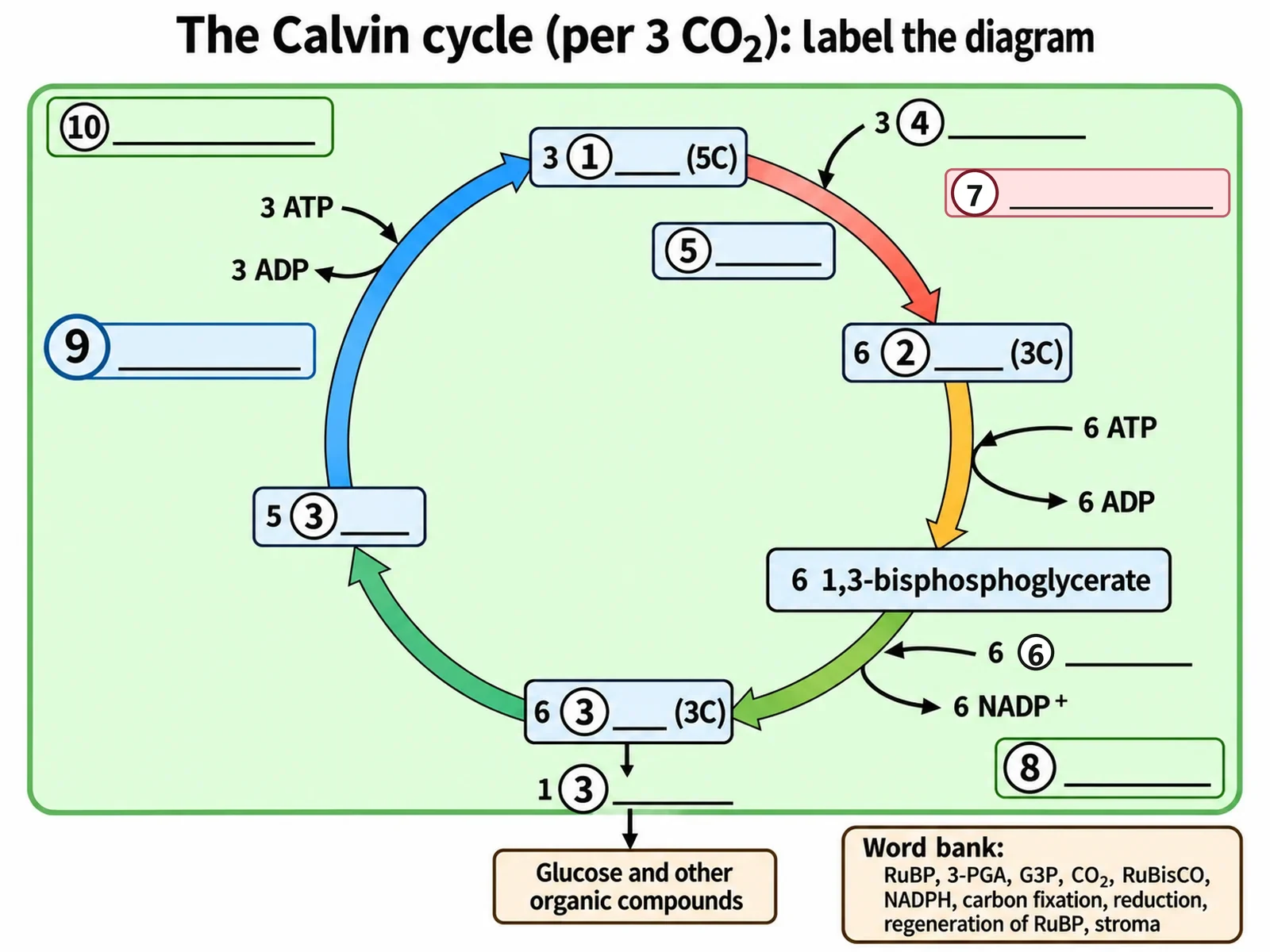
Create a blank Calvin cycle worksheet that is the same drawing as a labeled textbook Calvin cycle with the names removed. Draw one large clockwise loop inside a pale green rounded panel, split into three coloured arcs, with molecule boxes at the top, right, lower right, bottom, and lower left, and the same input and output arrows. Replace these ten names with numbered empty answer lines: 1 the top box (RuBP), 2 the right box (3-PGA), 3 the bottom box, the lower-left box, and the arrow leaving the loop (all G3P), 4 the gas entering at the upper right (CO2), 5 the enzyme on that arrow (RuBisCO), 6 the carrier entering beside ATP at the bottom (NADPH), 7 the upper right arc (carbon fixation), 8 the bottom arc (reduction), 9 the left arc (regeneration), 10 the panel (stroma). Keep the numerals 3, 6, 6, 1, 5 printed, and keep ATP, ADP, NADP+, and 1,3-bisphosphoglycerate printed. Add a word bank: "RuBP, 3-PGA, G3P, CO2, RuBisCO, NADPH, carbon fixation, reduction, regeneration, stroma".
Blank worksheet
Use this example
How to make a labeled Calvin cycle diagram
1
Pick the detail and the labels
Choose simple (five labels or fewer), the three stages, or full carbon counting, then choose labeled, numbered with a key, or a blank worksheet. Add the light reactions, photorespiration, or C4 and CAM only if you need them.
2
Generate the cycle
The generator keeps fixation, reduction, and regeneration in order in the chloroplast stroma, puts RuBisCO on the fixation step, and counts per 3 CO₂ — 9 ATP and 6 NADPH for each G3P that leaves.
3
Check it, then export
Count the carbons, check that ATP enters twice and NADPH once, and that no oxygen or glucose leaves the loop. Then download the PNG, or make the matching blank worksheet or answer key from the same image.
Calvin cycle key facts
Location
Chloroplast stroma
Stages
Carbon fixation → reduction → regeneration of RuBP
Fixing enzyme
RuBisCO (CO₂ + RuBP → 2 × 3-PGA)
Per 3 CO₂ (3 turns)
9 ATP + 6 NADPH used, 1 G3P exported
Per CO₂
3 ATP + 2 NADPH
Per glucose (6 CO₂)
18 ATP + 12 NADPH, 2 G3P
Carbon numbers
RuBP 5C · 3-PGA 3C · G3P 3C
Oxygen released
None — O₂ comes from the light reactions
What is a Calvin cycle diagram?
A Calvin cycle diagram is a map of the light-independent reactions of photosynthesis: the loop of reactions in the chloroplast stroma that takes carbon dioxide from the air and turns it into a three-carbon sugar phosphate, G3P. It is drawn as a cycle because the molecule that accepts CO₂, ribulose-1,5-bisphosphate (RuBP), is rebuilt at the end of every turn, so the same pool of RuBP keeps the loop going for as long as the leaf has CO₂, ATP, and NADPH.
A good diagram of the Calvin cycle does three jobs at once. It shows the order of the three stages — carbon fixation, reduction, and regeneration. It shows what crosses the edge of the loop and where: CO₂ coming in at fixation, ATP coming in at two places, NADPH coming in at one, ADP and NADP⁺ going back to the thylakoids, and one G3P going out. And it shows the bookkeeping, usually counted per three CO₂, which is the smallest number of turns that exports one whole three-carbon sugar. The pathway is also called the Calvin–Benson cycle or the Calvin–Benson–Bassham cycle, after the three Berkeley chemists who mapped it.
Labeled Calvin cycle diagram: what to label
The setting: the stroma of the chloroplast, the fluid around the thylakoid stacks. A label or a pale shaded panel is enough.
The three stages, in order around the loop: 1 carbon fixation, 2 reduction, 3 regeneration of RuBP.
RuBP (ribulose-1,5-bisphosphate), five carbons — the CO₂ acceptor at the top of the loop.
RuBisCO — the enzyme on the fixation arrow, and only on that arrow.
3-PGA (3-phosphoglycerate), three carbons — the first stable product, two per CO₂ fixed.
1,3-bisphosphoglycerate — the intermediate between the ATP step and the NADPH step; optional on simple diagrams.
G3P (glyceraldehyde-3-phosphate), three carbons — the sugar phosphate made by reduction; one in six leaves the loop.
Inputs: CO₂ at fixation, ATP at reduction and again at regeneration, NADPH at reduction.
Returns to the light reactions: ADP, inorganic phosphate, and NADP⁺.
The output arrow: G3P leaving towards “glucose, sucrose, starch, and other organic compounds”.
The three stages of the Calvin cycle, step by step
Stage 1, carbon fixation. CO₂ diffuses into the leaf through the stomata and into the stroma, where RuBisCO attaches it to RuBP. The six-carbon product is so unstable that it is never drawn as a separate box in most textbook figures: it splits immediately into two molecules of 3-PGA. This single step is the point at which inorganic carbon becomes part of an organic molecule, and almost all the carbon in a plant’s body — and in everything that eats plants — passed through it.
Stage 2, reduction. Each 3-PGA receives a phosphate group from ATP, becoming 1,3-bisphosphoglycerate, and is then reduced by NADPH, which hands over a pair of electrons. The result is G3P, a three-carbon sugar phosphate that holds much more chemical energy than 3-PGA. This is where the energy captured by the light-dependent reactions is actually stored in sugar: for every 3 CO₂ fixed, six ATP and six NADPH are spent here.
Stage 3, regeneration of RuBP. Of every six G3P made, one leaves the cycle as product and five stay behind. Those five three-carbon molecules — fifteen carbons in total — are rearranged through a series of four-, five-, six-, and seven-carbon sugar phosphates into three five-carbon molecules, which three more ATP convert into three RuBP. The loop is now back where it started and ready to fix three more CO₂.
Calvin cycle with carbon counting: why 3 CO₂ make one G3P
Carbon counting is the clearest way to see why textbooks count the Calvin cycle in threes. One turn fixes one CO₂, which is one carbon, but the product, G3P, has three carbons. So three turns are the smallest unit that exports a whole G3P without dismantling the loop. Over those three turns: 3 RuBP carry 15 carbons, 3 CO₂ add 3, and RuBisCO produces 6 molecules of 3-PGA holding 18 carbons. Reduction turns them into 6 G3P, still 18 carbons. One G3P — 3 carbons — leaves, and the remaining 5 G3P — 15 carbons — are rebuilt into 3 RuBP, 15 carbons. The books balance exactly.
The energy bookkeeping follows the same three turns: 6 ATP and 6 NADPH in reduction, plus 3 ATP in regeneration, for a total of 9 ATP and 6 NADPH per G3P exported, or 3 ATP and 2 NADPH per CO₂. A six-carbon glucose needs two G3P, so six turns, 18 ATP, and 12 NADPH. The most common counting error is mixing these two bases on one figure — for example, “3 CO₂” at the top of the loop and “18 ATP” at the bottom — so the generator writes the basis on every figure that shows numbers.
Simple Calvin cycle diagram and easy drawing
Not every class needs 1,3-bisphosphoglycerate. A simple Calvin cycle diagram for middle school or an introductory course keeps one bold loop and five labels at most: CO₂ goes in, RuBisCO fixes it, ATP and NADPH arrive from the light reactions, sugar (G3P) comes out, and RuBP is remade so the cycle can continue. That is enough to show the idea that matters — carbon from the air becomes sugar using energy captured from light — without a page of molecule names.
Simple does not mean wrong, though. Even the easiest Calvin cycle drawing should never show glucose coming out of every turn, oxygen coming out of the loop, or the cycle happening at night. If students are copying the drawing by hand, ask for thick outlines, flat colours, and large text, and keep the loop as one clean circle with the inputs entering from outside it.
To draw the Calvin cycle by hand in a few minutes, start with a large circle and an arrowhead showing it runs clockwise. Write RuBP at the top. Bring a CO₂ arrow in from the upper right and write RuBisCO beside it; that quarter of the circle is carbon fixation. Write 3-PGA on the right side, then bring ATP and NADPH arrows in from the bottom and write G3P below them; that is reduction. Draw one G3P arrow leaving the circle downward, and label the left side, which climbs back up to RuBP with one more ATP arrow, as regeneration. Shade the background pale green and write “stroma” in the corner.
How the Calvin cycle connects to the light reactions
Photosynthesis has two linked stages, and a diagram that shows both is often the clearest answer to “where does the Calvin cycle fit?” The light-dependent reactions run in the thylakoid membranes: light drives electrons from water through two photosystems, water is split and O₂ is released, and the energy is captured as ATP and NADPH. Both are released into the stroma.
The Calvin cycle in the stroma spends that ATP and NADPH to build G3P, and sends ADP, inorganic phosphate, and NADP⁺ back to the thylakoids to be recharged. That two-way shuttle is why the Calvin cycle stops within seconds when the light goes off, even though no step of it uses light directly. In a combined figure, the arrows that matter are ATP and NADPH from thylakoid to cycle, ADP and NADP⁺ from cycle to thylakoid, H₂O in and O₂ out at the light reactions, and CO₂ in and G3P out at the Calvin cycle.
Photorespiration, C4 and CAM: when RuBisCO grabs oxygen
RuBisCO’s full name — ribulose-1,5-bisphosphate carboxylase/oxygenase — gives away its weakness. It can attach O₂ to RuBP instead of CO₂. When it does, the products are one 3-PGA and one two-carbon 2-phosphoglycolate, which the plant must salvage through reactions in the peroxisome and mitochondrion that cost ATP and release CO₂ that had already been fixed. This is photorespiration, and it gets worse on hot, dry days, when stomata close to save water and the ratio of O₂ to CO₂ inside the leaf rises.
C4 and CAM plants work around the problem without changing the Calvin cycle at all. C4 plants such as maize and sugarcane fix carbon first in mesophyll cells using PEP carboxylase, which takes up dissolved CO₂ as bicarbonate and does not react with O₂, into a four-carbon acid. The acid moves into bundle sheath cells wrapped around the veins, where it releases CO₂ at high concentration right next to RuBisCO. CAM plants such as cacti and pineapple open their stomata at night, store fixed CO₂ as malic acid in the vacuole, and release it to the Calvin cycle during the day while the stomata stay shut. C4 separates the two fixation steps in space; CAM separates them in time.
What happens to G3P after it leaves the cycle
The G3P that leaves the Calvin cycle is the raw material for almost everything else a plant makes. Some is exported from the chloroplast to the cytoplasm and used to make sucrose, the sugar that travels through the phloem to roots, fruits, and growing tips. Some stays in the chloroplast and is built into starch for storage. Two G3P can be joined to make glucose or fructose, and G3P is also a starting point for amino acids, fatty acids, and cellulose. On a diagram, the honest way to show this is an arrow from G3P to a box such as “glucose and other organic compounds” — outside the loop — rather than a glucose molecule leaving every turn.
Calvin cycle diagram for AP Biology and college
For AP Biology and introductory college courses, a Calvin cycle diagram is expected to carry more than the loop. Students should be able to name the three stages, place RuBisCO on fixation, trace RuBP, 3-PGA, and G3P in order, and state that 3 CO₂ need 9 ATP and 6 NADPH to export one G3P. Exam questions then connect the cycle outward: to the light-dependent reactions through ATP, NADPH, ADP, and NADP⁺; to stomata and water loss through photorespiration; and to C4 and CAM as adaptations to hot or dry climates. College biochemistry adds the full names of the intermediates and the sugar phosphates of the regeneration stage. Choose the AP / college level with full detail to get the long-form names and exact stoichiometry on one figure.
Calvin cycle vs Krebs cycle: two loops that are easy to mix up
Students meet the Calvin cycle and the Krebs cycle in the same unit, both are drawn as loops of three- to six-carbon molecules, and both regenerate the molecule they started from — so their diagrams get confused. They run in opposite directions in every sense that matters. The Calvin cycle is anabolic: it builds sugar from CO₂, spends ATP and NADPH, and runs in the stroma of the chloroplast. The Krebs cycle is catabolic: it breaks the acetyl group of acetyl-CoA down to CO₂, loads electrons onto NAD⁺ and FAD to make NADH and FADH₂, makes one GTP or ATP per turn, and runs in the matrix of the mitochondrion.
The acceptor molecules differ too. The Calvin cycle’s acceptor is RuBP, with five carbons, and it takes in one CO₂ per turn. The Krebs cycle’s acceptor is oxaloacetate, with four carbons, and it takes in a two-carbon acetyl group per turn and releases two CO₂. If a diagram labeled “Calvin cycle” mentions NADH, FADH₂, oxaloacetate, citrate, or the mitochondrion, it has borrowed from the wrong pathway. Plant cells run both: the Calvin cycle in their chloroplasts by day, and the Krebs cycle in their mitochondria all the time.
How the Calvin cycle was discovered
The pathway was worked out at the University of California, Berkeley, between the late 1940s and the 1950s by Melvin Calvin, Andrew Benson, and James Bassham. They grew the single-celled green alga Chlorella in a flat glass vessel nicknamed the “lollipop”, fed it carbon dioxide made with radioactive carbon-14, and plunged samples into hot alcohol after a few seconds to stop every reaction at once. Separating the extracts by paper chromatography showed which molecules the radioactive carbon had reached first. After the shortest exposures almost all of it was in 3-PGA, which identified 3-PGA as the first stable product of carbon fixation; longer exposures traced the label through the sugar phosphates and back to RuBP, closing the loop. Calvin received the 1961 Nobel Prize in Chemistry for the work, and the cycle is now often called the Calvin–Benson or Calvin–Benson–Bassham cycle to credit his colleagues.
Calvin cycle images: what to check before you use one
Count what leaves: one G3P per three CO₂, never a glucose per turn.
Count what comes in: ATP at two places, NADPH at one, both as inputs rather than outputs.
Read the carrier names: NADPH and NADP⁺, never NADH and NAD⁺.
Check the order: RuBP, then 3-PGA, then G3P, then back to RuBP — and 3-PGA before G3P.
Look for stray oxygen: no O₂ leaves the Calvin cycle unless the figure is explicitly about photorespiration.
Check the location: stroma, not thylakoid, cytoplasm, or mitochondrion.
Check the basis: “per 3 CO₂” and “per glucose” numbers should never appear together without labels.
Most common Calvin cycle diagram mistakes
These are the errors that turn up most often in student drawings, in images found online, and in AI output. Check for each one before a diagram goes on a worksheet.
MistakeCorrect
MistakeGlucose leaves the cycle after every turn.
CorrectOne G3P leaves for every three turns (3 CO₂). Glucose is built later from two G3P, outside the loop.
MistakeO₂ is drawn coming out of the Calvin cycle.
CorrectThe Calvin cycle releases no oxygen. O₂ comes from splitting water in the light-dependent reactions.
MistakeNADH and NAD⁺ are written on the reduction step.
CorrectPhotosynthesis uses NADPH and NADP⁺. NADH belongs to respiration.
MistakeATP is shown entering only once, or being produced.
CorrectATP is consumed twice — 6 in reduction and 3 in regeneration per 3 CO₂ — and none is made.
Mistake3-PGA and G3P are swapped.
Correct3-PGA is the first product of fixation; G3P is made from it by ATP and NADPH and is the molecule that leaves.
MistakeThe cycle is drawn inside a thylakoid or on its membrane.
CorrectIt runs in the stroma, the fluid around the thylakoids.
MistakeLabels say "dark reaction" and show a moon.
CorrectIt is light-independent but runs in daylight, on ATP and NADPH made by the light reactions at the same time.
MistakeCounts mix bases, such as 3 CO₂ beside 18 ATP.
CorrectPer 3 CO₂: 9 ATP and 6 NADPH. Per 6 CO₂: 18 ATP and 12 NADPH. Write the basis on the figure.
C3 vs C4 vs CAM photosynthesis
All three run the same Calvin cycle with RuBisCO. They differ in how CO₂ is delivered to it.
C3
C4
CAM
First CO₂-fixing enzyme
RuBisCO
PEP carboxylase
PEP carboxylase
First stable product
3-PGA (3 carbons)
Oxaloacetate, then malate (4 carbons)
Oxaloacetate, stored as malic acid (4 carbons)
Where the Calvin cycle runs
Mesophyll cells
Bundle sheath cells
The same mesophyll cell
How the steps are separated
Not separated
In space: mesophyll, then bundle sheath
In time: CO₂ fixed at night, Calvin cycle by day
Stomata open
Day
Day
Night
Photorespiration
High in hot, dry conditions
Very low
Very low
Examples
Wheat, rice, soybean, most trees
Maize, sugarcane, sorghum
Cacti, pineapple, agave
Calvin Cycle Diagram FAQ
The loop itself and what crosses its edge. Inside the loop: RuBP (ribulose-1,5-bisphosphate, 5 carbons), 3-PGA (3-phosphoglycerate, 3 carbons), 1,3-bisphosphoglycerate, and G3P (glyceraldehyde-3-phosphate, 3 carbons), with the three stages named — carbon fixation, reduction, and regeneration of RuBP. Crossing the edge: CO₂ coming in at the fixation step with RuBisCO named on that arrow, ATP and NADPH coming in, ADP and NADP⁺ going back to the light reactions, and one G3P leaving as the product. The whole loop sits in the stroma of the chloroplast. A textbook-standard figure also writes the counts per 3 CO₂, because that is the smallest number of turns that exports one whole G3P.
Generate photosynthesis and respiration pathways, leaf and chloroplast diagrams, and worksheet-ready biology illustrations with the same SciFigure AI workflow.