
Venue · ICLR
ICLR Paper Figures: Figure 1 Examples to Learn From
An ICLR paper has to explain its method in Figure 1 before the reader reaches the text. This page collects 417 of those figures from ICLR 2025 to 2026, each from a paper whose OpenReview record shows the CC BY 4.0 license. ICLR, the International Conference on Learning Representations, centers on deep learning and representation learning, so most figures here show a model, a training pipeline or a new problem setting. Filter by year, type or rank, open a figure for its colors and credit, and note how authors place a baseline next to their own method.
417 Figure 1 images, 2025 to 2026, all from CC BY 4.0 papers
417 figures
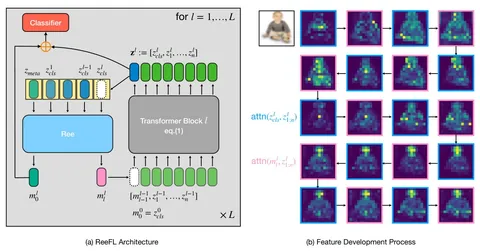
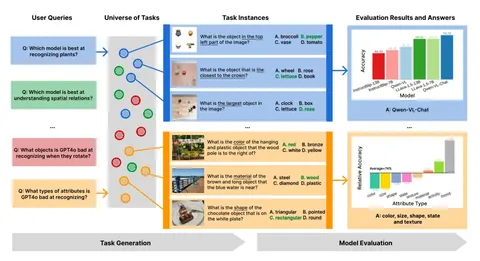
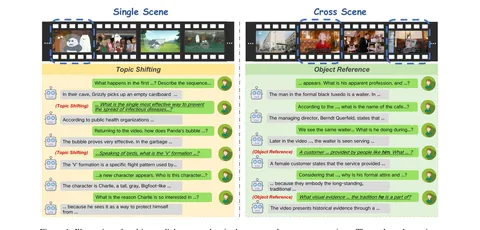
Habits that show up in ICLR Figure 1s
- 1
Baseline panel, your panel, then the gain
Panel (a) draws the prior method, panel (b) redraws the same inputs with the new one, and panel (c) adds small bar charts of the gain. Each panel has its own tint, so the two methods compare without the caption.
- 2
Snowflake for frozen, flame for trained
Small snowflake and flame icons mark which blocks stay frozen and which are trained, and a dashed legend box in the corner explains them along with the arrow styles. Readers see what the method updates at a glance.
- 3
Numbered steps that wrap around the canvas
Bold step titles run left to right along the top row, then right to left along the bottom, so a four-step data pipeline fits a wide, short canvas. The numbers keep the order clear where the arrows turn back.
- 4
Text colors that match image frames
Three answer lines are printed in red, yellow and blue, and the three sample images carry frames in the same colors. The reader links each viewpoint to its picture without extra arrows or labels.
- 5
A dashed line between agent and environment
A heavy dashed line splits the canvas into an Agent panel and an Environment panel, with the web server and its raw observation on the far side. The split makes clear which parts belong to the method and which come from the outside world.
- 6
Section numbers inside the boxes
Module titles carry the paper section that explains them, such as Section 3.2 beside the crossover step and Section 3.3 beside mutation. A reviewer who wants detail on one box knows exactly where to look in the text.
Questions about ICLR paper figures
What makes a good Figure 1 for an ICLR paper?
It shows the one idea a reader should remember before the method section. In this collection that usually means the new method drawn next to a baseline, real inputs and outputs instead of empty boxes, and a short legend for icons or arrow styles. Keep the reading order obvious, left to right or numbered, and keep the text large enough to read at the printed size.
Should Figure 1 in an ICLR paper have panel labels?
Use them when the figure has parts that the caption or text refers to separately. Many figures here label panels (a), (b) and (c), often for the baseline, the new method and the results. A single diagram with one reading path needs no letters; numbered steps serve it better.
Are ICLR papers licensed under CC BY 4.0?
Not every one, so check each paper. This gallery includes only ICLR papers whose license was verified as CC BY 4.0 from the license shown on the paper's OpenReview record, and every figure links to its paper. Papers that could not be verified are left out, so a missing paper says nothing about its quality.
Can I reuse these ICLR figures?
Copyright stays with the authors. These papers are under CC BY 4.0, which allows reuse, including commercial use, as long as you credit the authors, link to the paper and to the license, and note any changes you made. For your own paper it is usually better to borrow the layout idea and draw your own figure. If you start from an AI draft, check your venue's policy on AI-generated images before you submit.
Which kinds of Figure 1 are most common at ICLR?
In this collection, conceptual figures and pipeline diagrams are the two largest groups, followed by architecture diagrams and teaser figures that lead with results. Framework and taxonomy figures are rarer. Use the type filter above to see one kind at a time and compare how different authors solve the same layout problem.
Draft your own ICLR Figure 1
Describe your method, its inputs and the result you want to show, and SciFigure's AI figure tools draft a first version. Then check every label, arrow and symbol against your paper.
Open the AI figure generatorData and license
Every figure here is Figure 1 of a paper released under CC BY 4.0, cropped and resized, and each one credits its title, authors, venue and year with links to the paper and the license. Listing a figure does not mean its authors endorse SciFigure. How the licenses were checked.