For Researchers
GSA Connects Poster Guidelines: Board Size, Abstract Deadlines and a Layout for Geology Posters
GSA Connects poster rules: the 8 × 4 ft landscape board, 2026 abstract deadlines and fees, poster session hours, and a layout for geologic maps and sections.
 SciFigure Editorial
GSA Connects 2026, the annual meeting of the Geological Society of America, took place October 11–14, 2026, in Denver, Colorado, at the Colorado Convention Center. The next one, GSA Connects 2027, is set for October 17–20, 2027, in Montréal, Québec. Whether you are looking back at what Denver required or planning a poster for Montréal, the rules are scattered across the meeting site, the call for abstracts and the online program. This guide puts them in one place and then turns to the part GSA leaves to you: how to lay out maps, stratigraphic columns, cross-sections and geochemistry so they read from across an aisle.
Every size, date and fee below is as published on GSA's official pages when we checked them on November 17, 2026, and each one is listed in Sources at the end. Where GSA did not publish something for 2026, we say so and give the most recent official figure with its year.
GSA Connects poster rules at a glance
| Item | GSA Connects 2026 (as published) |
|---|---|
| Dates and venue | October 11–14, 2026, Denver, Colorado (Colorado Convention Center) |
| Poster board | One free-standing board, 8 ft wide × 4 ft high (96 × 48 in; GSA gives 122 × 244 cm) |
| Orientation | Landscape only. Printed posters may be any material, no bigger than 4 × 8 ft |
| Mounting | Push pins and Velcro provided at the board |
| Display hours | 8 a.m.–5:30 p.m. on your session day; posters must come down at the end of that day |
| Your presenting time | At your poster 9–11 a.m. or 2–4 p.m. |
| E-posters | None: every poster is presented in person, and GSA describes no virtual upload |
| Printing | GSA's presenter pages do not mention a printing service; bring your printed poster |
| Abstract deadlines | Opened May 5; Early Action May 19; final deadline August 6, 2026 |
| Abstract fee | Members $60 (students $25); non-members $80 (students $50); non-refundable |
| Abstract length | Not stated on the 2026 page; GSA's 2024 form allowed 2,050 characters, not counting spaces |
| Next meeting | GSA Connects 2027, October 17–20, 2027, Montréal |
If you remember only three things: print landscape, keep it within 8 × 4 ft, and be at your board for your two-hour presenting window.
Mistakes that cost geology posters attention
Most poster problems at GSA are not about the science: they are a poster that does not fit the board, or a map nobody can read from two metres away.
- Bringing a portrait poster. GSA's rule is landscape. A portrait A0 (84 × 119 cm) is short enough to hang, but it breaks the orientation rule and covers only about a third of an 8 ft board.
- Maps without the basics. A map with no scale bar, north arrow, coordinates or datum is the first thing a field geologist will ask about.
- Cross-sections with no line of section. If A–A′ is not drawn on the map, and the vertical exaggeration is not stated, readers cannot judge the geometry you are arguing for.
- Stratigraphic columns without a scale. Thickness in metres, a grain-size axis and a lithology key turn a decorative column into data.
- Geologic colours that collapse for colour-blind readers. Many map palettes put reds and greens side by side; patterns and labels have to carry the distinction too.
- Missing your window. Your poster hangs all day, but you are expected at the board from 9 to 11 a.m. or from 2 to 4 p.m. Check which one in the online program.
- Forgetting to register. GSA requires every presenter to register for the meeting. The abstract fee does not cover registration.
GSA Connects 2026 dates and abstract deadlines
GSA's Call for Abstracts page listed these dates for 2026. Submission has now closed.
| Date (2026) | What happened |
|---|---|
| May 5 | Abstract submission opened |
| May 19 | Early Action deadline: submit by this date to be told about acceptance by mid-June |
| Mid-June | Early Action notices |
| August 6 | Final abstract deadline, and the last day for updating invited-speaker lists |
| October 11–14 | GSA Connects 2026, Denver |
What about the GSA abstract deadline for 2027? GSA had not published 2027 abstract dates on the pages we checked. The 2026 pattern was an early-action date in May and a final deadline in early August; treat that as a pattern, not a promise, and check the Montréal call for abstracts when it opens.
GSA abstract rules that shape the poster
- Fees (2026): GSA members pay $60 as professionals and $25 as students; non-members pay $80 and $50. The fee is non-refundable, and invited speakers pay it too.
- The two-abstract rule: you may submit up to two abstracts as presenting author if one of them is for a poster and the two cover different content. Invited abstracts to Pardee Keynote or topical sessions do not count toward the limit, and neither do abstracts for sessions held in Spanish.
- Length: the 2026 call does not restate a limit. GSA's 2024 submission guide set the body at 2,050 characters or fewer, not counting spaces, and said tables are allowed but must fit within that same space. Expect the form itself to enforce the current limit.
- Presentation mode: the 2024 form let you choose oral, poster or either, and warned that organizers may override the choice. Choosing "either" is not a guarantee of a talk.
- Authorship: GSA asks that submission reflect a sincere intent to present, and that every listed co-author made a real contribution and agreed to be listed.
- Finding past abstracts: GSA keeps a searchable archive of meeting abstracts linked from its Find Abstracts page, which is useful for seeing how sessions in your discipline have framed their work.
The GSA poster board: size and print options
GSA gives each poster presenter one horizontal, free-standing board, 8 feet wide and 4 feet high, with push pins and Velcro supplied. Printed posters can be any material and any size up to 4 × 8 ft (122 × 244 cm) in landscape orientation. The board's proportion is 2:1, which is wider than most posters people bring from other meetings.
| Print size | Centimetres | How it sits on the board |
|---|---|---|
| 96 × 48 in | 244 × 122 cm | Fills the board edge to edge: the largest GSA allows |
| 92 × 46 in | 234 × 117 cm | Same 2:1 shape with 2 in of clearance each side, so the edges are not fighting the frame |
| 72 × 36 in | 183 × 91 cm | 2:1 at 75% scale; a lighter, cheaper print with room left over |
| 48 × 36 in | 122 × 91 cm | A common size elsewhere; covers half the board's width |
| A0 landscape | 118.9 × 84.1 cm | Fits, but covers about 49% of the width |
Fabric is allowed. Because GSA accepts any material, a fabric poster that folds into a suitcase is a sensible choice if you are flying, especially across a border to Montréal in 2027.
Reusing a poster from another meeting? A 48 × 36 in print hangs but leaves half the board empty. Re-flow it to 2:1 if you can: maps and cross-sections are naturally wide.
How GSA poster sessions work
- All day on the board, two hours at it. Posters are displayed 8 a.m.–5:30 p.m., and presenters stand at their posters 9–11 a.m. or 2–4 p.m. Posters must be removed at the end of the day of the session.
- In person only. GSA says all posters are presented in person.
- Power. If your poster needs electricity (a screen, a sandbox, a sensor demo), GSA asks you to request it by email at meetings@geosociety.org.
- Wi-Fi. GSA's presenter page says Wi-Fi is available in the poster hall, which matters if your QR code points to a live dataset.
- Photos and recordings are allowed unless the presenter has said otherwise. If you do not want your poster photographed, put GSA's "No Recording" logo on it.
- Lightning Talks. GSA's 2026 program describes 3-minute talks paired with a poster, and poster-only session advocates could add them on the Innovation Stage in the Exhibit Hall.
Poster, Lightning Talk or oral talk at GSA
| Poster | Lightning Talk | Oral talk | |
|---|---|---|---|
| Length | On display 8 a.m.–5:30 p.m.; you present for a 2-hour window | 3 minutes, paired with a poster | 12 minutes plus 3 minutes of questions |
| Where | Poster hall, one 8 × 4 ft board | Innovation Stage in the Exhibit Hall | Session room |
| What you bring | A printed landscape poster, up to 4 × 8 ft | A short talk that sends people to the poster | Slides at 16:9, as PowerPoint or PDF |
| Deadline on site | Hang it before the session; take it down the same day | As scheduled | Upload in the Speaker Ready Room at least 24 hours before |
For talks, GSA's meeting computers are PCs with MS Office 2016, Keynote is not supported, and the Speaker Ready Room has no internet, so bring your file on a drive. If you cannot get there in time, take it to your session room at least 30 minutes before the session starts.
How to build a GSA poster, step by step
1. Set up the page at the board's proportion
Start with a 2:1 landscape page. PowerPoint will not make a page larger than 56 in on either side, so for a full 96 × 48 in poster design at 48 × 24 in and ask the printer to scale to 200%. Illustrator, Inkscape, Affinity and QGIS layouts can work at full size. Decide on the print size before you place a single figure; re-flowing a finished poster from 4:3 to 2:1 takes longer than building it right.
2. Write a title that states the finding
The title band is the only part people read while walking. "Diachronous onset of fluvial incision along the southern Front Range" tells a passer-by what you found; "Fluvial geomorphology of the Front Range" does not. Put the session code and poster number in the band so people can find you in the online program.
3. Put the location map top left
Visitors look for "where" before "what". Give the study area its own panel in the first column, with an inset locator map, a scale bar, a north arrow, a coordinate grid and the projection and datum in small type. If you show a geologic map, use the conventional unit colours and patterns your field expects (the US Federal Geographic Data Committee's geologic map symbolization standard is the usual reference in North America) and label the units directly on the map wherever you can, rather than relying on a legend alone.
4. Draw stratigraphic columns and cross-sections to scale
A measured section needs a vertical scale in metres, a grain-size axis (clay, silt, sand, gravel), a lithology key and sample positions. If you correlate several sections, align them on a datum and draw the tie lines. For cross-sections, mark the line of section on the map, state the vertical exaggeration, and keep interpreted contacts visibly different from observed ones (dashed versus solid is the convention). Use timescale colours from the International Chronostratigraphic Chart if you colour by age.
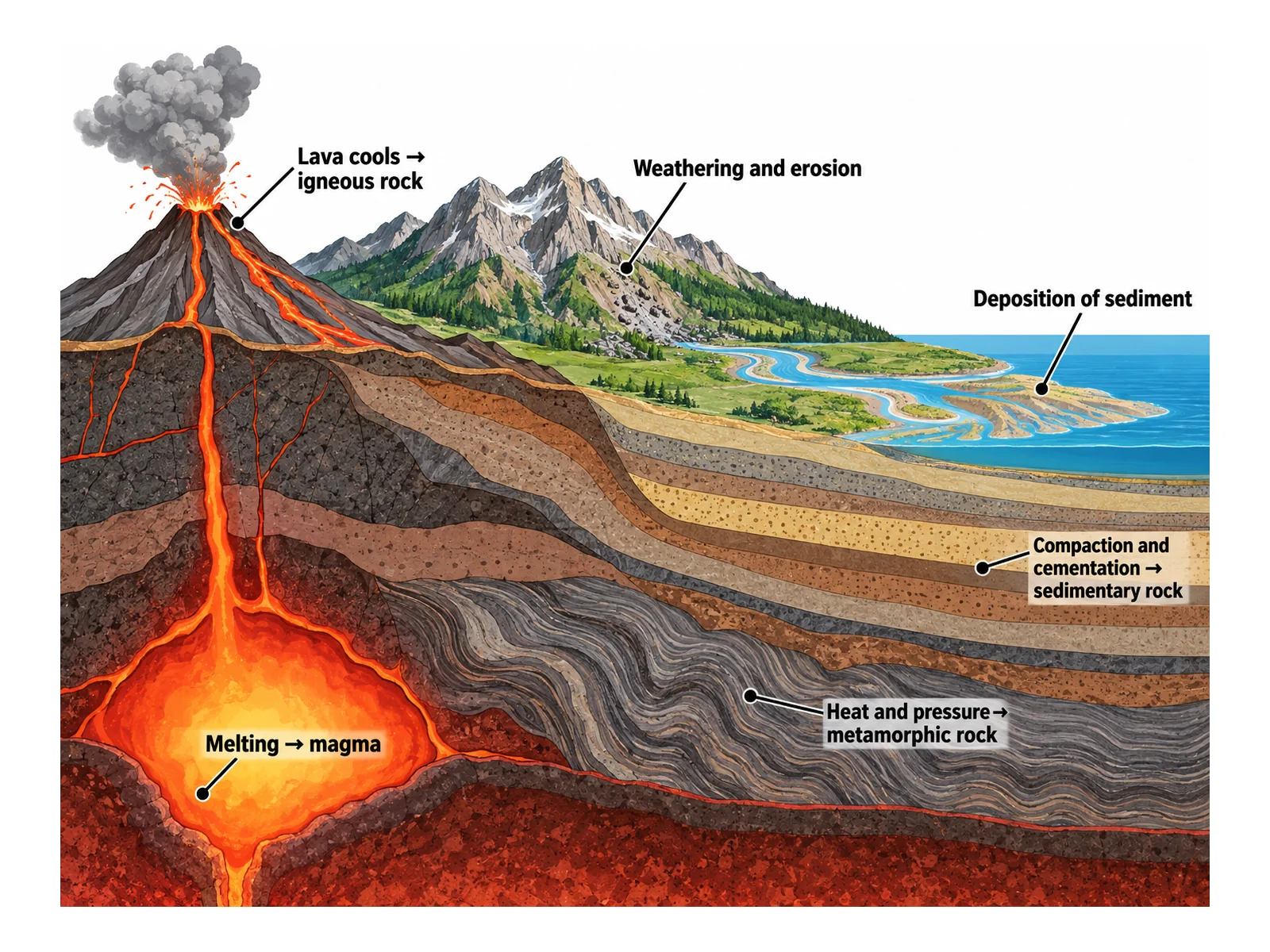
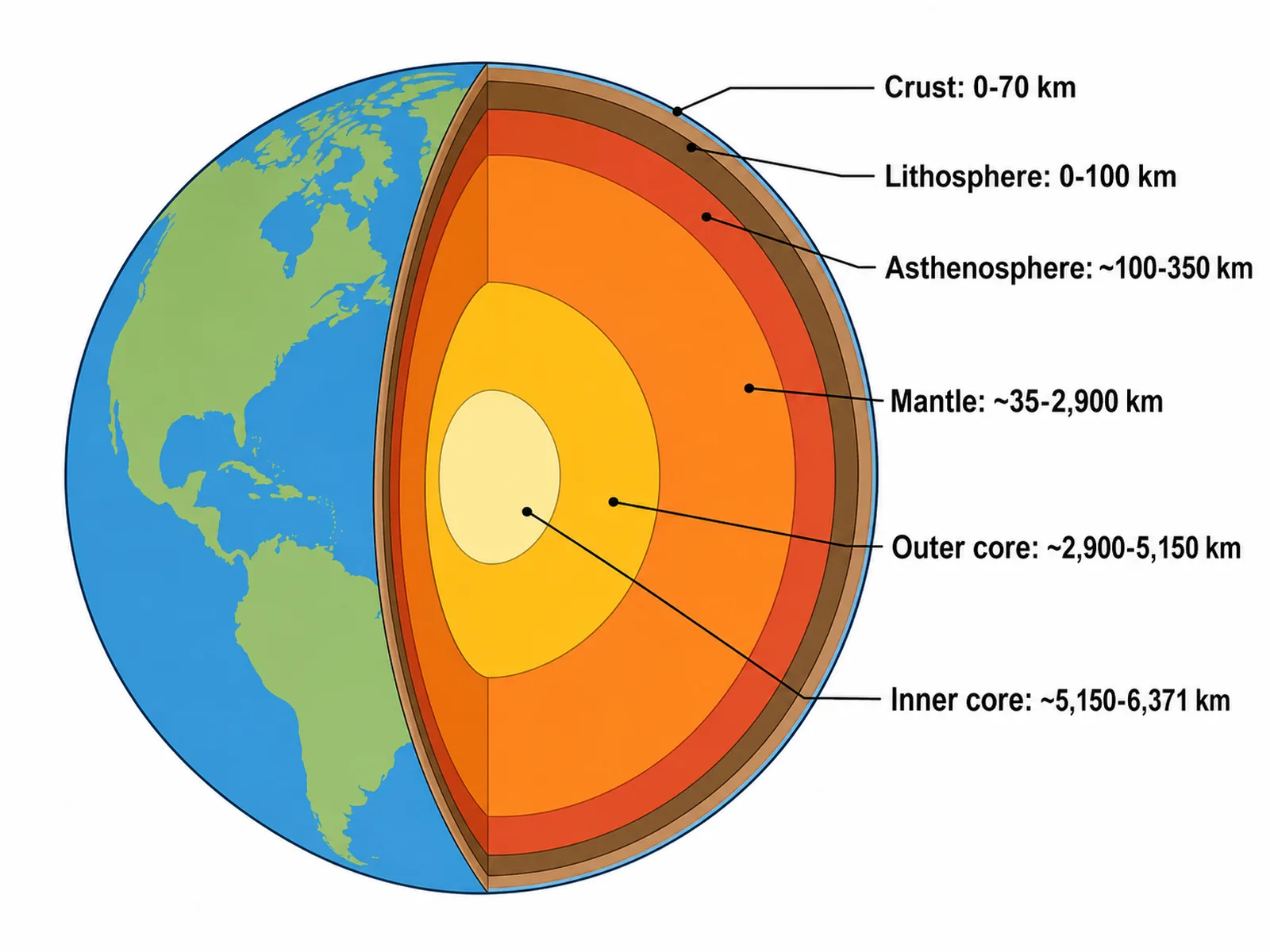
For a teaching or outreach poster, a clean schematic can carry the concept before your data take over. The rock cycle diagram page draws block-diagram style overviews like the one below; keep any such schematic clearly separate from your measured data.
5. Make geochemistry and geochronology plots readable from two metres
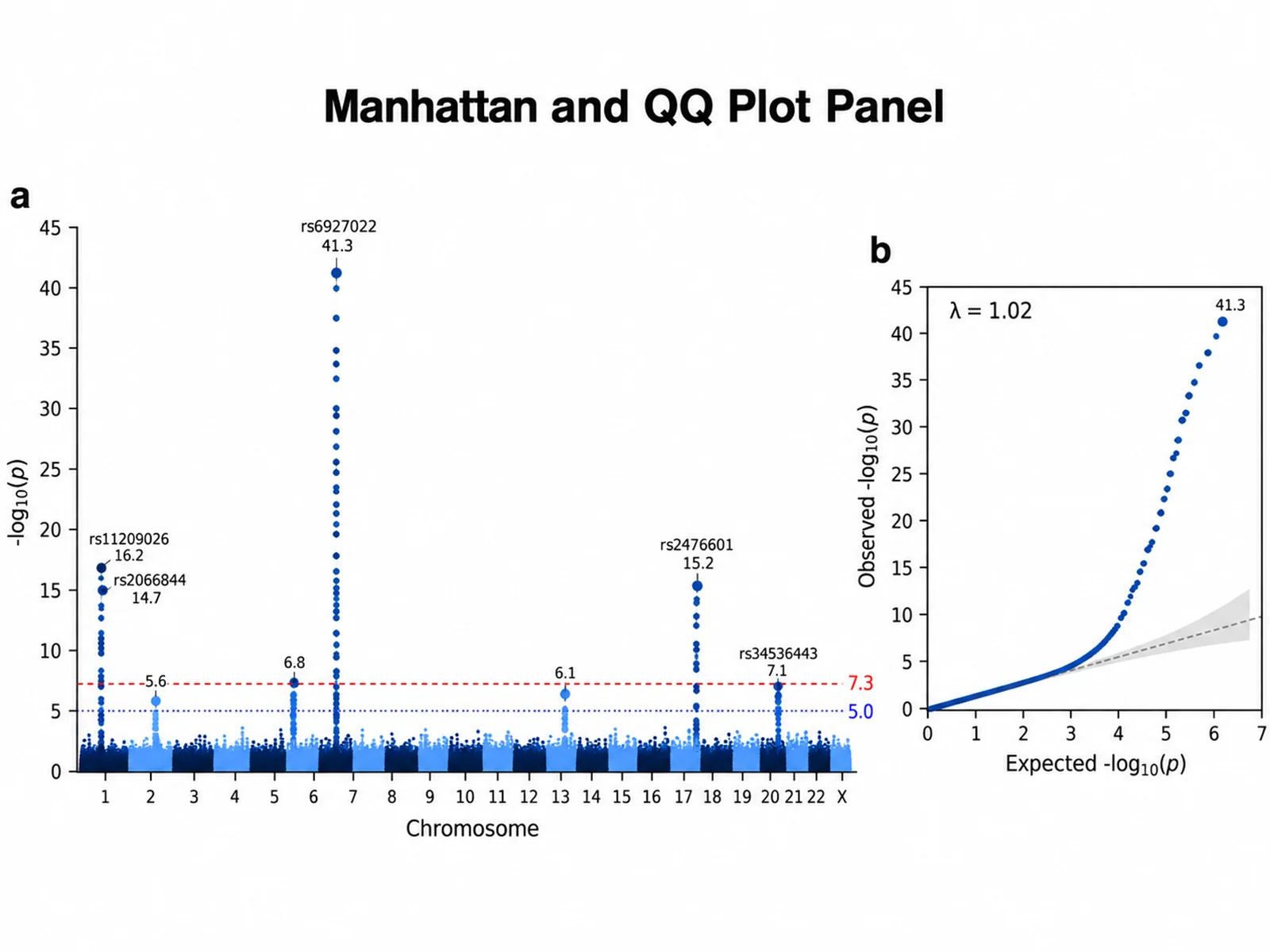
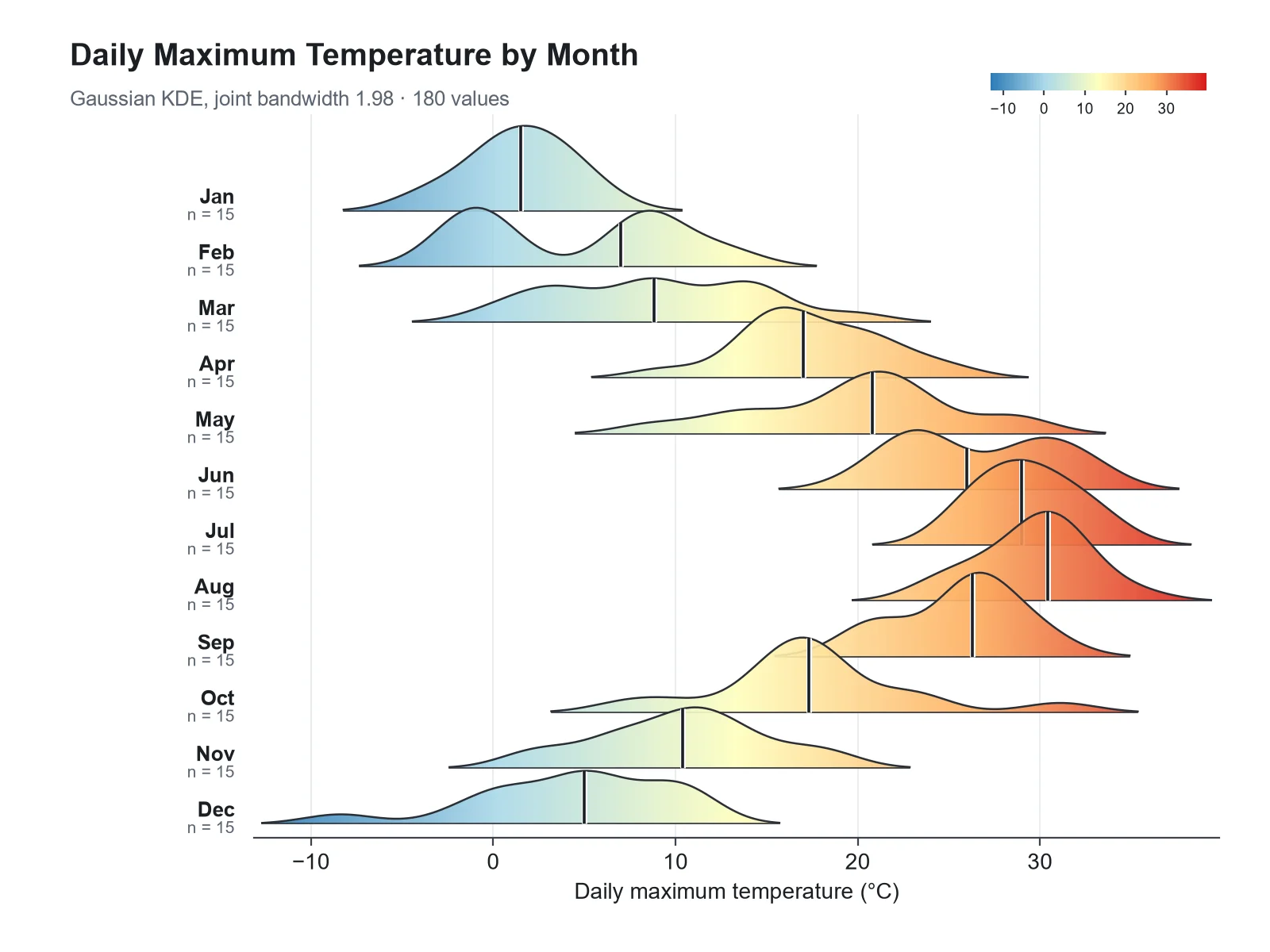
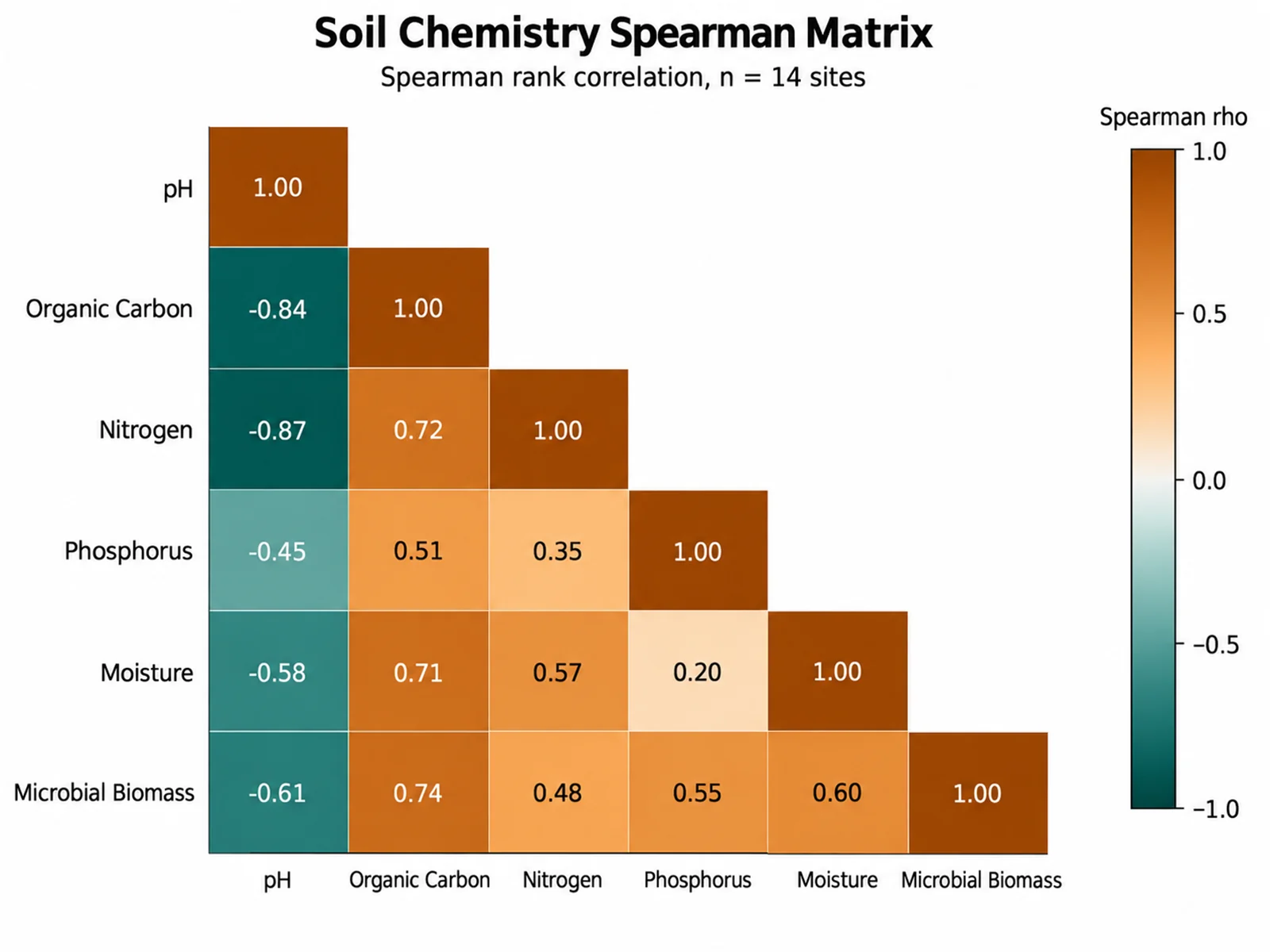
Plot fewer, larger panels. A scatter plot of two oxides with the sample groups in distinct marker shapes beats a grid of nine small Harker diagrams. For many variables at once, a lower-triangle correlation matrix or a PCA biplot shows the structure in one panel. Detrital zircon age spectra are usually shown as stacked kernel density estimates, which the ridgeline plot maker draws directly from your ages, and grain-size distributions read well as a histogram. On every geochronology result, state the uncertainty and its level (for example 2σ), n, and the MSWD where you report a weighted mean.
6. Treat field photos as figures
Every outcrop photo needs an object or bar for scale, an arrow for up or north where it matters, and a caption that says where it was taken. Trace contacts and label units on the photo itself.
7. Choose colours that survive colour blindness and a print shop
Geology inherits red-green conventions from maps, which is a problem for readers with red-green colour-vision deficiency, roughly one man in twelve in populations of European ancestry. Keep conventional unit colours, but add patterns or direct labels, and use a safe palette such as Okabe-Ito for data plots; our scientific color palettes guide and the colorblind-friendly palette reference cover the options. Run the finished poster through the colorblind simulator before you send it to print.
8. Proof at 100% and print early
View a section at 100% and step back from the screen. Export plots as PDF or SVG where you can, and check every photo and scanned map with the image DPI checker at the width it will be printed; aim for 150 DPI or more at final size. A scanned field sketch can be cleaned up and enlarged without blur in the vectorizer.
A sample layout for the 8 × 4 ft GSA board
This grid fills the full 96 × 48 in board. For a 72 × 36 in print, multiply every number by 0.75. It uses four columns, because the 2:1 board is too wide for the three-column layout most templates assume.
| Zone | Size (in) | Size (cm) | What goes there |
|---|---|---|---|
| Outer margin | 1 | 2.5 | Clear on every side |
| Title band | 94 × 7 | 239 × 18 | Finding-style title, authors, affiliations, session and poster number, QR code |
| Column 1 | 19 wide | 48 wide | Question (two or three sentences), location map with inset, geologic setting |
| Column 2 | 26 wide | 66 wide | Main map or cross-section, with A–A′ on the map |
| Column 3 | 26 wide | 66 wide | Measured sections, geochemistry or geochronology panels |
| Column 4 | 20 wide | 51 wide | Interpretation schematic, conclusions (top), implications and next steps |
| Gutters | 1 | 2.5 | Between columns and between bands |
| Footer | 94 × 1.5 | 239 × 4 | Key references, funding, acknowledgements, contact |
Widths: 1 + 19 + 1 + 26 + 1 + 26 + 1 + 20 + 1 = 96 in. Height: 1 + 7 + 1 + 35.5 (body) + 1 + 1.5 + 1 = 48 in.
Type sizes for a 96 × 48 in poster (our recommendation for reading at 1.5–2 m):
| Element | At full size | If you design at half size (48 × 24 in) |
|---|---|---|
| Title | 130–160 pt | 65–80 pt |
| Authors and affiliations | 54–66 pt | 27–33 pt |
| Section headings | 66–80 pt | 33–40 pt |
| Body text | 32–40 pt | 16–20 pt |
| Map labels, axis labels, legends | at least 26 pt | at least 13 pt |
| References and footer | 22–24 pt | 11–12 pt |
Our font guide for figures and posters covers which typefaces hold up at this size, and the scientific poster layout checklist goes through spacing and alignment in more detail.
A prompt for drafting your GSA poster
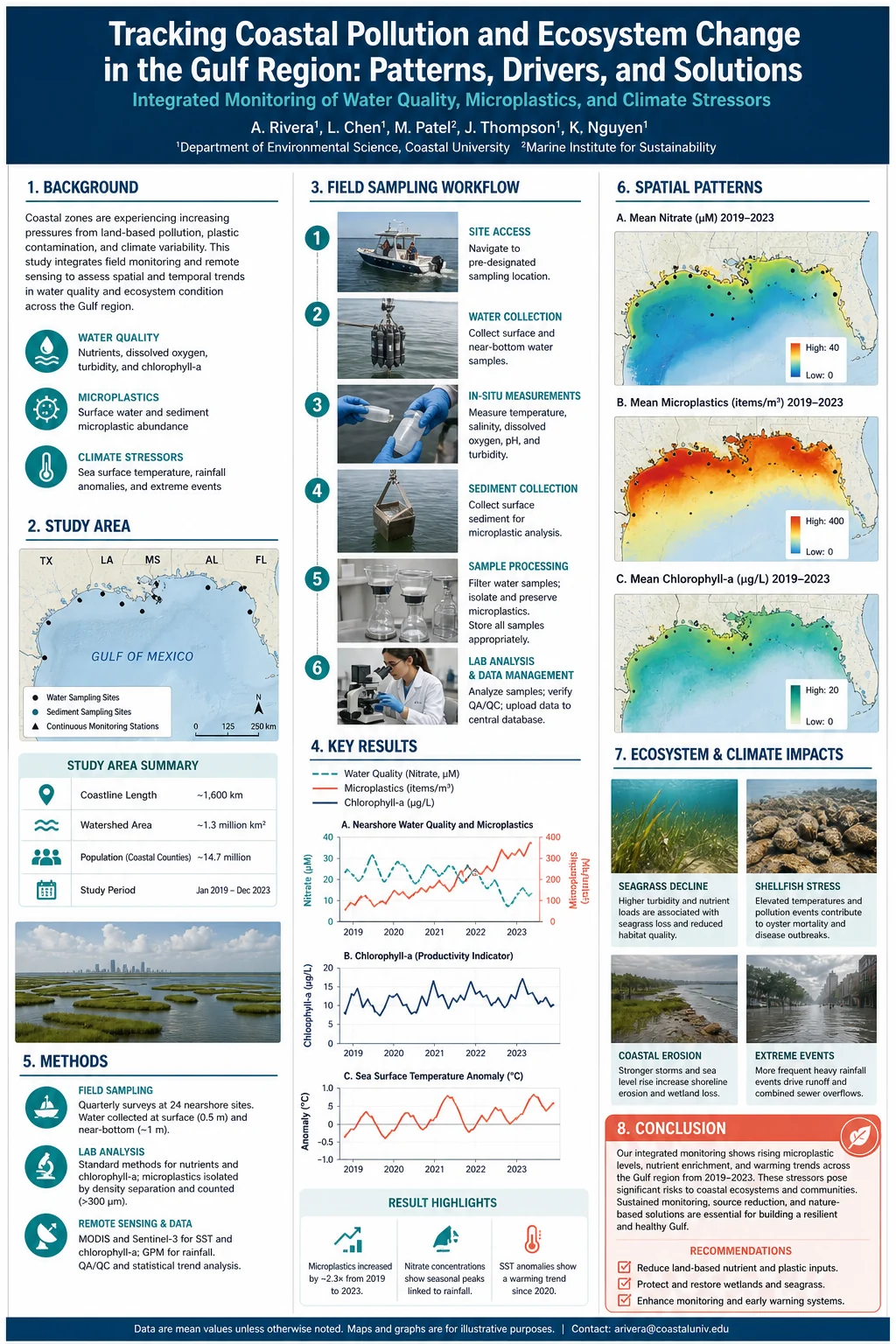
The scientific poster maker turns a description into a full poster draft, which is the fastest way to compare arrangements before you commit. Pick the 16:9 aspect ratio, the closest preset to the board's 2:1, and adapt this prompt:
Create a landscape geology conference poster for an 8 ft wide by 4 ft high board. Title band across the top: "[your finding as a sentence]", authors, affiliations, poster number and a QR code placeholder. Four columns below. Column 1: short research question, a location map with inset locator map, scale bar, north arrow and coordinate grid, then the geologic setting. Column 2: a large geologic map or cross-section A–A′ with vertical exaggeration stated. Column 3: two measured stratigraphic sections with metre scale and grain-size axis, plus one geochemistry scatter plot. Column 4: an interpretation block diagram, then three short conclusion statements. White background, dark text, colour-blind-safe palette, patterns as well as colours for rock units, large readable labels.
Use the draft to settle structure and to draw explanatory panels such as a workflow or block diagram; for those, the scientific diagram maker and the workflow diagram generator give you more control. Keep maps, sections and plots as the files you made from your own data, so every contact and value on the board is yours. If the same work is heading to a journal next, the graphical abstract maker reuses the same story in a single panel.
How to use this guide, depending on who you are
- Student with a first poster: use the at-a-glance table, the mistakes list, the steps and the sample layout as they are.
- Researcher planning for Montréal 2027: read the abstract rules first, especially the two-abstract rule, and watch for an early-action date in May.
- Adviser or lab manager: share the checklist and printing tips, and budget for a 2:1 print rather than a standard 48 × 36 in one.
GSA poster checklist before you print
- Landscape, no larger than 96 × 48 in (244 × 122 cm); 2:1 proportion if you want to fill the board.
- Title states the finding; session code and poster number in the title band.
- Location map with inset, scale bar, north arrow, coordinates, projection and datum.
- Line of section on the map; vertical exaggeration stated on every cross-section.
- Measured sections with metre scale, grain-size axis and lithology key.
- Ages with uncertainty, its level (for example 2σ), n and MSWD where relevant.
- Field photos with scale, orientation and location.
- Patterns or labels as well as colours; checked in a colour-blindness simulator.
- Every raster image at 150 DPI or more at its printed width.
- Funding, acknowledgements and contact in the footer; "No Recording" logo if you want it.
- QR code to your preprint, data or lab page, tested on two phones.
- Electricity requested by email in advance if you need it.
Printing and travel tips
- Order early. GSA's presenter pages offer no printing service, so print at home and allow at least a week.
- Ask your print shop about roll width first. A 48 in tall poster needs a roll at least 48 in wide; a 36 in tall poster is easier to find a printer for and cheaper.
- Matte, not gloss. Poster halls are lit from above, and gloss turns maps into mirrors.
- Fabric for flying. It is allowed, it folds, and it survives a carry-on.
- Pack a few pins of your own, plus QR cards for people who want to follow up.
Frequently asked questions
When and where was GSA Connects 2026?
October 11–14, 2026, in Denver, Colorado, with presentations at the Colorado Convention Center.
When and where is GSA Connects 2027?
October 17–20, 2027, in Montréal, Québec, Canada. GSA's future-meetings list then has Portland, Oregon (October 8–11, 2028) and Denver again (October 14–17, 2029).
What size is the GSA poster board?
One free-standing board 8 feet wide by 4 feet high (96 × 48 in). Your printed poster may be any size up to 4 × 8 ft (122 × 244 cm).
Is the GSA poster landscape or portrait?
Landscape. GSA's presenter page says posters must be in landscape orientation.
What was the GSA abstract deadline for 2026?
The final deadline was August 6, 2026. An Early Action deadline of May 19, 2026, gave notification of acceptance by mid-June.
How long can a GSA abstract be?
The 2026 call does not state a limit. GSA's 2024 submission guide allowed 2,050 characters, not counting spaces, with any tables fitting in the same space; the submission form enforces the current limit.
How much does it cost to submit a GSA abstract?
For 2026, $60 for GSA professional members, $25 for student members, $80 for non-member professionals and $50 for non-member students. The fee is non-refundable and separate from registration.
How many abstracts can I submit to GSA Connects?
Up to two as presenting author, if one is a poster and they cover different content. Invited abstracts to Pardee Keynote or topical sessions and abstracts for Spanish-language sessions do not count toward the limit.
When do I have to be at my GSA poster?
During your presenting window, either 9–11 a.m. or 2–4 p.m. The poster stays up from 8 a.m. to 5:30 p.m. and must be taken down at the end of the day.
Does GSA have e-posters or print posters for presenters?
No e-posters: GSA says all posters are presented in person. Its presenter pages do not mention a printing service, so bring your printed poster.
Related guides
- AGU poster guidelines: the AGU26 abstract rules, in-person and online iPoster options, and session times in San Francisco.
- ASHG poster guidelines: abstract rules, the Exhibit & Poster Hall schedule and layouts for pedigrees and GWAS plots.
- SfN Neuroscience 2026 poster guide: a 6 × 4 ft board and a three-column template.
- Biomedical meetings: the AACR, AHA Scientific Sessions and SOHO poster guides.
- How to make a scientific poster for the general principles, and colorblind-safe palettes for science figures for map and plot colours.
- Figure legend generator for captions that stand on their own.
Sources
All pages checked on November 17, 2026.
- Geological Society of America, GSA Connects 2026 home page (dates and city)
- Geological Society of America, Call for Abstracts, GSA Connects 2026 (deadlines, fees, two-abstract rule, poster board and hours)
- Geological Society of America, Presenter Info, GSA Connects 2026 (board size and orientation, presenting windows, removal, oral talks, Speaker Ready Room, recording policy, Wi-Fi)
- Geological Society of America, Future Meetings (2026–2031 dates and cities)
- Geological Society of America, GSA Connects 2026 online program (session types, Lightning Talks)
- Geological Society of America, Preparing for an Abstract Submission, GSA 2024 Annual Meeting (2,050-character limit, tables, presentation mode)
- Geological Society of America, Find Abstracts (abstract archive)