For Researchers
SOHO Annual Meeting Poster Guidelines: Abstract Deadline, 350-Word Limit, Poster Session and Layout
SOHO poster guide for the Houston hematologic oncology meeting: the 350-word abstract, May deadline, poster session and walks, and a layout for blood cancers.
 SciFigure Editorial
The Society of Hematologic Oncology (SOHO) meets every September in Houston, and its annual meeting is one of the few large conferences devoted entirely to blood cancers. It is friendly to poster presenters: there is no submission fee, accepted presenting authors get a free registration, and the best posters win cash awards. The catch is that the rules are brief and scattered, the abstract is short (350 words, no figures), and SOHO does not publish its poster board size; presenters receive their instructions only after acceptance.
This guide pulls together what SOHO has published: the abstract submission rules and deadline, the poster session and poster walks, publication and embargo, and how to lay out leukemia, lymphoma and myeloma data so they read at a crowded board. For general poster craft, start with how to make a scientific poster. Every fact is from sohoonline.org as we checked it on November 17, 2026, with each page listed in Sources. The fourteenth annual meeting, SOHO 2026, ran September 9–12, 2026, at the George R. Brown Convention Center in Houston. SOHO has opened a SOHO 2027 page but had not posted the 2027 dates or abstract deadline when we checked, so the 2026 rules below are the latest official ones.
SOHO poster and abstract rules at a glance
| Item | SOHO 2026 (latest published) | Source, checked Nov 17, 2026 |
|---|---|---|
| Dates and venue | September 9–12, 2026, George R. Brown Convention Center, Houston; hybrid (in person, virtual, on demand) | SOHO home and SOHO 2026 pages |
| Every year | Annual meeting in September in Houston | SOHO home page |
| SOHO 2027 | Dates and abstract deadline not yet posted | SOHO 2027 page |
| Abstract submission (2026) | Opened January 15; closed May 15, 2026, 11:59 p.m. CST | 2026 submission guidelines |
| Notification (2026) | On or before June 12 (guidelines); by June 15 (FAQ) | Guidelines; abstracts FAQ |
| Abstract length | 350 words or fewer in the body; title, authors, keywords and affiliations not counted | Abstract submission page |
| Figures in the abstract | None: no tables, figures, graphs or images | Abstract submission page |
| File | Online submission plus a Microsoft Word file (.doc or .docx) | 2026 submission guidelines |
| Fee | No submission fee | Abstracts FAQ |
| Membership | Presenting author must be a SOHO member (membership is free) | Abstracts FAQ |
| Registration | Free full registration for the presenting author; no travel or hotel reimbursement | Abstract submission page |
| Poster session (2026) | Wednesday, September 9, 6:55–7:55 p.m., Level 3, Hall B3, with the welcome reception | 2026 program |
| Poster walks (2026) | Three lunchtime walks by disease, September 9, 10 and 11 | 2026 program |
| Poster board size | Not published on SOHO's public pages; presenters receive guidelines after acceptance | Submission guidelines |
| Best poster awards | Eight: $2,500, $1,750, $1,000 and five of $500 | Abstract submission page |
| Publication | Abstracts in Clinical Lymphoma, Myeloma & Leukemia; option to submit a full paper | 2026 submission guidelines |
Seven mistakes that cost SOHO abstracts and posters
- Pasting a table into the abstract. SOHO allows no tables, figures, graphs or images in the abstract. Put the numbers in the text.
- Running over 350 words. The limit covers the body only, but it is strict. Phrases are acceptable in place of full sentences.
- Using trade names. The title and text may not contain trade names; use nonproprietary drug names.
- Leaving out consent and off-label use. For clinical studies, say whether informed consent was obtained, and state any off-label drug use clearly.
- Submitting the same study twice. Several versions of one study, or one abstract under more than one topic, will be rejected.
- Printing before you hear from SOHO. The board size arrives with the presenter guidelines after acceptance. Draft in a scalable layout and print once you know the size.
- Booking two categories. You cannot present abstracts from different disease categories in the poster session, because each category has its own section of the hall. Two abstracts in the same category can be placed together on request.
SOHO dates and deadlines
| Date (2026) | What happened |
|---|---|
| January 15 | Abstract submission opened |
| May 15, 11:59 p.m. CST | Abstract deadline; last day to edit or withdraw |
| June 1 | Young Investigator Scholarship applications due |
| June 12–15 | Acceptance notifications to the presenting author |
| August 31 | Embargo period ended; accepted abstracts added to the website |
| September 9–12 | SOHO 2026 in Houston; poster session on September 9 |
SOHO 2027 dates were not published when we checked. Because SOHO meets each September in Houston, and the 2026 cycle opened in mid-January and closed in mid-May, expect a similar window for 2027, and confirm on the SOHO 2027 page.
SOHO abstract submission: how it works
What SOHO wants. Original work that addresses a scientific question, shows new developments or reports original results on treating patients with hematologic malignancies. Previously published work may be used, and SOHO accepts encore abstracts, including adapted ones. Isolated case reports and hypotheses without data are discouraged.
Categories (2026). Choose one per abstract: acute lymphoblastic leukemia; acute myeloid leukemia; cellular therapy; chronic lymphocytic leukemia; chronic myeloid leukemia; Hodgkin lymphoma; aggressive B-cell lymphoma; indolent B-cell lymphoma; mantle cell lymphoma; T-cell lymphoma; myelodysplastic neoplasms; myeloproliferative neoplasms; multiple myeloma.
Structure. SOHO suggests, but does not require, structured headings: Context, Objective, Design, Setting, Patients or Other Participants, Interventions, Main Outcome Measures, Results and Conclusions. Its guidance on results is worth following on the poster too: give absolute numbers alongside relative measures, 95% confidence intervals or p-values, intention-to-treat results for randomised trials, and sensitivity and specificity for diagnostic tests.
Mechanics.
- Join SOHO (free) if the presenting author is not a member.
- Log in to the online submission system; the submitter need not be an author, and selects the first and presenting author.
- Enter the abstract and upload a Word file containing the title, authors and affiliations, and the full abstract body, following SOHO's sample format.
- Edit until the deadline; after it, no changes and no withdrawals.
English. Write in clear American English; SOHO assumes presenting authors can present and answer questions in English.
What it costs. Nothing to submit. The presenting author of an accepted abstract gets a complimentary full registration, but travel and hotel are not reimbursed; SOHO's Young Investigator Scholarship has a separate application.
The SOHO poster session and poster walks
SOHO runs one main poster session plus three poster walks. In 2026 the session and the walks were held in Hall B3 on Level 3 of the George R. Brown Convention Center:
| Event (2026) | Day | Time (Central) | Diseases |
|---|---|---|---|
| Poster Walk I | Wednesday, September 9 | 11:56 a.m.–12:56 p.m. | ALL, MDS, AML |
| Poster awards | Wednesday, September 9 | 6:30–6:45 p.m. | All categories |
| Poster session and welcome reception | Wednesday, September 9 | 6:55–7:55 p.m. | All categories, Hall B3 |
| Poster Walk II | Thursday, September 10 | 12:27–1:27 p.m. | Myeloma, MPN, CML, CLL |
| Poster Walk III | Friday, September 11 | 12:17–1:17 p.m. | Aggressive and indolent B-cell lymphoma, cellular therapy |
Everyone accepted for a poster must attend the poster session. A coauthor can stand in for the presenting author. The session is short, an hour during a reception, so your poster has to make its point in the time it takes a visitor to walk past. SOHO's exhibit hall also had electronic poster viewing stations in 2026.
Best poster awards. Eight awards: $2,500 for first place, $1,750 for second, $1,000 for third and $500 each for five honourable distinctions. Abstracts selected for oral presentation in the general sessions are also eligible.
Publication, copyright and embargo
- Journal. Accepted abstracts are published in the meeting proceedings in Clinical Lymphoma, Myeloma & Leukemia, and presenting authors are offered the option of submitting a full paper to the journal.
- Copyright. Authors keep copyright of their abstracts and presentation materials.
- Encores. SOHO allows SOHO abstracts to be presented again elsewhere. For a 2026 abstract, its FAQ gives the citation as: "© 2026 Society of Hematologic Oncology, Inc. Reused with permission. This abstract was accepted and previously presented at the 2026 SOHO Annual Meeting. All rights reserved."
- Confidentiality. Before SOHO releases the abstract, authors, sponsors and others may not make the information public, present it, or use it for securities trading. Legally required trial-registry and regulatory disclosures are exempt; for other exceptions, give SOHO at least 48 hours' notice.
- Updated data. Nothing new can be added to the abstract after submission, but updated data may go on the poster.
What size should a SOHO poster be?
SOHO does not publish its poster board dimensions on its public pages; its guidelines say oral and poster presenters receive the date, time and presentation guidelines after acceptance. Use the size in that email, and do not reuse another meeting's size without checking.
Until then, build the poster on a proportional grid so that it scales to whatever SOHO specifies:
| Zone | Share of width | Share of height | What goes there |
|---|---|---|---|
| Margins | 1.5% each side | 2% top and bottom | Clear space |
| Title band | Full width | 14% | Title, authors, affiliations, logos, category (for example "AML") |
| Left column | 28% | Body | Context, objective, design, patients, treatment schema |
| Centre column | 38% | Body | Primary endpoint (response or survival), key secondary result |
| Right column | 28% | Body | Correlatives (MRD, flow, genomics), safety, conclusions |
| Footer | Full width | 5% | References, funding, disclosures, contact, QR code |
If the board turns out to be portrait, stack the same blocks in two columns: context and methods above the primary result on the left, correlatives and conclusions on the right. Whatever the size, aim for body text of about 28–32 pt on a 4 × 6 ft poster and scale it with the page; our guide to fonts for scientific figures and posters covers typefaces, and the scientific poster layout checklist covers reading order.
Designing a hematologic malignancy poster
Name your response criteria. Hematology readers expect to see which criteria you used, and which version: for example ELN 2022 for AML, iwCLL 2018 for CLL, the Lugano classification for lymphoma and IMWG criteria for myeloma. Put the criteria in the methods and in the legend of the response figure.
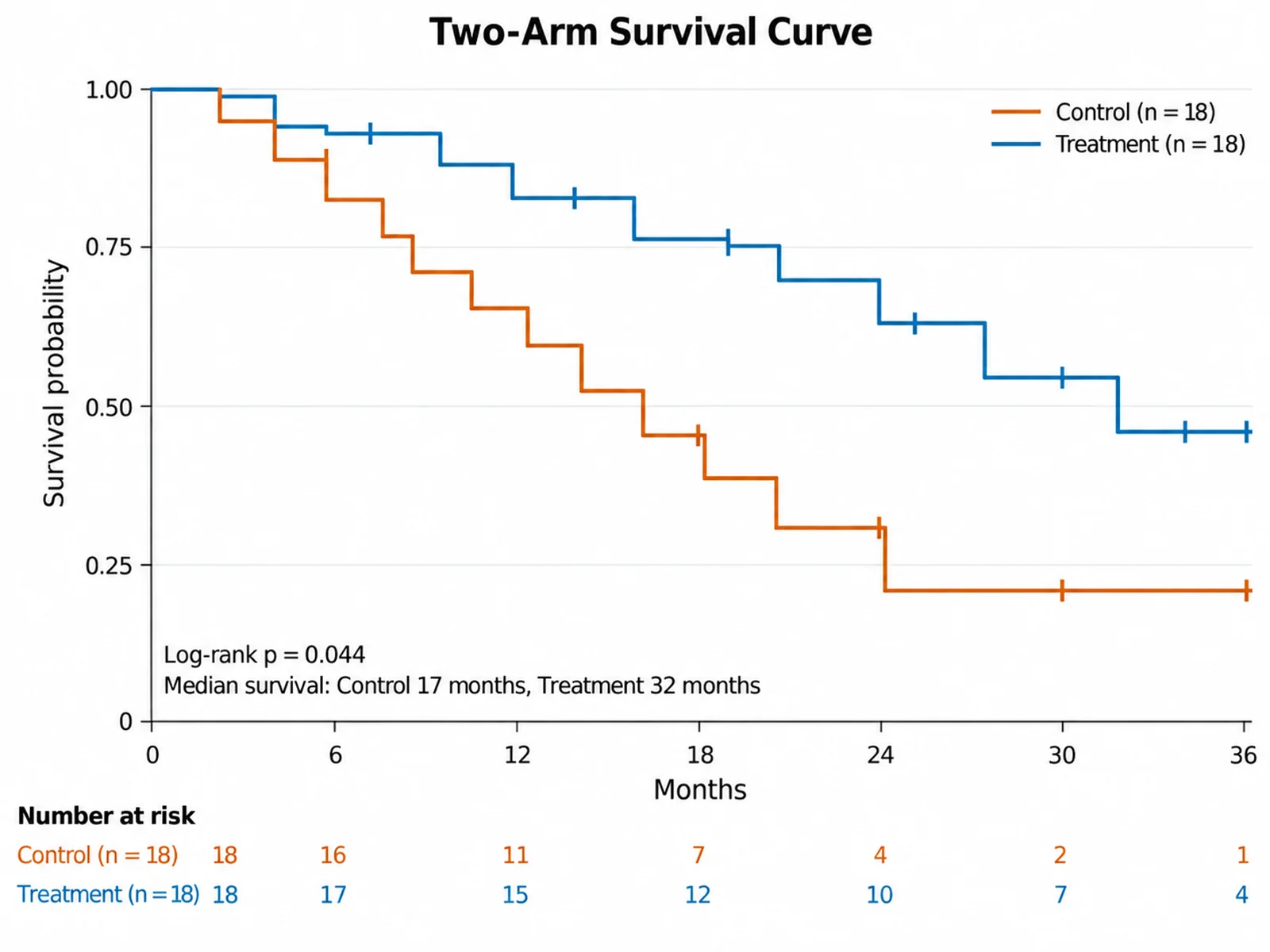
Survival with the number at risk. Progression-free and overall survival belong in Kaplan–Meier curves with censoring marks, a number-at-risk table, medians with 95% CIs and the follow-up. After transplant or cellular therapy, show relapse and non-relapse mortality as cumulative incidence with competing risks, not as one minus Kaplan–Meier. The Kaplan–Meier plot generator builds the curves and the risk table together.
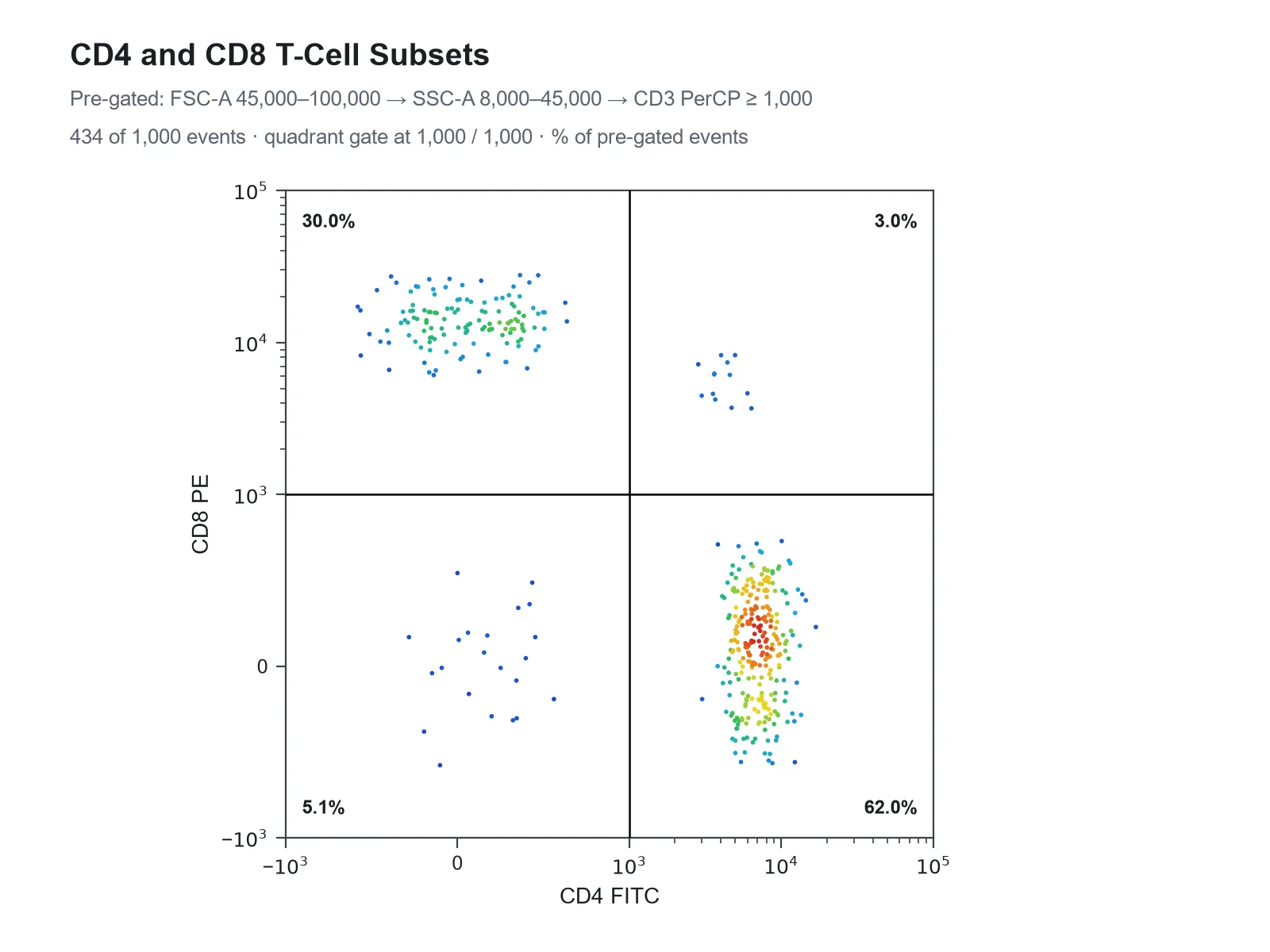
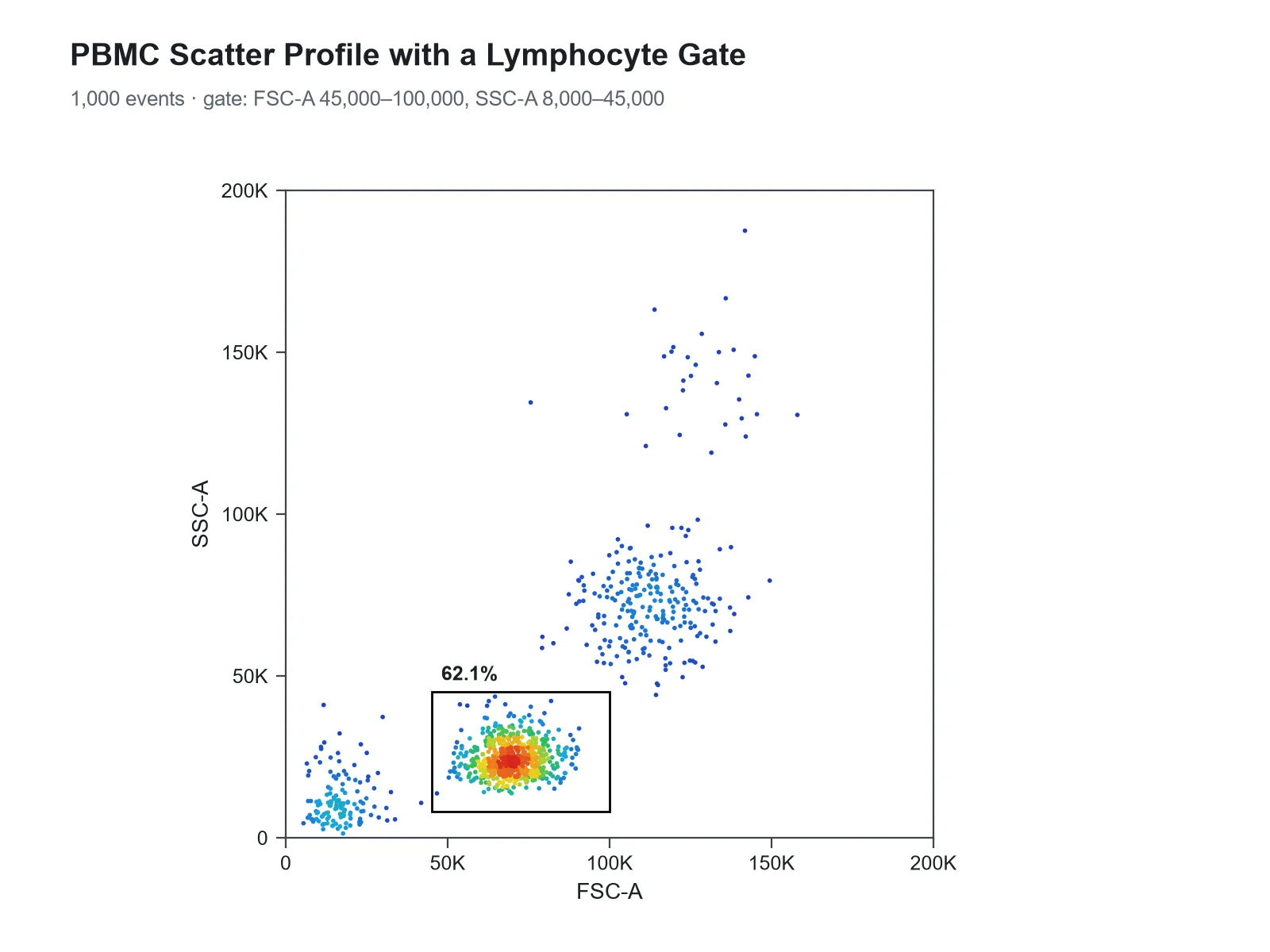
Show the gating path for flow cytometry. Immunophenotyping, CAR-T expansion and MRD by flow are central to SOHO posters. Show how you got to the population you report: the scatter gate, then the marker plot, with marker and fluorochrome on each axis and the percentage of the parent gate in each quadrant. Our flow cytometry plot generator draws gated dot plots and histograms from your event data.
MRD needs its method and sensitivity. State the assay (multiparameter flow, NGS or PCR), its sensitivity (for example 10⁻⁵), the sample (marrow or blood) and the timepoint. A response table without MRD sensitivity is the first thing a hematologist will ask about.
Grade toxicity by the right scale. Adverse events go by CTCAE grade with the version stated; cytokine release syndrome and ICANS after CAR-T go by ASTCT consensus grading. A stacked bar of events by grade, one bar per arm, reads faster than a table at poster distance.
Duration of response. A swimmer plot (one horizontal bar per patient, with markers for response, progression and ongoing treatment) is the standard way to show durability in small cohorts. Sort the bars by duration and use one marker style per event.
Genomics. Mutation and expression patterns across patients read best as a clustered heatmap with annotation tracks for risk group and response; our heatmap guide covers ordering and colour scales. For two-group comparisons, a volcano plot with thresholds stated works.
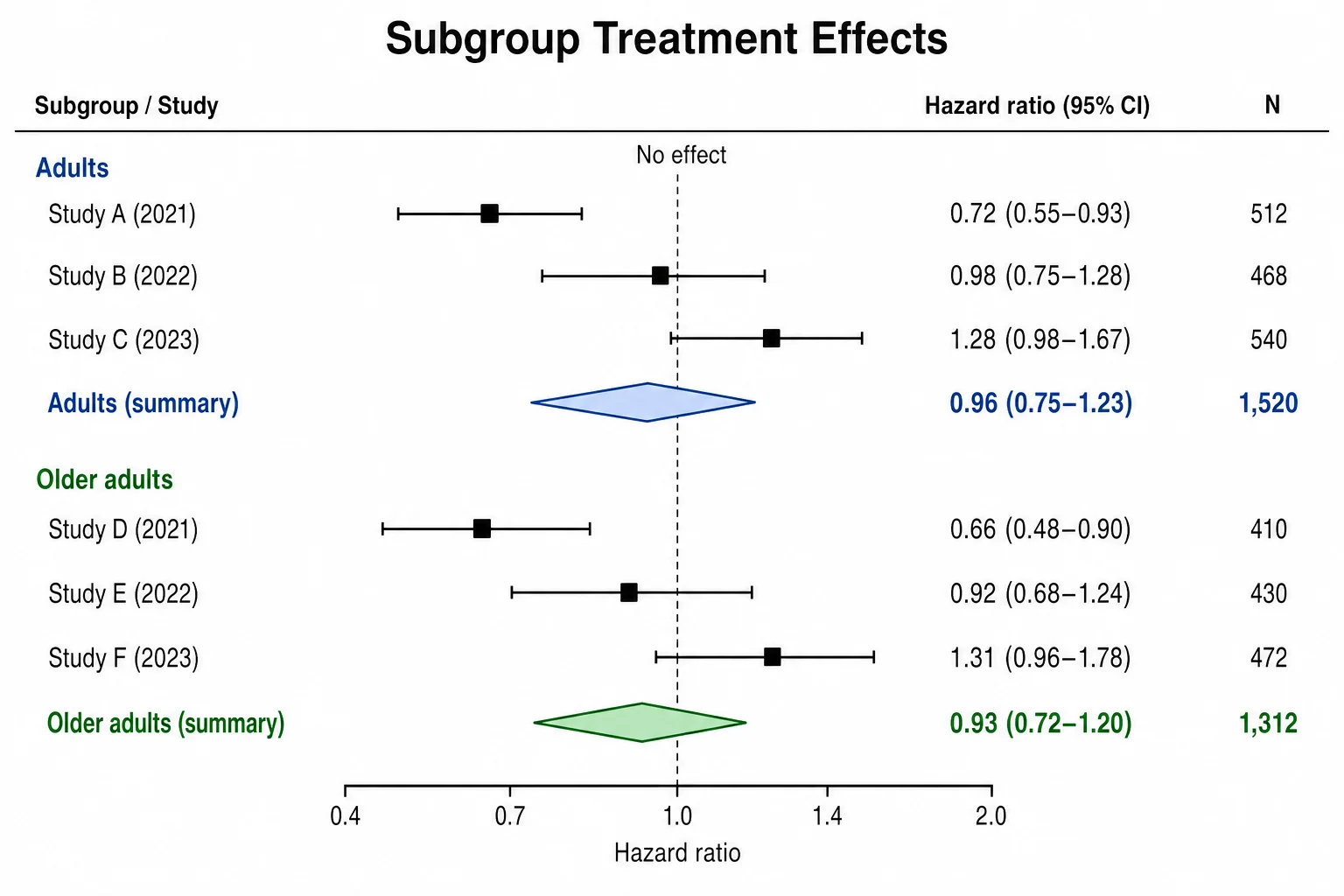
Subgroups as a forest plot. Cytogenetic risk, age group, prior lines and TP53 status are typical subgroups. Show them in a forest plot with patient numbers and the hazard ratio and 95% CI beside each line; see our forest plot guide.
Lab values. Counts and biomarker levels by group read well as a box and whisker plot with the individual points shown, and units on the axis (for example ×10⁹/L).
Morphology and imaging. Marrow aspirates, biopsies and smears need the stain, the magnification and a scale bar; PET images need the timepoint and the Deauville score where relevant. Check each image at its printed size with the image DPI checker.
Colour. Keep one colour per arm or cohort on every plot, choose it from the colorblind-friendly palette, and check the finished poster in the colorblind simulator. Our scientific color palettes guide explains when to use sequential, diverging and categorical scales.
How to build your SOHO poster step by step
1. Read the acceptance email first
SOHO sends accepted presenters their session details and presentation guidelines. Take the poster size from them, and if it is missing, ask SOHO (admin@sohoonline.org) before you print. Note the category you were accepted in.
2. Set up a proportional grid
Use the shares in the table above at your expected size, so you can resize the page without re-laying out every block.
3. Write a title that states the finding
Keep the accepted abstract title on the poster; if it is descriptive, add a one-line takeaway under it, such as "Drug X plus azacitidine: 68% MRD-negative CR in older adults with AML" (with your own numbers).
4. Make the primary endpoint the largest figure
A response bar chart, Kaplan–Meier curve or MRD figure in the centre column, at least a quarter of the poster area.
5. Add the correlatives and safety
Flow gating, MRD, genomics, then the toxicity summary by grade.
6. Check text size, colour and image resolution
Body text 28–32 pt at 4 × 6 ft, colour-blind-safe colours, every image checked at print size.
7. Print and pack
Matte paper or fabric; a fabric print folds into a suitcase for the flight to Houston.
A prompt you can adapt for a first draft
SOHO has not published a policy on AI tools. If you use one to draft a layout, say so if asked, rebuild every chart from your own data, and check every label.
Landscape scientific poster for the SOHO annual meeting (hematologic oncology).
Title band: "Drug X plus azacitidine in older adults with AML: response and
MRD in a real-world cohort", authors, affiliations, category tag "AML".
Left column: context, objective, design, patients (n = 120), treatment schema.
Centre: large bar chart of response by ELN 2022 criteria, then a Kaplan–Meier
overall survival curve with number at risk and median (95% CI).
Right: MRD by multiparameter flow (sensitivity 10^-4) with a gating example,
adverse events by CTCAE grade as stacked bars, conclusions.
Footer: references, funding, disclosures, QR code. Sans-serif, body 30 pt,
white background, colour-blind-safe palette, one colour per cohort.
Paste it into the scientific poster maker for a starting layout, then replace each chart with one built from your data in the Kaplan–Meier plot generator, the flow cytometry plot generator and the bar chart generator, and write the legends with the figure legend generator.
SOHO poster checklist
- Size and format taken from SOHO's presenter guidelines (or confirmed with SOHO), not guessed.
- Accepted title, authors and category on the poster; updated data allowed.
- Takeaway line under the title if the title is descriptive.
- Response criteria and version named; MRD assay and sensitivity stated.
- Kaplan–Meier curves with number at risk, medians and 95% CIs; competing risks handled properly after transplant or cellular therapy.
- Flow plots with markers, fluorochromes and the gating path.
- Adverse events by CTCAE grade; CRS and ICANS by ASTCT grading.
- Generic drug names; off-label use and informed consent stated.
- Images with stain, magnification and scale bar, checked at print size.
- Colour-blind-safe colours, consistent per cohort.
- Presenter (or a coauthor) at the board for the poster session; diseases' poster walk noted in your calendar.
Frequently asked questions
When is SOHO 2026?
The fourteenth SOHO annual meeting took place September 9–12, 2026, at the George R. Brown Convention Center in Houston, Texas, as a hybrid meeting with in-person, virtual and on-demand participation.
What was the SOHO 2026 abstract deadline?
May 15, 2026, at 11:59 p.m. CST. Submission opened on January 15, 2026, and no edits or withdrawals were possible after the deadline.
When is SOHO 2027, and when is its abstract deadline?
SOHO had not posted the 2027 dates or deadline when we checked on November 17, 2026. SOHO meets every September in Houston, and in 2026 abstracts were accepted from mid-January to mid-May.
How long can a SOHO abstract be?
350 words or fewer in the body. The title, authors, keywords and affiliations are not counted. Tables, figures, graphs and images are not allowed.
Is there a fee to submit an abstract to SOHO?
No. The presenting author must be a SOHO member, but membership is free, and an accepted presenting author receives a complimentary registration.
Does SOHO accept encore abstracts?
Yes, including adapted encores. SOHO also lets you present your SOHO abstract again at other meetings with its standard citation.
What size is the SOHO poster board?
SOHO does not publish its board size on its public pages. Accepted presenters receive presentation guidelines with the session details; use the size given there, or ask SOHO before printing if it is not stated.
When is the SOHO poster session?
In 2026, the poster session ran on Wednesday, September 9, from 6:55 to 7:55 p.m., with the welcome reception, after the poster awards. Lunchtime poster walks by disease ran on September 9, 10 and 11.
Where are SOHO abstracts published?
In the meeting proceedings in Clinical Lymphoma, Myeloma & Leukemia. SOHO also adds accepted abstracts to its website after the embargo period, which ended on August 31 in 2026.
Can I present two posters at SOHO?
Only if both are in the same disease category, in which case SOHO can place them together on request. Abstracts in different categories sit in different sections of the poster hall.
Related guides
- ASH annual meeting poster guidelines: the other big hematology meeting, with print-on-upload posters.
- AACR Annual Meeting poster guidelines: board size, e-poster and oncology figure conventions.
- AHA Scientific Sessions poster guidelines: moderated digital posters and the ePoster.
- ASHG poster guidelines for genetics and genomics work.
- How to make a scientific poster and the scientific poster layout checklist.
Sources
All pages checked on November 17, 2026.
- Society of Hematologic Oncology, SOHO home page (annual meeting every September in Houston; SOHO 2026 dates, venue and hybrid format)
- Society of Hematologic Oncology, SOHO 2026 meeting page (venue, hotel, electronic poster viewing)
- Society of Hematologic Oncology, SOHO 2026 Abstract Submission (350-word limit, no figures, deadline, awards, registration)
- Society of Hematologic Oncology, SOHO 2026 Submission Guidelines (PDF) (timeline, categories, structure, general rules, poster session date, publication)
- Society of Hematologic Oncology, Abstracts: Frequently Asked Questions (encores, fee, membership, copyright, embargo date, multiple posters)
- Society of Hematologic Oncology, Confidentiality and Embargo Policies (PDF)
- Society of Hematologic Oncology, SOHO 2026 Program (PDF) (poster session, awards and poster walk times)
- Society of Hematologic Oncology, SOHO 2027 page (no 2027 dates posted yet)