For Researchers
ASHG Poster Guidelines: Abstract Rules, Deadlines and Layouts for Human Genetics Posters
ASHG poster and abstract guide: the 2026 Montréal poster hall schedule, abstract deadline and scoring rubric, character limits, fees, and layouts for genetics.
 SciFigure Editorial
The ASHG 2026 Annual Meeting, the American Society of Human Genetics' yearly conference, ran October 20–24, 2026, at the Palais des Congrès de Montréal. The next one, ASHG 2027, is listed for October 26–30, 2027, in Nashville, Tennessee. Most people who present at ASHG present a poster: ASHG's own scoring rubric expects about 80% of submitted abstracts to become posters. This guide collects what ASHG publishes about abstracts, the poster hall and presenters, and then covers what it does not: how to lay out pedigrees, variant tables, Manhattan plots and expression data so they work on a poster board.
A note on sources. ASHG's meeting site has already switched to 2027, and several 2026 presenter pages have been taken down. Everything below comes from official ASHG pages and documents that were still online when we checked on November 17, 2026: the 2026 exhibitor FAQ, the 2026 abstract scoring rubric, ASHG's events calendar and the ASHG 2025 abstract and session pages. Where a 2026 figure is not available, we give the most recent official one with its year, and we say plainly where we could not verify something.
ASHG poster and abstract rules at a glance
| Item | What ASHG published |
|---|---|
| ASHG 2026 dates and venue | October 20–24, 2026, Palais des Congrès de Montréal (Montreal Convention Centre) |
| Exhibit & Poster Hall | Hall 220, level 2; open Wednesday October 21 to Friday October 23, 9:30 a.m.–4:30 p.m. (Thursday until 6:15 p.m.) |
| Poster sessions | Poster presentations closed out each hall day; Thursday's Exhibit Hall Special Event and Poster Session ran 4:15–6:15 p.m. |
| How long a poster hangs | One day only, with a new set of posters each day (ASHG 2025 session rules) |
| Poster board | 8 ft wide × 4 ft high, landscape; recommended print 72 × 36 in (183 × 91 cm) |
| Printing on site | None: the convention centre had no business or print centre in 2026, and ASHG recommends no printer |
| Wi-Fi | None in the Exhibit & Poster Hall; basic Wi-Fi in the main halls and session rooms |
| Registration | Every poster presenter needs a full scientific registration, or the presentation slot is forfeited |
| Abstract deadline (2026) | May 18, 2026 |
| Abstract length (latest published, 2025) | Title up to 200 characters, body up to 2,500 characters, both including spaces |
| Abstract fee (2025) | Free for ASHG members; $75 for non-members; free for residents of low-income and lower-middle-income countries |
| Likely outcome (2026 rubric) | About 80% poster, 10% Reviewers' Choice poster or Lightning Talk, 8% platform, 0.5% plenary |
| Next meeting | ASHG 2027, October 26–30, 2027, Nashville, Tennessee |
Mistakes that cost ASHG abstracts and posters
- An abstract that reads like an advertisement. ASHG's rubric gives the lowest score, an automatic decline, to abstracts that promote a technology, software or company with insufficient data.
- Results that were already published. ASHG counts work as previously published if it was accepted for peer-reviewed publication, or for an oral presentation at another conference, by the May 18 deadline. A preprint does not count as published.
- Figures, tables or links in the abstract body. ASHG's 2025 form did not allow references, figures (tables, images, graphs) or URLs in the abstract text, and it asked for no identifying author or institution details because review is blind.
- A QR code that needs the internet. There was no Wi-Fi in the 2026 Exhibit & Poster Hall. Point QR codes at pages that load fast on mobile data, or print the key supplementary figure instead.
- Planning to print in Montréal. The convention centre had no print centre in 2026. Print before you travel.
- Not registering. A presenter without a full scientific registration loses the slot. An exhibitor badge cannot be used to present a poster.
- Genetics figures that skip the conventions. A Manhattan plot with no significance line, a pedigree with non-standard symbols or a variant named without its transcript makes geneticists stop reading.
ASHG abstract deadline and timeline
The 2026 rubric fixes the 2026 submission deadline at May 18, 2026. ASHG's 2025 instructions, the most recent full timeline still online, show how the rest of the cycle runs.
| Step | ASHG 2026 | ASHG 2025 (for comparison) |
|---|---|---|
| Abstract submission deadline | May 18, 2026 | Edits allowed until June 10, 2025, 5:00 p.m. US Eastern |
| Review | Not published on pages still online | June 10 to July 31, 2025 |
| Acceptance notices | Not published on pages still online | Early August 2025 |
| Abstracts published online | Not published on pages still online | Mid-September 2025 |
| Withdrawal deadline | Not published on pages still online | September 9, 2025, 5:00 p.m. US Eastern (no refunds) |
| Meeting | October 20–24, 2026, Montréal | October 14–18, 2025, Boston |
ASHG abstracts for 2027. ASHG's events calendar lists the 2027 meeting for October 26–30, 2027, and its 2027 site said registration was "coming soon" when we checked. No 2027 abstract deadline had been published. The 2026 deadline fell in mid-May, so plan to have your results ready by spring, and confirm the date on ashgmeeting.ashg.org once the call opens.
ASHG abstract submission rules (latest published: 2025)
ASHG's 2025 step-by-step instructions are the most recent complete rules on ashg.org. Check the 2027 call for changes.
- Title: up to 200 characters including spaces, in sentence case.
- Body: up to 2,500 characters including spaces.
- Not allowed in the body: references, figures (tables, images, graphs) and URLs, and anything that identifies authors or institutions.
- Authors: up to 30, plus any groups or consortia. The presenter must be the first author; a group cannot be the sole or first author; co-first and co-last authors are not permitted.
- One first-author abstract: a presenting author cannot be the first author of another submitted abstract.
- Fees (2025): $0 for ASHG members, $75 for non-members. Free for residents of World Bank low-income and lower-middle-income countries, and for non-member NIH employees using an nih.gov address.
- Other fields: one topic, up to five keywords in order of importance, a curated itinerary theme, a primary audience, and one learning objective that starts with a measurable verb ("understand", "learn" and "know" are not accepted).
How ASHG scores abstracts (2026 rubric)
Reviewers score each abstract from 1 to 9 on impact and quality, and the score decides the format.
| Score | Outcome | Expected share | What the rubric looks for |
|---|---|---|---|
| 1 | Decline | 0.5% | Advertisement for a product or company |
| 2–3 | Decline | 1% | Flawed or unclear methods, immature results, not human genetics |
| 4–5 | Poster | 80% | Sound methods; results published, or unpublished but incremental |
| 6 | Reviewers' Choice poster or Lightning Talk | 10% | Unpublished, somewhat mature results that advance the field |
| 7–8 | Platform talk | 8% | Unpublished, mature results of broad interest |
| 9 | Plenary | 0.5% | Exceptionally mature results, a top advance in the field |
Novelty and maturity of the results drive most of the score. The part you control when writing is organization: the rubric rewards an abstract with a clearly outlined hypothesis, methods and results, and the same structure is what makes the poster work.
How the ASHG poster hall works
- Where and when (2026). The Exhibit & Poster Hall was Hall 220, on level 2 of the Palais des Congrès, just outside registration. It was open Wednesday to Friday, 9:30 a.m.–4:30 p.m., with Thursday extended to 6:15 p.m. for a new Exhibit Hall Special Event and Poster Session from 4:15 to 6:15 p.m. ASHG scheduled poster presentations at the end of each hall day.
- One day per poster. ASHG's 2025 session rules say each poster is displayed for one day only, and the presenter is available at it during that day's poster session.
- Reviewers' Choice and Lightning Talks. The top 10% of posters receive a Reviewers' Choice designation. In 2025 ASHG introduced Lightning Talks for top-scoring poster abstracts: a 3-minute talk followed by 2 minutes of questions.
- The program and mobile app in 2026 showed general schedule information to anyone, but saving a schedule and the interactive features needed a scientific registration.
Poster, Lightning Talk, platform or plenary
| Poster | Lightning Talk | Platform | Plenary | |
|---|---|---|---|---|
| Rubric score (2026) | 4–5 (or 6 for Reviewers' Choice) | 6 | 7–8 | 9 |
| Expected share (2026) | 80% (+10% Reviewers' Choice) | Within the 10% | 8% | 0.5% |
| Length (2025) | One day on the board | 3 min + 2 min Q&A | 10 min + 5 min Q&A | 13 min + 5 min Q&A |
| How many (2025) | More than 3,000 posters | Top-scoring poster abstracts | 248 abstracts | 15 abstracts |
ASHG poster board size
ASHG poster boards are 8 ft wide by 4 ft high, in landscape, and the recommended print is 72 × 36 in (183 × 91 cm), which leaves room for pins on every side of the board. Design at that size from the start rather than scaling a portrait template.
Two practical consequences hold whatever the exact board: plan a landscape layout, and make it readable from 1.5–2 m, because the ASHG hall is busy and visitors scan from the aisle.
How to design an ASHG poster, step by step
1. Lead with the finding and the cohort
Write the title as the result ("Rare GENE1 loss-of-function variants double the risk of early-onset X in 48,000 exomes"), not the topic. Under it, a cohort strip gives the numbers every geneticist looks for first: sample size, cases and controls, ancestry groups, sequencing or genotyping platform, and the genome build (for example GRCh38).
2. Make the Manhattan plot readable from the aisle
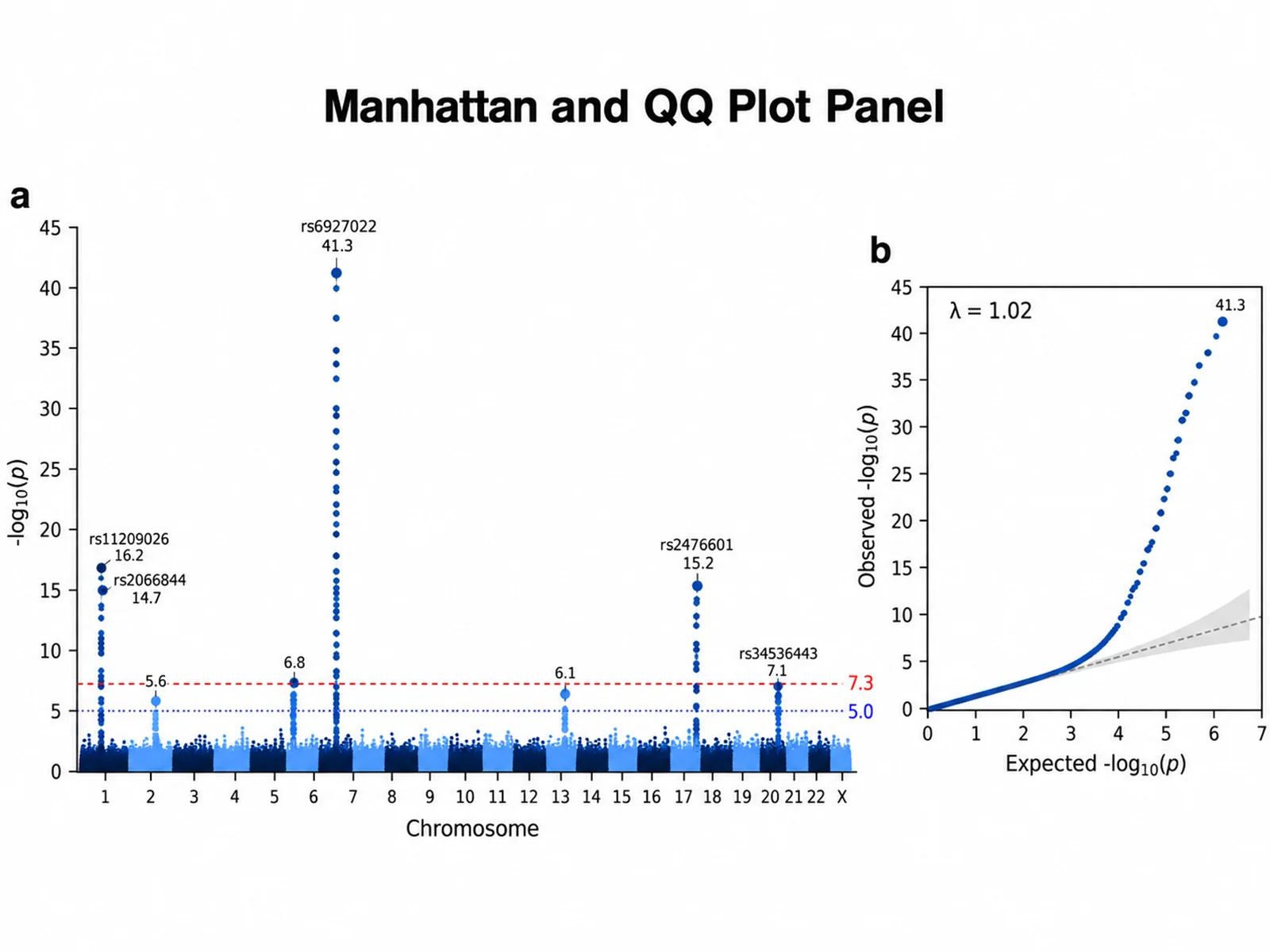
Give the genome-wide plot the full width of a column. Draw the genome-wide significance line at P = 5 × 10⁻⁸ (−log₁₀ P ≈ 7.3), alternate two tones by chromosome, and label only the lead variants with the rsID and the nearest gene in italics. Put the QQ plot beside it with the genomic inflation factor (λ). The Manhattan plot generator draws both panels from your summary statistics, with threshold lines and labels you control.
3. Show effect sizes, not just P values
A forest plot of odds ratios or betas with 95% confidence intervals, split by cohort or ancestry, answers "how big, and does it replicate?" in one glance. The forest plot generator and our guide on how to make a forest plot cover the layout. Population structure is usually shown as a PCA plot of the first two principal components coloured by ancestry group.
4. Draw pedigrees with standard symbols
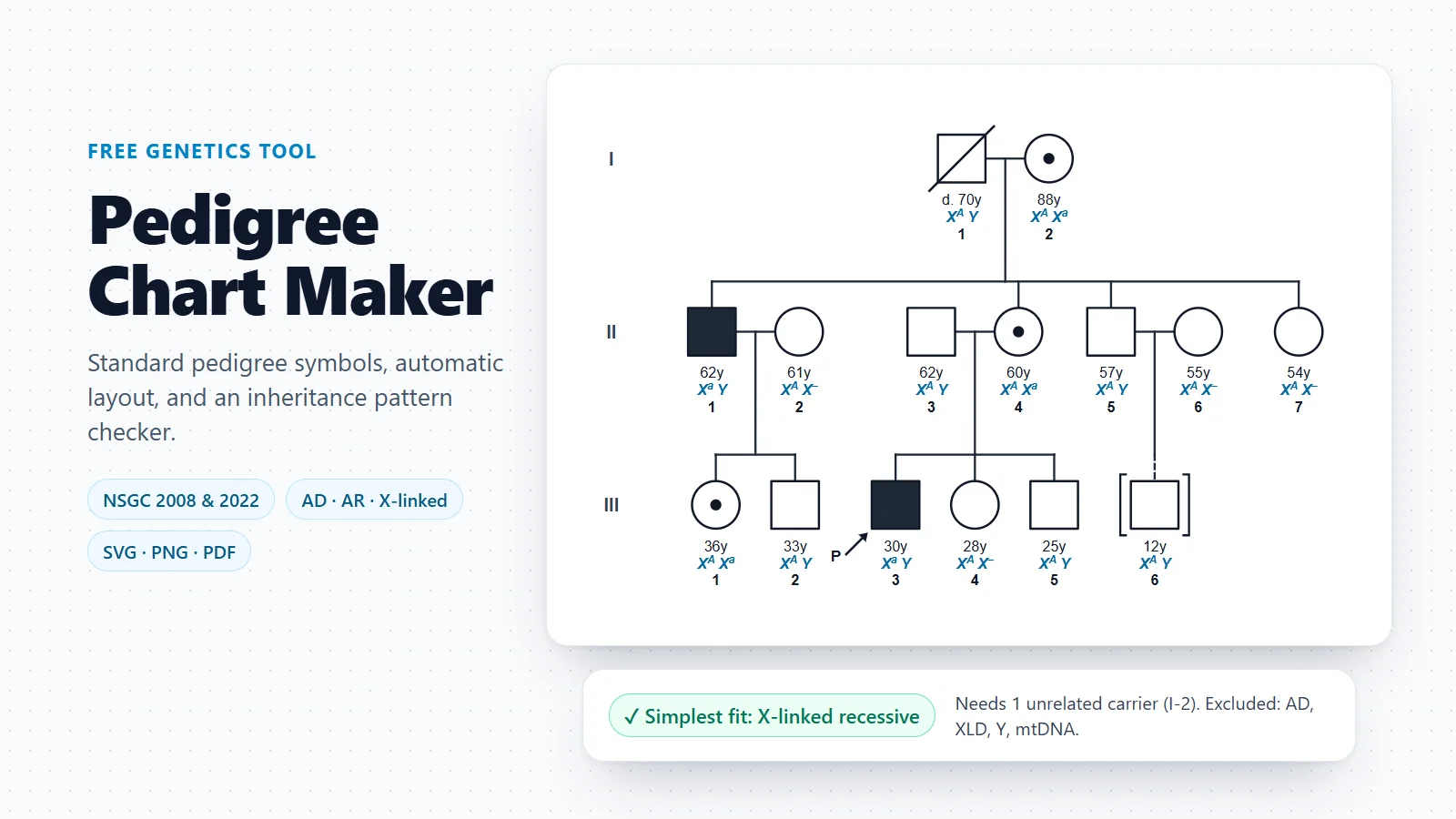
Use the standardized human pedigree nomenclature from the National Society of Genetic Counselors: squares and circles, filled for affected individuals, a dot for carriers where you show them, a diagonal line for deceased individuals, Roman numerals for generations and an arrow for the proband. Keep only the detail the argument needs; exact ages and birth order can identify a family, so follow the consent your study holds. The pedigree chart maker lays out multi-generation families with standard symbols, checks which inheritance patterns fit, and exports SVG or PDF that stays sharp at poster size.
5. Name variants so other geneticists can look them up
Give each variant in HGVS nomenclature with its reference transcript and version (for example NM_ identifier, c. and p. notation), the genome build, and the classification terms from the ACMG/AMP framework (pathogenic, likely pathogenic, uncertain significance, likely benign, benign). A small variant table usually reads better than a lollipop plot crowded with labels. Gene symbols go in italics.
6. Summarize overlaps and expression without a five-way Venn
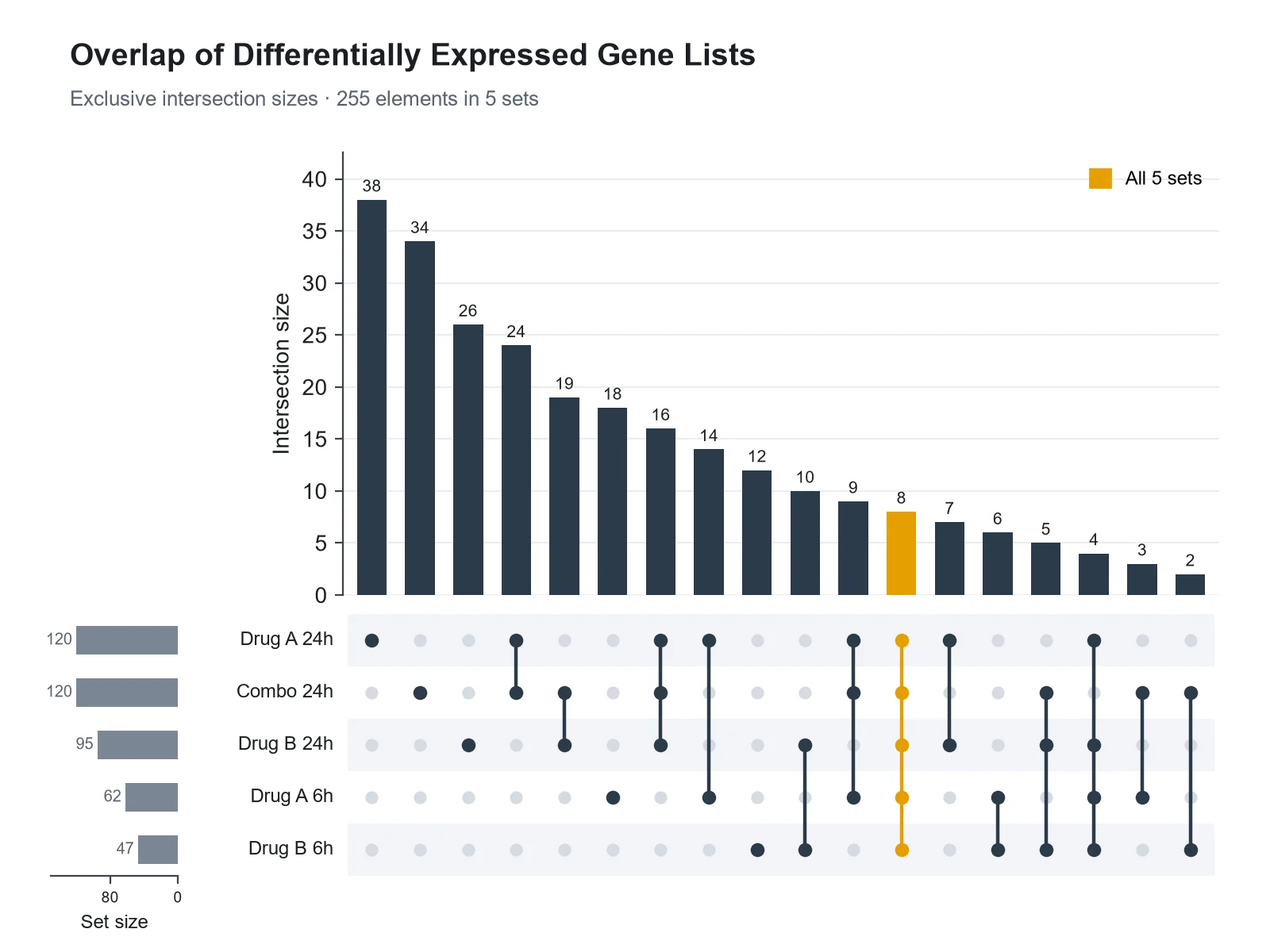
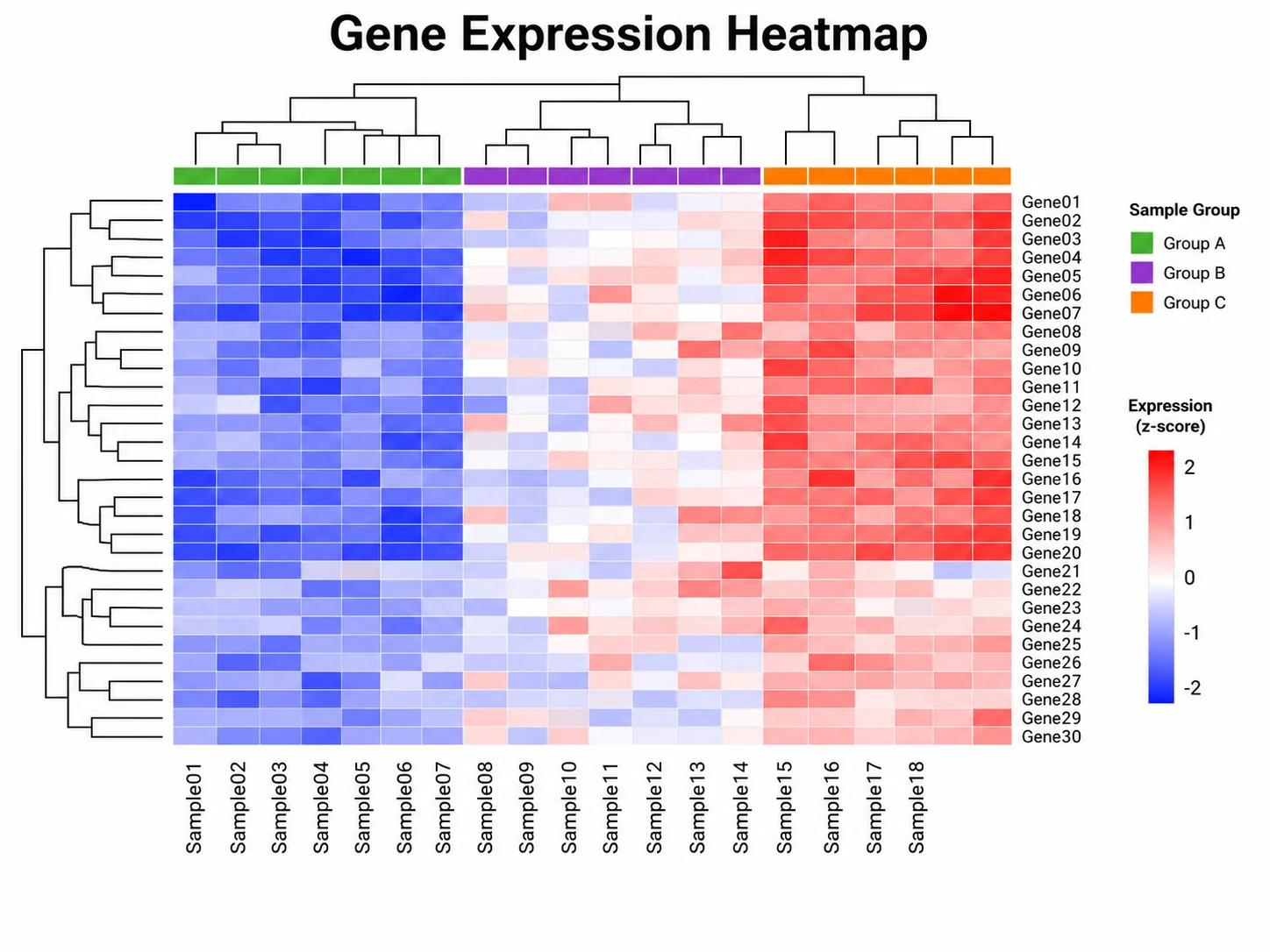
For overlaps between gene or variant sets across cohorts, tissues or methods, an UpSet plot reads more clearly than a Venn diagram with more than three circles; the UpSet plot generator builds one from your lists. Expression or methylation results fit a clustered heatmap with a labelled z-score scale and annotated sample groups, and differential results fit a volcano plot with thresholds stated in the caption.
7. Choose colours that survive colour blindness
Red-green heat maps are still common in genomics, and they fail for many readers with colour-vision deficiency. Use a blue-white-red diverging scale for z-scores, Okabe-Ito colours for groups (see our Okabe-Ito hex codes), and check the finished poster with the colorblind simulator.
8. Proof at size, then print at home
Export plots as PDF or SVG. For any raster panel (microscopy, gel images, screenshots of genome browsers) check the effective resolution at its printed width with the image DPI checker; aim for at least 150 DPI at final size. Then print before you travel: there was no print centre at the 2026 venue.
A sample layout for a 72 × 36 in ASHG poster
This grid uses the recommended landscape 72 × 36 in print.
| Zone | Size (in) | Size (cm) | What goes there |
|---|---|---|---|
| Outer margin | 1 | 2.5 | Clear on every side |
| Title band | 70 × 5.5 | 178 × 14 | Finding-style title, authors, affiliations, poster number, QR code |
| Left column | 18 wide | 46 wide | Question, cohort strip (n, ancestry, platform, genome build), methods workflow |
| Centre column | 32 wide | 81 wide | Manhattan and QQ plots on top; forest plot or pedigree below |
| Right column | 18 wide | 46 wide | Variant table, functional or expression panel, conclusions at the top |
| Gutters | 1 | 2.5 | Between columns and bands |
| Footer | 70 × 1.5 | 178 × 4 | References, funding, consent and data-access statement, contact |
Widths: 1 + 18 + 1 + 32 + 1 + 18 + 1 = 72 in. Height: 1 + 5.5 + 1 + 25 (body) + 1 + 1.5 + 1 = 36 in.
Type sizes at 72 × 36 in: title 100–120 pt, authors 44–54 pt, headings 54–64 pt, body 28–34 pt, axis labels and variant tables at least 22 pt, references 18–20 pt. Our font guide for figures and posters lists typefaces that hold up at that size, and the scientific poster layout checklist covers spacing and alignment.
A prompt for drafting an ASHG poster
The scientific poster maker turns a description into a full poster draft, which is useful for testing arrangements before you build the final file. Choose the 16:9 aspect ratio, the closest preset to a 2:1 landscape print, and adapt this prompt:
Create a landscape human genetics conference poster, 72 by 36 inches. Title band: "[your finding as one sentence]", authors, affiliations, poster number and a QR code placeholder. Three columns. Left: research question, a cohort summary strip (sample size, ancestry groups, platform, GRCh38) and a methods workflow. Centre (widest): a Manhattan plot with a genome-wide significance line and labelled lead variants, a QQ plot beside it, and a forest plot of effect sizes by cohort below. Right: three conclusion statements at the top, a variant table with HGVS names and ACMG classifications, and a small expression heatmap. White background, colour-blind-safe palette, italic gene symbols, large readable labels.
Use the draft for structure and for explanatory panels such as the study workflow, which the workflow diagram generator can also draw. Keep every plot as the file you made from your own data, so each P value, effect size and genotype on the board is yours. For the broader principles, see how to make a scientific poster.
How to use this guide, depending on who you are
- Trainee with a first ASHG poster: read the mistakes list, the step-by-step section and the checklist, and use the sample layout as is.
- Researcher planning an ASHG 2027 abstract: the abstract rules and scoring rubric matter most; draft a clear hypothesis, methods and results before May.
- Genetic counsellor or clinician with a case series: pay most attention to pedigree conventions, variant naming and what your consent allows you to show.
ASHG poster checklist
- Landscape print at 72 × 36 in (183 × 91 cm) for the 8 × 4 ft board.
- Title states the finding; poster number in the title band.
- Cohort strip with n, ancestry groups, platform and genome build.
- Manhattan plot with 5 × 10⁻⁸ line; QQ plot with λ; lead variants labelled with rsID and gene.
- Effect sizes with 95% confidence intervals, by cohort or ancestry.
- Pedigrees in standard nomenclature, with only the detail your consent covers.
- Variants in HGVS form with transcript and version; ACMG/AMP classification terms.
- Gene symbols in italics.
- No red-green pairings; checked in a colour-blindness simulator.
- Every raster panel at 150 DPI or more at printed size.
- QR code that works on mobile data, or a printed fallback for the key extra figure.
- Funding, consent and data-access statements in the footer.
- Printed before travel; full scientific registration confirmed.
Frequently asked questions
When and where was ASHG 2026?
October 20–24, 2026, at the Palais des Congrès de Montréal (Montreal Convention Centre) in Montréal, Québec.
When is ASHG 2027?
ASHG's events calendar lists the ASHG 2027 Annual Meeting for October 26–30, 2027, and ASHG's exhibitor information places it in Nashville, Tennessee.
What was the ASHG 2026 abstract deadline?
May 18, 2026. ASHG had not published a 2027 abstract deadline when we checked.
How long can an ASHG abstract be?
In ASHG's 2025 rules, the latest published, the title could be up to 200 characters and the body up to 2,500 characters, both including spaces. References, figures, tables and URLs were not allowed in the body.
How much does it cost to submit an ASHG abstract?
In 2025, submission was free for ASHG members and $75 for non-members, and free for residents of low-income and lower-middle-income countries.
What size is the ASHG poster board?
ASHG poster boards are 8 ft wide by 4 ft high, in landscape, and the recommended print is 72 × 36 in (183 × 91 cm).
How are ASHG abstracts assigned to posters or talks?
Reviewers score each abstract from 1 to 9. In the 2026 rubric, scores of 4–5 mean a poster (about 80% of abstracts), 6 a Reviewers' Choice poster or Lightning Talk, 7–8 a platform talk and 9 a plenary.
Does a preprint count as previously published at ASHG?
No. ASHG counts work as previously published only if it was accepted for peer-reviewed publication or for an oral presentation at another conference by the submission deadline. Preprints do not count.
Can I print my ASHG poster at the convention centre?
Not in 2026: the Palais des Congrès had no business or print centre, and ASHG did not recommend a printer. Print before you travel.
How long is my poster displayed at ASHG?
ASHG's 2025 rules display each poster for one day only, with the presenter at the poster during that day's session.
Related guides
- GSA Connects poster guidelines: an 8 × 4 ft landscape board and a four-column layout.
- AGU poster guidelines: abstract limits, in-person and online iPoster options, and session times.
- ASH 2026 poster guidelines: ASH prints your poster from an upload.
- AACR and SOHO poster guides for cancer genetics and hematologic oncology work.
- How to make a volcano plot and how to make a heatmap for the expression panels.
- Scientific color palettes for colour-blind-safe choices.
Sources
All pages checked on November 17, 2026.
- American Society of Human Genetics, ASHG 2026 Exhibitor FAQs (PDF) (meeting dates and venue, Exhibit & Poster Hall location and hours, the Thursday poster session, Wi-Fi, no on-site print centre, registration required to present, 2027 location)
- American Society of Human Genetics, 2026 ASHG Abstract Scoring Rubric (PDF) (May 18 deadline, scores and expected shares, previously published definition, preprints)
- American Society of Human Genetics, Upcoming Deadlines and Events (ASHG 2026 end date, ASHG 2027 dates)
- American Society of Human Genetics, ASHG Annual Meeting site (now showing ASHG 2027, Nashville)
- American Society of Human Genetics, Abstract Submission: Step-by-Step Instructions, ASHG 2025 (character limits, content rules, authors, fees, 2025 timeline)
- American Society of Human Genetics, Scientific Session Types at the ASHG Annual Meeting, ASHG 2025 (posters displayed one day, Reviewers' Choice, Lightning Talk, platform and plenary formats)