For Researchers
AACR 2027 Poster Guidelines: Board Size, E-Poster Rules, Deadlines and a Layout Template
AACR 2027 poster guide: the 5.75 × 3.75 ft board in inches and cm, the companion e-poster, abstract and late-breaking deadlines, and a layout for Orlando.
 SciFigure Editorial
The AACR Annual Meeting 2027 runs April 2–7, 2027, at the Orange County Convention Center in Orlando, Florida. If your abstract went in before the regular deadline on November 10, 2026, the next questions are practical ones: how big can the poster be, what is the "companion e-poster" AACR now requires, and when does each file have to be ready? If you are still writing, the late-breaking and clinical trials window opens on December 2.
AACR spreads the answers across several pages, and its presenter page appears only weeks before each meeting. This guide puts them in one place. Every date and rule below is from aacr.org as we checked it on November 17, 2026; the Sources section at the end lists each page. AACR has not yet posted its presenter page for 2027, so the board size, e-poster format and printing details come from the 2026 presenter page (San Diego, April 17–22, 2026), and we label them that way.
AACR 2027 poster rules at a glance
| Item | What AACR says | Source, checked Nov 17, 2026 |
|---|---|---|
| Dates and venue | April 2–7, 2027, Orange County Convention Center, Orlando | AACR 2027 key dates |
| Poster board (latest published, 2026) | Usable area 5.75 ft wide × 3.75 ft high (69 × 45 in; about 1.75 × 1.1 m) | AACR 2026 Information for Presenters |
| Orientation | Horizontal (landscape); posters may not exceed the board | AACR 2026 Information for Presenters |
| Required on the poster | A top panel with the abstract number, title and authors | AACR 2026 Information for Presenters |
| Legibility | Text, symbols and figures readable from 6 ft | AACR 2026 Information for Presenters |
| Presenting | All accepted posters presented in person | AACR 2027 abstracts page |
| Companion e-poster | Required, as a video or a PDF | AACR 2027 abstracts page |
| E-poster format (2026) | PDF with optional MP3/M4A audio, or a video of up to 5 slides; no PowerPoint or Keynote files | AACR 2026 Information for Presenters |
| Session format (2026) | 3-hour sessions; presenters at the board for the first 2 hours | AACR 2026 Information for Presenters |
| Printing (2026) | Optional printing through Genigraphics, picked up at the convention center | AACR 2026 Information for Presenters |
| Regular abstracts | Closed November 10, 2026, 11:59 p.m. ET | AACR 2027 key dates |
| Late-breaking and clinical trials | Open December 2, 2026; close January 6, 2027, 11:59 p.m. ET | AACR 2027 key dates |
| Abstract length | 2,600 characters, not counting spaces or the author block; each table counts as 800 | AACR 2027 abstracts page |
| Fee | US$85 per abstract, nonrefundable | AACR 2027 abstracts page |
Five mistakes that trip up AACR presenters
- Printing to a "standard" 48 × 72 in size. AACR's board gives you 69 × 45 in of usable space, and the rule is explicit: posters cannot exceed it. A 4 × 6 ft print that works at many other meetings will hang over the edge.
- Designing in portrait. AACR asks for horizontal posters. A tall poster wastes most of a wide board and pushes your conclusions below knee height.
- Forgetting the top panel. AACR wants the abstract number, title and authors in a band at the top.
- Leaving the e-poster to the last week. The e-poster is a separate, mandatory file with its own deadline, and in 2026 it fell before the meeting opened. A slide-deck PowerPoint file is not accepted, and neither is Keynote.
- Releasing data too early. Abstracts are embargoed until AACR publishes them, and posting a preprint after the abstract deadline but before release counts as a breach. The poster's own data are released when AACR posts the e-posters (noon ET on April 2, 2027).
AACR 2027 dates and deadlines
All times Eastern. From AACR's key-dates list unless noted.
| Date | What happens |
|---|---|
| September 28, 2026 | Regular abstract submission opened |
| November 10, 2026, 11:59 p.m. | Regular abstract deadline (passed) |
| December 2, 2026 | Late-breaking and clinical trials submission opens |
| December 7, 2026 | Early registration deadline (lowest rates) |
| December 21, 2026 | Regular abstract status notifications |
| January 6, 2027, 11:59 p.m. | Late-breaking and clinical trials deadline, including placeholder abstracts |
| January 11, 2027 | Manuscript deadline for simultaneous publication (regular abstracts) |
| January 21, 2027 | Regular abstract scheduling notifications (your session) |
| January 28, 2027, noon | Final data due for clinical trial placeholder abstracts |
| February 3, 2027 | Late-breaking and clinical trials notifications |
| February 4, 2027 | Regular abstract withdrawal deadline; online itinerary planner (tentative) |
| February 9, 2027 | Manuscript deadline for simultaneous publication (late-breaking and clinical trials) |
| February 12, 2027 | Advance registration deadline |
| February 19, 2027 | Housing deadline; last day for registration refunds (less a $125 fee) |
| February 25, 2027 | Late-breaking and clinical trials withdrawal deadline |
| March 2, 2027, 4:30 p.m. | Regular abstract titles and texts posted; late-breaking and clinical trials titles only |
| March 19, 2027 | Regular abstracts published in an online-only supplement to Cancer Research |
| April 2, 2027, noon | E-posters and late-breaking/clinical trials abstract texts released |
| April 2–7, 2027 | Annual meeting (opens 3 p.m. April 2) |
| Through October 2027 | E-posters available to registered attendees (abstracts page) |
AACR has not yet published the 2027 e-poster deadline or the poster session times. For scale, in 2026 the e-poster portal opened on March 19 and closed on April 14, three days before the meeting began, and the Genigraphics print-order deadline was April 8. Expect your scheduling notification (January 21) to give your session; the planner will show the time.
AACR poster size in feet, inches and centimetres
The 2026 presenter page sets a usable area of 5.75 feet wide by 3.75 feet high, which AACR rounds to about 1.75 × 1.1 metres, and says posters cannot exceed it. AACR's printing partner listed the same maximum for 2026: 69 inches wide by 45 inches high.
| Measurement | Feet | Inches | Centimetres |
|---|---|---|---|
| Usable width | 5.75 ft | 69 in | 175.3 cm |
| Usable height | 3.75 ft | 45 in | 114.3 cm |
| Orientation | Landscape | Landscape | Landscape |
| Our recommended print size | 5.5 × 3.5 ft | 66 × 42 in | 167.6 × 106.7 cm |
Printing slightly under the maximum, at 66 × 42 in, leaves 1.5 inches on every side for pins and uneven board edges, and it is a common printer size. The 2026 page asks that everything be readable from six feet. In practice that means body text of about 28–32 pt, section headings of 48–60 pt and a title of 90 pt or more on a 66 × 42 in poster. Our guide to fonts for scientific figures and posters covers which typefaces hold up at that distance.
Printed poster vs companion e-poster
AACR now asks every poster presenter for two things: the printed poster on the board and a companion e-poster on the virtual platform. They have different jobs.
| Printed poster | Companion e-poster | |
|---|---|---|
| Who sees it | People in the Orlando poster hall during your session | Registered attendees online, from April 2 until October 2027 |
| Format | Landscape print, no larger than 69 × 45 in (2026 board) | Video or PDF (2027); in 2026, a PDF with optional MP3/M4A audio, or a video of up to 5 slides |
| Not accepted | Anything larger than the board | PowerPoint or Keynote files (2026) |
| Content | Your poster | A copy of the print poster, a modified version, or a summary of the key findings (2027) |
| Deadline | Your session | Not yet announced for 2027 (2026: April 14) |
| Embargo | Data public when e-posters post (noon ET, April 2) | Same |
The simplest route is a PDF of the print poster plus a short narration. With the video route, five slides means one each for the question, the design, the main result, the supporting result and the conclusion. AACR's own e-poster guide shows how to record narration over slides in PowerPoint and export it as a 1080p video, which is how you turn a deck into an accepted format.
How AACR poster sessions run
These details are from the 2026 presenter page; AACR usually repeats them, but check the 2027 page when it appears.
- Sessions last three hours, and your poster stays on the board for all of it. You must be at the poster for the first two hours; the last hour is yours to walk the hall.
- Setup opens 30 minutes before your session. Take the poster down as soon as the session ends: AACR is not responsible for posters left behind, and the next presenter needs the board.
- Register for the full meeting at your membership rate and book your own hotel; poster presenters are not comped.
- If you cannot attend, tell AACR in writing. Failing to show without notice can limit your ability to present at future AACR meetings. A coauthor may present instead, and if nobody can, the abstract must be withdrawn.
- Printing on site: in 2026, posters ordered through Genigraphics were collected in Lobby B2 of the convention center from 2 p.m. on Saturday, April 18, the meeting's second day. Order early if you plan to fly without a tube.
AACR abstract rules for 2027 (and what they mean for the poster)
- Length: 2,600 characters for the title, body and tables combined, excluding spaces and the author block. Each table counts as 800 characters, and the system will not let an over-length abstract be completed.
- Fee: US$85 per abstract, nonrefundable whatever the outcome.
- Sponsorship: abstracts are sponsored by an AACR member, and student members cannot act as sponsors.
- Encore presentations are allowed for clinical trials abstracts submitted by the January 6 deadline, provided you name the original meeting and its date.
- Trials in Progress abstracts describe an ongoing phase I, II or III trial and are presented in a dedicated poster session. They contain Background and Methods only, must give a registry number, and must not include results, preliminary data or proprietary drug names. The trial must be open on January 6, 2027, although it need not be recruiting yet. Your TiP poster follows the same rule: schema, eligibility, endpoints and accrual status, but no outcome data.
- AI: describe any AI used in the research in the Methods, and disclose AI used to produce new text in a sentence at the end of the abstract body. Authors remain responsible for accuracy. AACR's published policy addresses the abstract; we found no separate rule for posters, so apply the same transparency to the poster.
- Updated data may appear on the poster, but the title, authors and science should match the accepted abstract.
Is there an official AACR poster template?
No. AACR's presenter page offers branded slide templates for speakers, but no poster template, and it does not ask for AACR branding on posters. What it does require is the top panel with the abstract number, title and authors, a landscape format and a maximum size. The layout below meets those requirements; you can rebuild it in PowerPoint or Illustrator, or start from our scientific poster maker and edit the result.
How to build an AACR poster step by step
1. Set the page to 66 × 42 inches, landscape
Set the size before placing anything; scaling a smaller draft up later blurs embedded images.
2. Write the top panel first
Put the abstract number at the left of the title band, the title as your main finding (for example "Drug X deepens responses in KRAS G12C colorectal cancer"), then authors and affiliations. Leave space at the right for institutional logos and a QR code.
3. Pick one hero figure
Decide which single figure carries the result: a waterfall plot for a response study, a Kaplan–Meier curve for a survival endpoint, a tumour-growth curve for an in vivo model. Give it the centre column and at least a quarter of the poster area.
4. Build every figure at print size
Make each chart at the size it will be printed, with axis labels at 24 pt or larger. Charts drawn for a manuscript and enlarged later end up with hairline axes and tiny tick labels.
5. Check every image at its printed size
Microscopy, IHC and imaging panels need roughly 150–300 effective pixels per inch at print size. Run each through the image DPI checker with the dimensions you will print it at.
6. Make colour carry meaning
Use one colour per arm or group across every plot, chosen from a colour-blind-safe set such as the colorblind-friendly palette, and preview the finished poster in the colorblind simulator.
7. Export twice
Export a print PDF with fonts embedded, and a screen-size e-poster PDF or narrated video. Check the e-poster on a laptop at 100% zoom.
Figures cancer researchers expect on an AACR poster
AACR covers everything from basic biology to phase III trials, but a few figure types appear on almost every clinical and translational poster. Get their conventions right and expert readers will trust the rest.
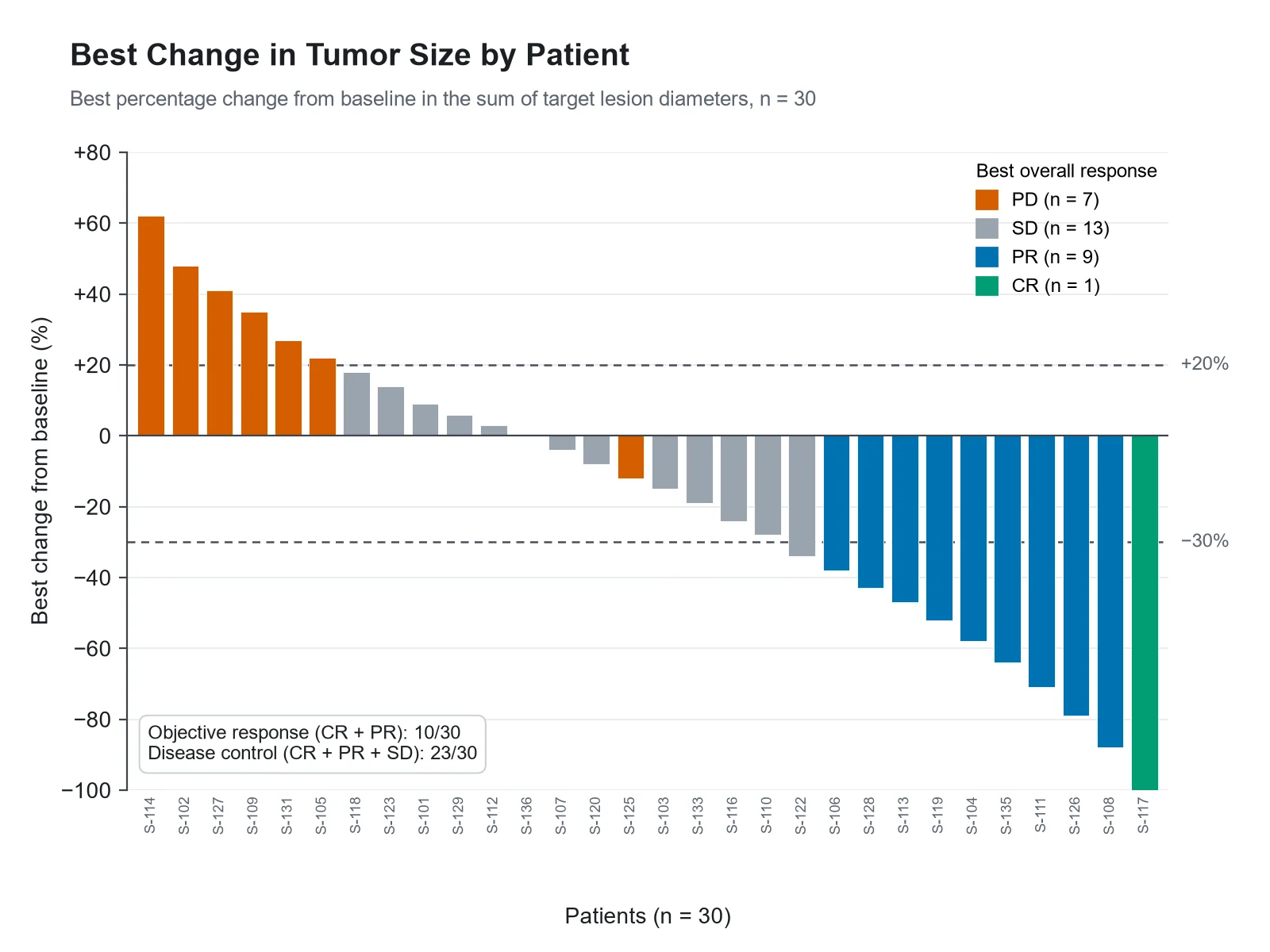
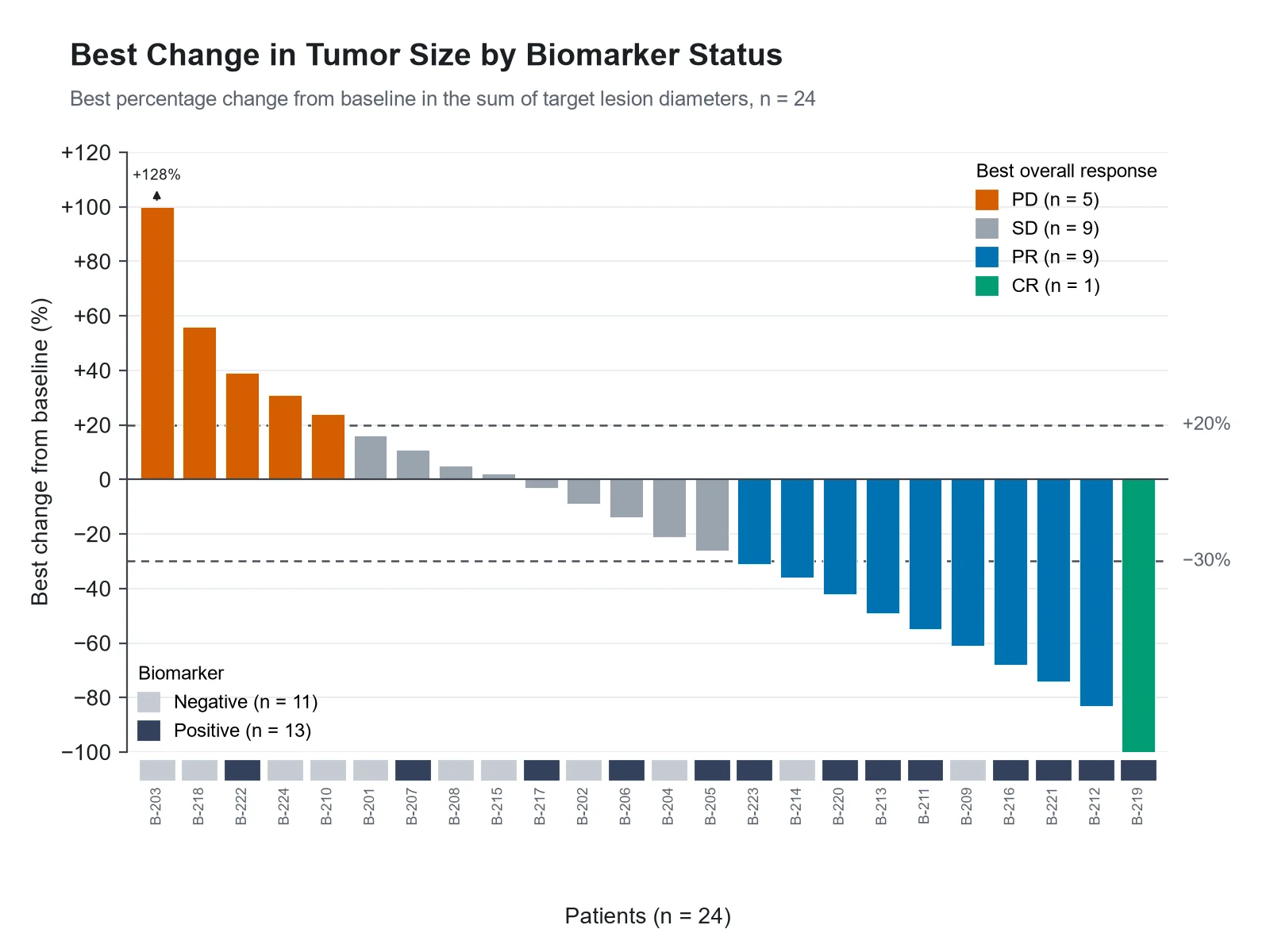
Waterfall plots for tumour response. Plot each patient's best percentage change from baseline in the sum of target lesion diameters, sorted from worst to best, coloured by best overall response, with dashed reference lines at +20% and −30% (the RECIST 1.1 thresholds for progression and partial response). State the objective response and disease control rates in the panel. Our waterfall plot generator draws these from a table of patient values.
One detail that confuses readers: a patient can have a negative bar and still be classed as progressive disease, because a new lesion means progression whatever the target lesions did. Keep that bar coloured as progression and explain it in the legend rather than recolouring it.
Biomarker annotations. If response depends on a biomarker, add a strip under the bars showing each patient's status, and cap extreme bars (marking the true value) so one outlier does not flatten the rest.
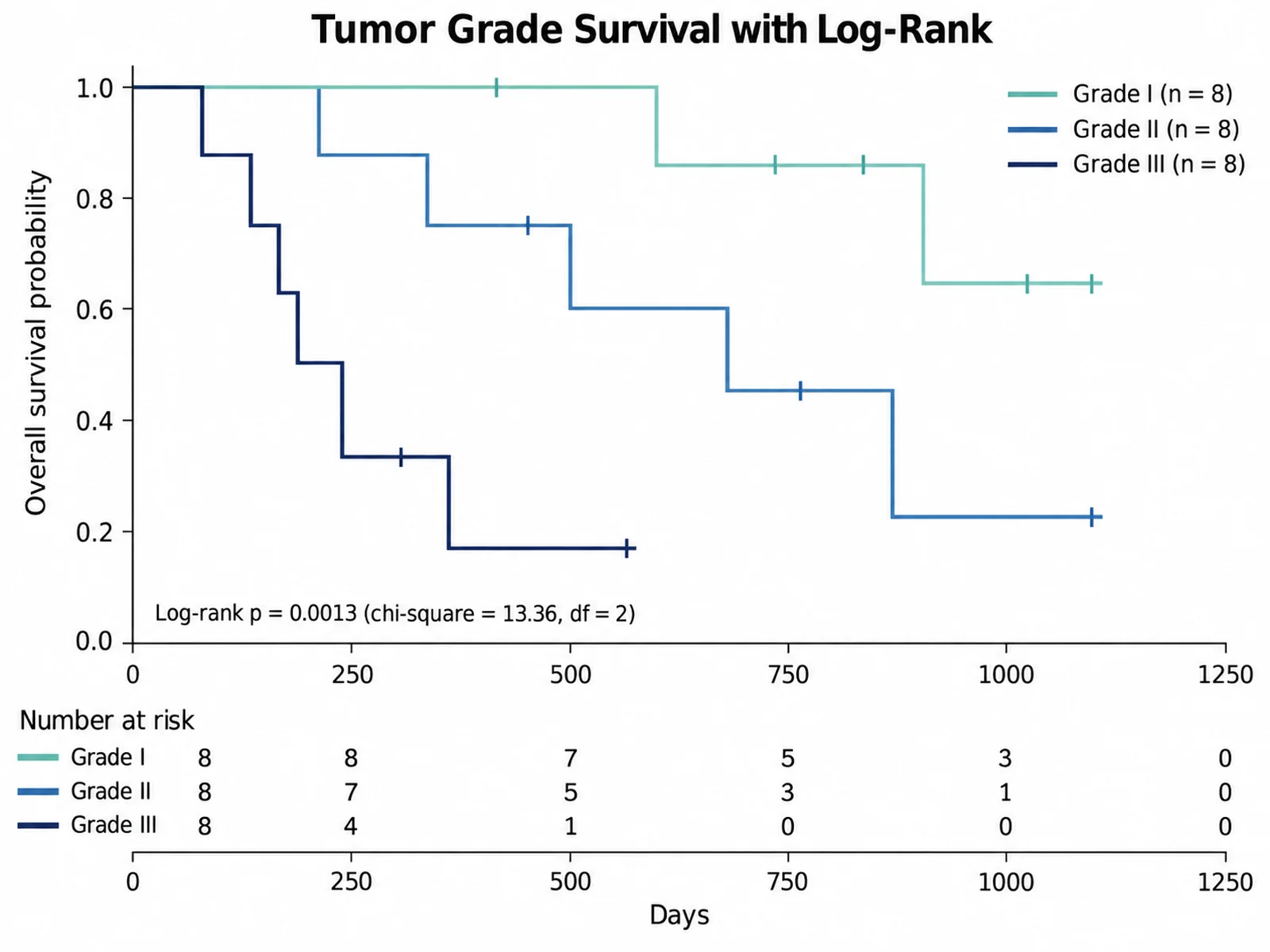
Kaplan–Meier curves for survival endpoints. Mark censored patients with ticks, put a number-at-risk table under the x-axis in type as large as the tick labels, and report the median with its 95% CI, the hazard ratio with its 95% CI, and the test. Our Kaplan–Meier plot generator builds the curve and risk table from time and event columns; for a randomised trial, pair it with a flow diagram from the CONSORT diagram generator, which checks that the counts add up.
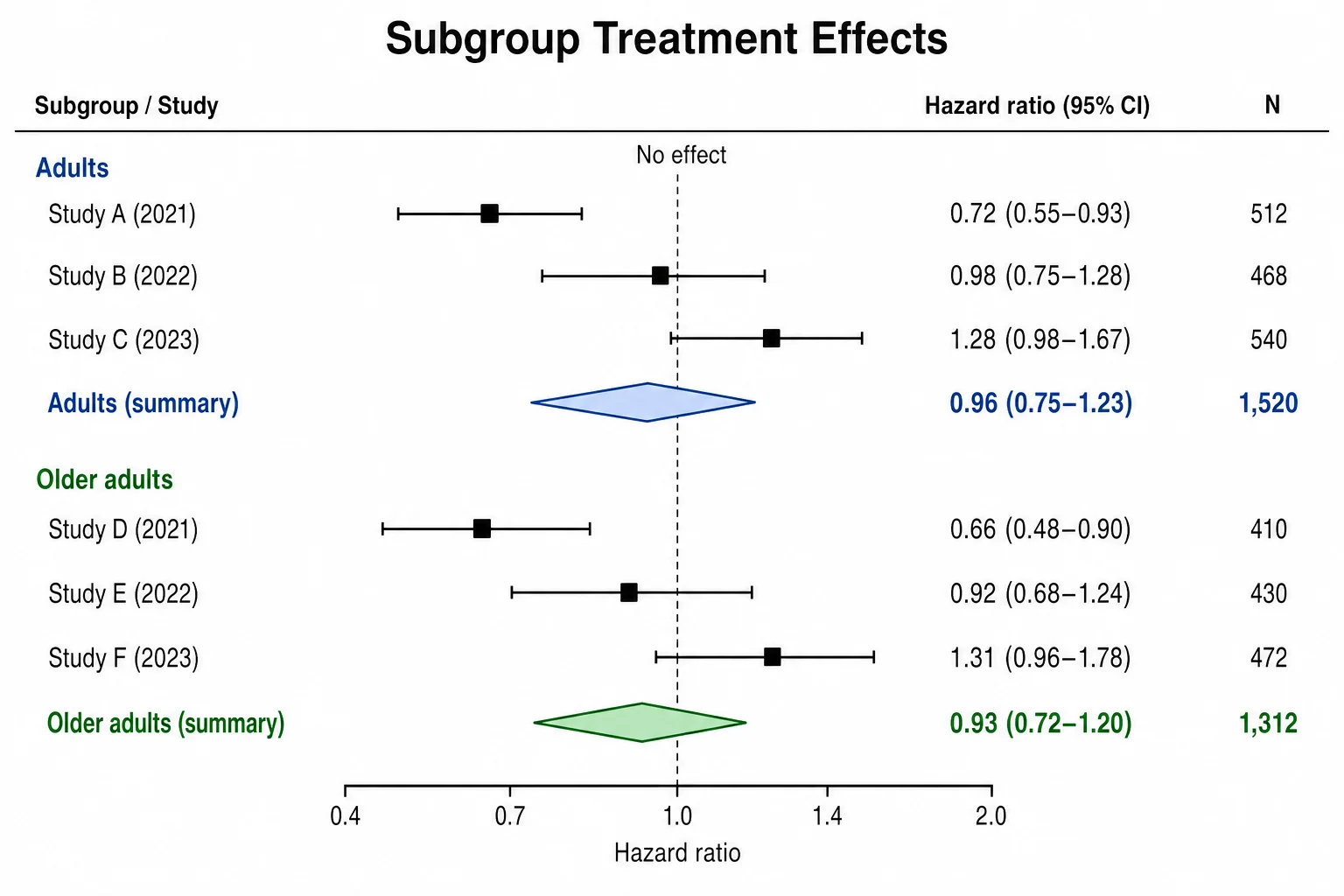
Forest plots for subgroups. Subgroup effects belong in a forest plot with the number of patients per subgroup, the hazard ratio and 95% CI written beside each line, a vertical line at no effect, and a log-scaled ratio axis. Our forest plot guide walks through the layout.
Genomics and mechanism. Show differential expression as a volcano plot with thresholds stated, sample patterns as a clustered heatmap, and a pathway as a schematic from the biological pathway diagram generator.
Images. Every IHC, IF or imaging panel needs the stain or marker, the magnification and a scale bar, and representative images should be matched to the quantification beside them.
A layout template for the AACR board
This grid is for a 66 × 42 in print, which fits the 69 × 45 in board with room to spare.
| Zone | Inches | Centimetres | What goes there |
|---|---|---|---|
| Outer margin | 1 | 2.5 | Clear on every side |
| Top panel | 64 × 7 | 162.6 × 17.8 | Abstract number, results-style title, authors, affiliations, logos |
| Left column | 19 wide | 48.3 wide | Background, hypothesis, methods schematic or trial schema, patient characteristics |
| Centre column | 24 wide | 61 wide | Hero figure (waterfall or KM curve), key secondary result |
| Right column | 19 wide | 48.3 wide | Biomarker or mechanism panel, safety, conclusions, QR code |
| Gutters | 1 | 2.5 | Between columns and bands |
| Footer | 64 × 2 | 162.6 × 5.1 | References, funding, disclosures, contact |
Width: 1 + 19 + 1 + 24 + 1 + 19 + 1 = 66 in. Height: 1 + 7 + 1 + 29 (body) + 1 + 2 + 1 = 42 in. For more on proportions and reading order, see our scientific poster layout checklist.
A prompt you can adapt for a first draft
If you use an AI tool for a first draft, disclose it the way AACR asks for abstracts, and replace every chart with one made from your own data before printing. A prompt that gives a useful starting layout:
Landscape scientific poster, 66 × 42 inches, for the AACR Annual Meeting.
Top panel: abstract number placeholder "#1234" at left, title "Drug X deepens
responses in KRAS G12C colorectal cancer", authors and affiliations, space for
two logos and a QR code at right.
Three columns: left = background, hypothesis, trial schema (phase II, n = 30);
centre = large waterfall plot of best change in tumour size with +20% and −30%
reference lines, then a Kaplan–Meier curve with number at risk;
right = biomarker panel, adverse events by grade table, conclusions.
Footer: references, funding, disclosures. Sans-serif type, body 30 pt,
white background, colour-blind-safe colours, one colour per response category.
Paste it into the scientific poster maker, then rebuild the charts in the waterfall plot generator and Kaplan–Meier plot generator from your data. For a one-image summary to share after the embargo lifts, the graphical abstract maker works from the same content.
Printing and travel tips for Orlando
- Order print early. If you use the meeting printer, put the order in well before its deadline (April 8 in 2026) and collect it on arrival.
- Fabric travels better than paper. A fabric print folds into a suitcase; paper needs a tube.
- Matte, not gloss. Hall lighting turns glossy paper into a mirror.
- Print a proof. Print one section at 100% on letter or A4 paper and look at it from six feet. If you cannot read it, nobody else will.
AACR poster checklist
- Landscape, no larger than 69 × 45 in (2026 board); we suggest 66 × 42 in.
- Top panel with abstract number, title and authors.
- Title states the finding; content matches the accepted abstract.
- Readable from six feet: body text about 30 pt, headings 48 pt or more.
- Waterfall plots with RECIST lines and response rates; KM curves with number at risk, median and HR with 95% CI.
- Every image with stain, magnification and scale bar; checked at print size.
- Colour-blind-safe colours, consistent per group.
- Trials in Progress posters contain no results.
- AI use disclosed where AACR asks for it.
- Companion e-poster ready as a PDF or video (no PowerPoint or Keynote) before the deadline.
- Nothing public before noon ET on April 2, 2027.
- At the board for the first two hours of your session; poster down when it ends.
Frequently asked questions
What size is the AACR poster board?
The most recent figure AACR has published, for 2026, is a usable area of 5.75 ft wide by 3.75 ft high (69 × 45 in, about 175 × 114 cm). Posters cannot exceed it. AACR has not yet posted its 2027 presenter page.
What are the AACR poster dimensions I should print?
Print in landscape at no more than 69 × 45 in. We recommend 66 × 42 in (about 168 × 107 cm), which leaves a margin on the board and is a common printer size.
Is there an official AACR poster template?
AACR does not publish one. It provides branded slide templates for speakers but no poster template. Your poster needs a top panel with the abstract number, title and authors, a landscape format and a size within the board.
Does AACR require an e-poster?
Yes. For 2027, every poster presenter must present in person and also submit a companion e-poster as a video or a PDF. In 2026, that meant a PDF with optional MP3 or M4A audio, or a video of up to five slides; PowerPoint and Keynote files were not accepted.
When is the AACR 2027 abstract deadline?
The regular deadline was November 10, 2026, at 11:59 p.m. ET. Late-breaking and clinical trials abstracts can be submitted from December 2, 2026, until January 6, 2027, at 11:59 p.m. ET.
What is the AACR abstract character limit?
2,600 characters for the title, body and tables combined, not counting spaces or the author block. Each table counts as 800 characters.
How long do I have to stand at my AACR poster?
In 2026, poster sessions lasted three hours and presenters had to stay at the poster for the first two. The poster itself stays up for the whole session.
When can I share my AACR poster publicly?
Regular abstracts become public on March 2, 2027, at 4:30 p.m. ET. Poster data are released when AACR posts the e-posters at noon ET on April 2, 2027. Posting a preprint after the abstract deadline but before release counts as an embargo breach.
Where can I see AACR 2025 or 2026 posters?
AACR keeps e-posters on its virtual platform for registered attendees only, for a limited time; access to the 2026 e-posters ended on October 31, 2026. The abstracts stay public in the Cancer Research proceedings supplements. For 2027, AACR says e-posters will be available to registrants through October 2027.
Can I use AI to make my AACR poster?
AACR's 2027 policy allows AI with disclosure in the abstract, and authors stay responsible for accuracy. We found no separate poster rule, so disclose AI use on the poster too and plot only your own data.
Related guides
- AHA Scientific Sessions poster guidelines: moderated digital posters, the 4 × 6.4 ft board and the 2,500-character abstract.
- SOHO annual meeting poster guidelines: the hematologic oncology meeting in Houston.
- ASH annual meeting poster guidelines: print-on-upload posters and ASH's AI rules.
- ASHG, GSA Connects and AGU poster guides.
- How to make a scientific poster and scientific color palettes.
Sources
All pages checked on November 17, 2026.
- AACR, AACR Annual Meeting 2027: Key Dates (venue, deadlines, notifications, publication and e-poster release dates)
- AACR, AACR Annual Meeting 2027: Abstracts (character limit, fee, in-person and companion e-poster rules, encore rule, AI policy, withdrawal dates)
- AACR, Trials in Progress Abstract Submission Guidelines 2027 (PDF)
- AACR, Embargo Policy (abstract and e-poster release times for 2027)
- AACR, AACR Annual Meeting 2026: Information for Presenters (board size, orientation, top panel, e-poster formats, session format, printing; the page has since been taken down, and we read the copy archived on April 17, 2026)
- AACR, AACR Annual Meeting 2026: Meeting Resources (2026 dates and venue; e-poster access ended October 31, 2026)
- AACR, Guidelines for Creating E-Posters (recording narration and exporting video)
- Genigraphics, AACR Annual Meeting 2026 poster printing (maximum print size, 69 × 45 in)