Publishing & Journals
Nature Medicine Submission Guide: Author Guidelines, Article Types and Figure Requirements
Nature Medicine author guidelines in one place: article types and word limits, review times, fast track, the APC, clinical reporting rules and figure specs.
 SciFigure Editorial
Nature Medicine is a monthly journal that publishes translational and clinical research from every area of medicine, judged on originality, timeliness and impact on human health. Like the other Nature journals, it has no external editorial board: full-time professional editors decide what is sent for review and what is published.
The journal's instructions are spread over a dozen pages, and what delays papers most is rarely the word count: it is missing trial protocols, flattened figure labels and unlicensed illustrations. This guide collects the Nature Medicine author guidelines in one place, with every fact taken from nature.com or Nature's research figure guide on 17 November 2026. For Nature itself (reference style, Letters, the flagship's acceptance rate) see our Nature submission guide; this page covers what is different at Nature Medicine.
Nature Medicine at a glance
| Item | Nature Medicine |
|---|---|
| Journal Impact Factor | 52.3 (2025 Journal Citation Reports, released 2026) |
| Median time to first editorial decision | 4 days |
| Median time from submission to acceptance | 117 days |
| Frequency | Monthly, with research published online ahead of the issue |
| Presubmission enquiries | Not accepted |
| Initial submission format | Any reasonable layout; PDF, Word, or TeX/LaTeX sent as a compiled PDF |
| Gold open access APC | £9,390 / $12,850 / €10,850 |
| ISSN / EISSN | 1078-8956 / 1546-170X |
The metrics and medians are labelled 2025 on the journal's metrics page. The 117-day median includes revisions, so treat it as typical rather than a promise.
Seven reasons Nature Medicine submissions stall
- The trial was registered late. Trials must be registered before the first participant is enrolled, and primary results of unregistered trials "will not be considered".
- The protocol or statistical analysis plan is missing. Clinical trial submissions must include the latest protocol and SAP in English, with amendments explained.
- No reporting checklist. Randomized trials need the CONSORT 2025 checklist with the files; reports that do not conform "may need to be revised before formal review".
- Labels flattened into images. The journal names uneditable and low-resolution images as two of the most common reasons for delay in manuscript preparation.
- A BioRender figure on a free plan. At acceptance you are asked to confirm whether you hold a full licence to publish or a free trial plan. Free plans do not cover publication.
- Generative AI anywhere in a figure. Nature's figure guide does not permit it, including Photoshop's Generative Fill and content-aware tools.
- Legends that hide the statistics. Each legend must state centre values, what the error bars show, n, the statistical test and P values.
What Nature Medicine publishes
The aims and scope cover new concepts in human biology and disease, new therapies and drug development, all phases of clinical work and new health technologies. The journal names the clinical study types it considers:
- case reports and small case series;
- clinical trials of phase 1, 2, 3 or 4;
- observational studies, meta-analyses and biomarker studies;
- public and global health studies;
- "hybrid" studies that report preclinical and translational findings alongside clinical data.
If your work is strong but not clinical, Nature Communications covers all of the natural sciences, and the transfer service can move a declined manuscript there.
Nature Medicine article types and word limits
| Content type | Main text | Abstract | Display items | References (guideline) |
|---|---|---|---|---|
| Article | Up to 4,000 words, excluding abstract, Methods, references and legends | Up to 150 words, unreferenced | Up to 6 | Up to 60 |
| Brief Communication | Up to 2,000 words including abstract, references and legends; no headings | Up to 150 words, unreferenced | Up to 2 (flexible at the editor's discretion) | Up to 20 |
| Resource | Up to 4,000 words, same exclusions as Article | 150 words | Up to 6 | Up to 60 |
| Analysis | Up to 4,000 words, same exclusions as Article | 150 words | Up to 6 | Up to 60 |
| Correspondence | Up to 1,000 words; no new research data | None | Up to 2 | Up to 10 |
| Review | 4,000 words; illustrations strongly encouraged | None | Not set | Up to 100 |
| Perspective | Up to 4,000 words | None | Not set | Up to 100 |
| Comment | 1,500–2,000 words; schematic figures encouraged | None | Not set | Up to 15 |
Articles, Resources and Analyses run as an untitled introduction, Results, Discussion and Online Methods, with subheadings in Results and Methods but none in the Discussion. A Resource presents a large data set of broad use; an Analysis is a new analysis of existing data, such as large omics data sets or meta-analyses of clinical studies. Matters Arising comment on papers published in Nature Medicine and have their own submission process, and News & Views are commissioned. Correspondence, Reviews, Perspectives and Comments are non-primary content: they cannot carry original findings and can only be published on the subscription route.
Does Nature Medicine accept presubmission enquiries?
No. Nature Medicine's guidelines state that it does not accept presubmission enquiries. For questions about whether a clinical trial suits the journal, or about the fast track, contact the editorial team directly. This is a real difference from Nature, which does accept them.
How to submit to Nature Medicine, step by step
1. Check the fit and the content type
Read the aims and scope, choose the content type from the table above, and plan the display items to its limit before you write the figure legends.
2. Register and document the study
For a trial, confirm the registration number is in the abstract and Methods, and assemble the signed protocol, the SAP, and the reporting checklist that matches your design (see the reporting table below).
3. Prepare one manuscript file
Initial submissions need no special formatting. Upload a PDF, a Word file, or a TeX/LaTeX manuscript as a compiled PDF. The file includes author names and affiliations, the full text with Methods, a reference list, figures, and up to ten Extended Data items if you use them.
4. Write the cover letter
Explain why the work matters and why it suits Nature Medicine's broad readership. Disclose related manuscripts under consideration or in press, mention any earlier discussion with an editor, and add suggested or excluded reviewers with reasons. Reviewers never see the letter. If you choose double-anonymized review, the author details go here instead of in the manuscript.
5. Declare AI use and add statements
Large language models cannot be authors; document any use of one in the Methods. Add a data availability statement, a code availability statement if you wrote custom code, a competing interests statement and a funding statement (for clinical studies, also the sponsor's role).
6. Submit and track
Submit through the journal's online system. If the paper goes out for review you are asked to read and sign the editorial policies.
The editorial process and review timeline
| Stage | What happens | Published timing |
|---|---|---|
| Quality check | An editorial assistant checks the files are complete | Not stated |
| First editorial decision | An editor, with the team, decides whether to send the paper for review | Median 4 days (2025) |
| Peer review | Reviewers with the right expertise report; your suggestions may or may not be used | Not stated (fast track: referees asked for 1 week) |
| Decision | Invitation to revise and resubmit, or decline | Not stated |
| Acceptance | Acceptance in principle, then formatting and checks | Median 117 days from submission (2025) |
| Production | Copy editing, proofs, scheduling | You are told 6 calendar days before online publication |
Reviewers stay anonymous unless they choose otherwise. Nature Medicine runs transparent peer review as an opt-in: at the end of review you can choose to publish the reviewer reports and your rebuttal with the paper.
Appeals succeed only when the editors are convinced the decision was an error. Transfers to another Nature Portfolio journal start from the decision email, and the reviewer reports and identities go with the paper (except to the npj Series and Scientific Reports). If you would rather the next journal did not see the review history, make a new submission instead.
The fast track
Nature Medicine offers expedited review for trials presented for the first time at a major clinical meeting, secondary analyses of practice-changing trials, and studies with immediate public health implications. Email the relevant editor with a summary and justification; the editors decide within 2 business days. For publication timed to a conference talk, the complete submission must arrive at least 6 weeks before the presentation, and you must answer production requests within 1 business day after acceptance.
Open access and the APC
Primary research can be published on the traditional subscription route or as gold open access. The gold open access APC is £9,390 / $12,850 / €10,850, and the article is published under a Creative Commons licence. If your funder requires immediate open access, for example under Plan S or the NIH public access policy, choose gold open access: the journal says the subscription route does not suit authors whose funders require no embargo. Colour printing of figures in subscription content is charged separately; ask the editorial office for the price.
Nature Medicine figure requirements
Nature Medicine's acceptance-stage instructions set the basics, and Nature's research figure guide, which the journal points to, fills in the details.
| Requirement | Specification | Source |
|---|---|---|
| Resolution | At least 300 dpi for figure panels | Nature Medicine AIP and formatting |
| Width | At most 180 mm | Nature Medicine AIP and formatting |
| Column widths | 89 mm single, 183 mm double; maximum height 170 mm | Research figure guide |
| Typeface | Sans-serif, preferably Arial or Helvetica; Symbol for Greek | Both |
| Text size | 5 pt minimum, 7 pt maximum | Both |
| Panel labels | 8 pt bold, upright, lowercase a, b, c | Research figure guide |
| Colour | RGB; converted to CMYK for print | Research figure guide |
| Export | PDF or EPS preferred, vector text and lines, fonts embedded (TrueType 2 or 42), text not outlined | Research figure guide |
| Photographs | 300 dpi minimum; 450 dpi or more gives the best online proofs | Research figure guide |
| Scale bars | Scale bars, not magnification factors, on an editable layer | Both |
| Extended Data | Up to 10 items, each fitting one PDF page; not copy-edited | Nature Medicine AIP and formatting |
| Source data | Unprocessed gels and blots as one PDF per figure; statistics source data as one Excel file per figure | Nature Medicine AIP and formatting |
Two details trip people up. The journal's 180 mm maximum and the guide's 183 mm double column disagree slightly, so design double-column figures at 180 mm and they satisfy both. And the guide asks for real, editable text: in Matplotlib set pdf.fonttype to 42, and in Prism untick the outline-text option. Check photographs against the 300 and 450 dpi thresholds at their printed width in our image DPI checker, and compare these rules with other journals in journal figure requirements by publisher.
The guide also asks graphs to drop gridlines, drop shadows, patterns and coloured text, and to use axis tick marks, units in parentheses and a colour-blind-safe palette; preview yours in the colorblind simulator or start from our colorblind-safe palettes.
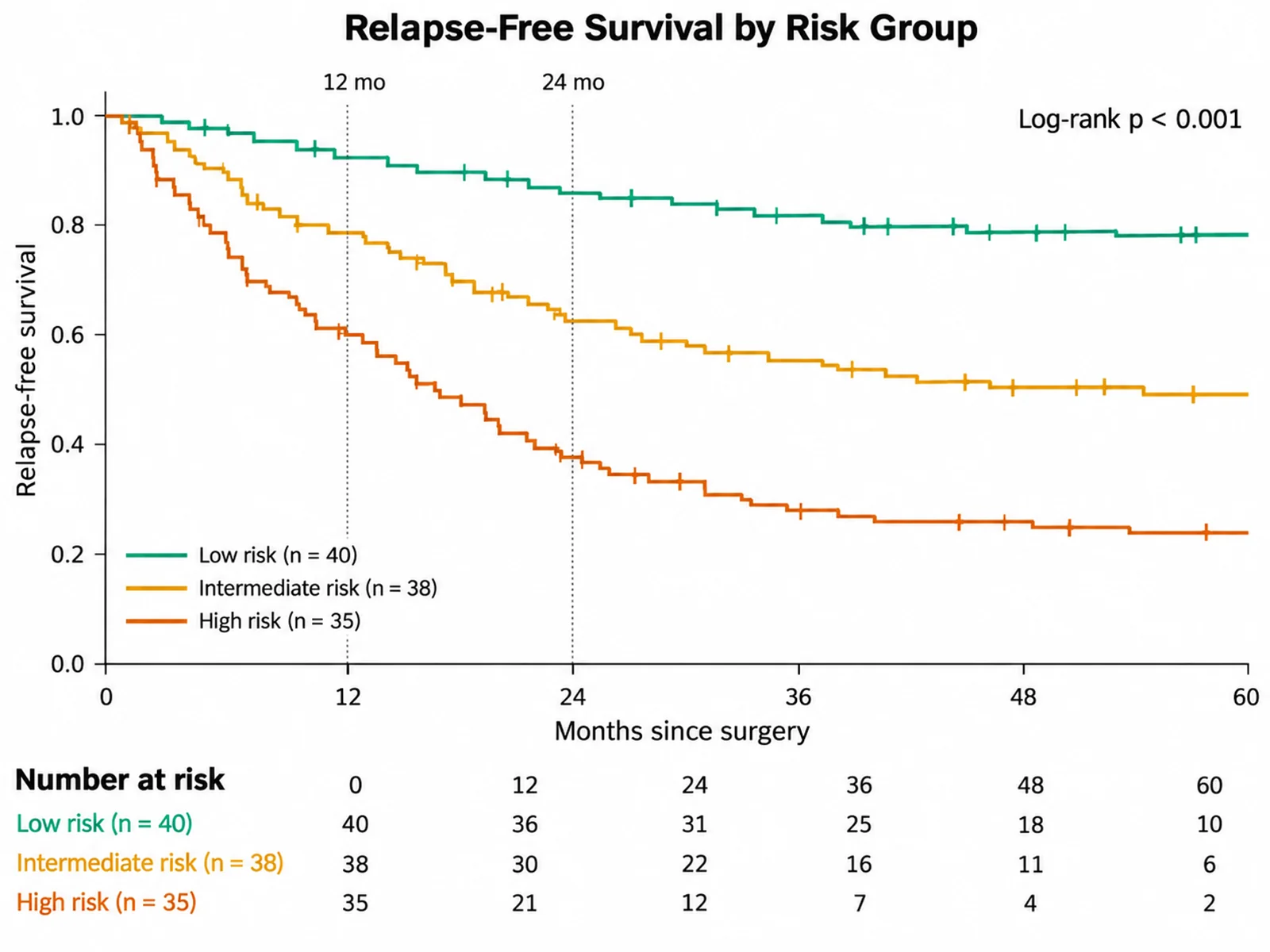
Figure legends
Each legend needs a brief title, a short description of every panel in order, and no methods detail. Describe keys in words ("open red triangles"), and state the centre values, how the error bars were calculated, the sample size, the test and the P values. Keep within the word limit of the article type. The figure legend generator puts these parts in a consistent order you can trim.
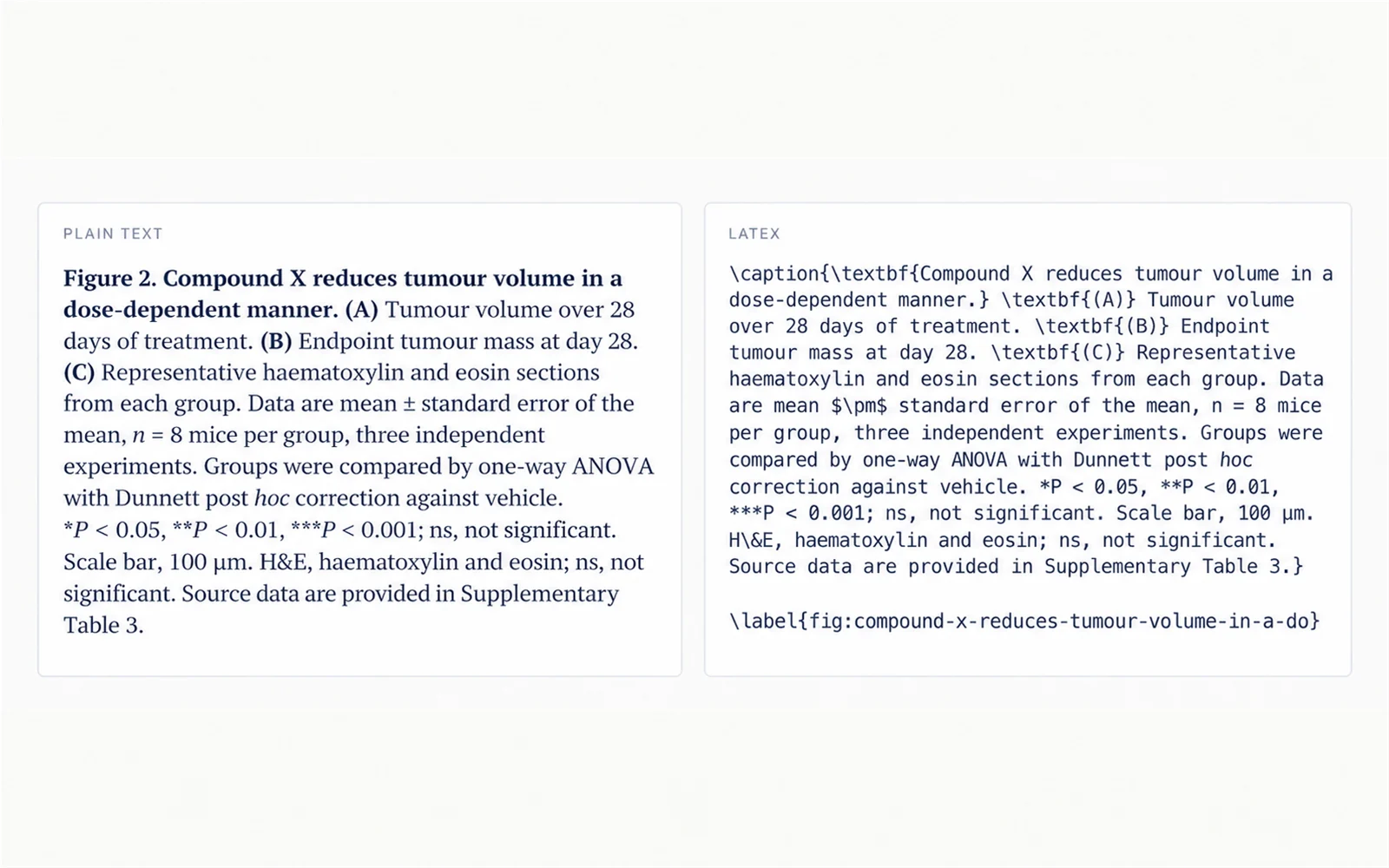
Image integrity and generative AI
Nature Portfolio's image integrity policy applies: images must be minimally processed, adjustments such as brightness and contrast applied to the whole image and equally to controls, and cloning or healing tools are not acceptable. Images from different times or places must not be combined, and non-adjacent gel lanes must be marked. Editors may screen images with software and ask for the unprocessed files.
On AI, the research figure guide is unambiguous: "The use of any sort of generative AI in figures is not permitted", which includes content-aware editing in Photoshop. Cover art follows the same line: images created with generative AI tools are not permitted as cover submissions. Springer Nature's wider AI policy permits assistive uses such as language polishing and encourages authors to disclose them. If you used AI for a graphical abstract on a conference poster, keep it out of the manuscript; our free AI graphical abstract makers comparison explains which publishers accept what.
Clinical reporting guidelines Nature Medicine requires
| Study type | Required guideline | What to submit |
|---|---|---|
| Randomized trial | CONSORT 2025 (cluster trials: the cluster extension) | CONSORT checklist with the manuscript files |
| Trial of an AI intervention | CONSORT-AI | CONSORT-AI checklist |
| Observational study | STROBE | Reporting per the statement |
| Systematic review or meta-analysis | PRISMA | Reporting per the guideline |
| Biomarker and clinical outcome study | STARD or its extensions; REMARK for oncology biomarkers | Reporting per the guideline |
| Prediction model | TRIPOD, or TRIPOD-AI for regression or machine learning | Reporting per the statement |
| Target trial emulation | TARGET | Reporting per the statement |
| Any AI model applied to medicine | MI-CLAIM-GEN | The MI-CLAIM-GEN checklist |
| Case report outside a trial | CARE, with ethics and consent statement | Statement of approval and consent |
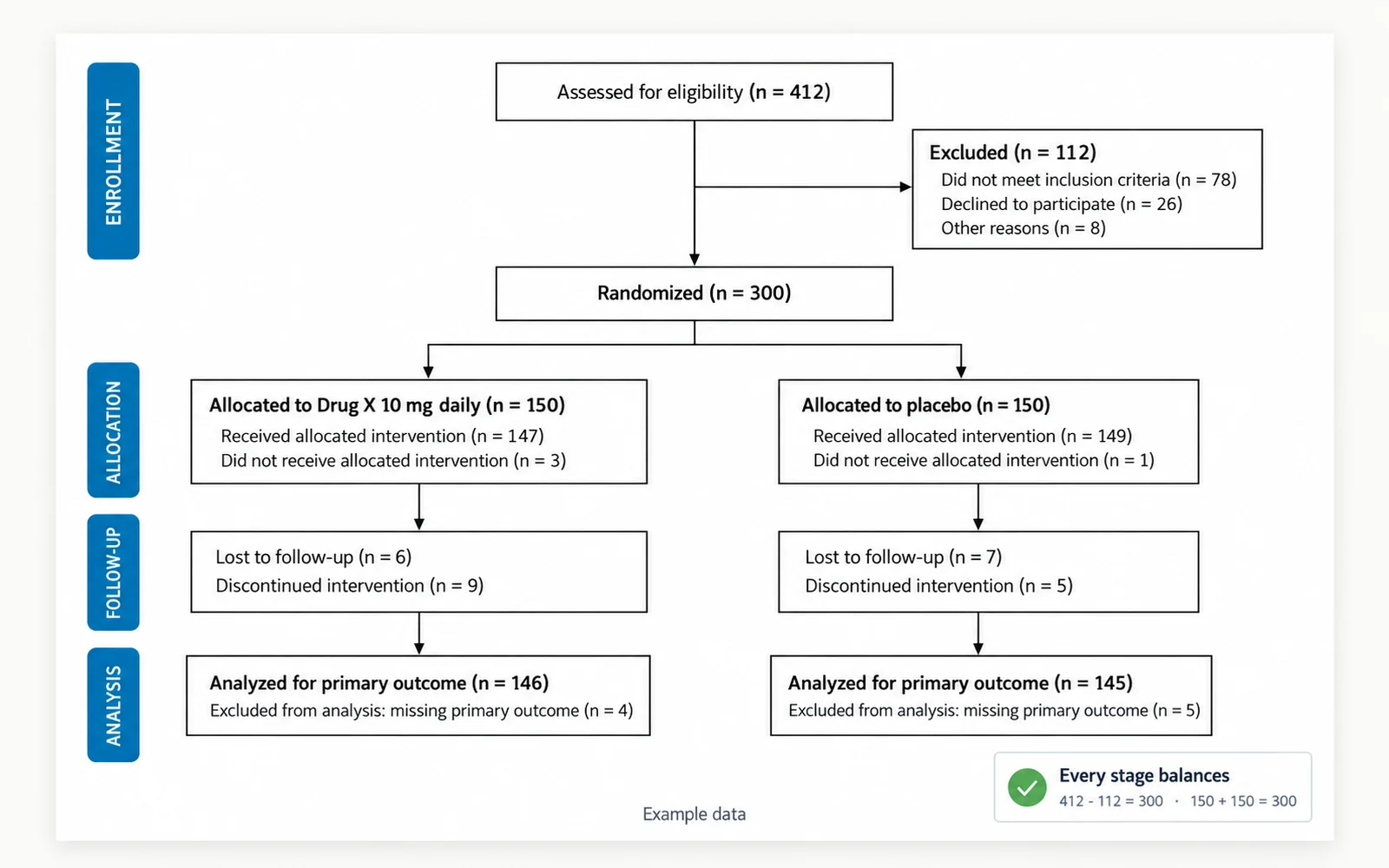
For trials, the journal also recommends a CONSORT-style flow diagram, a baseline characteristics table and adverse events in the main text, plus the exact dates of first and last enrolment and of the data lock. Trials that began enrolling on or after 1 January 2019 need a data sharing plan in their registration. Our CONSORT diagram generator checks that every stage balances, and the PRISMA flow diagram guide covers the systematic review equivalent.
Make the figures with SciFigure
For a Nature Medicine manuscript, use the SciFigure tools that involve no generative AI. They run in your browser and are free:
- the CONSORT diagram generator for the trial flow diagram, exported as SVG or PNG;
- the figure legend generator for legends with the statistics in order;
- the image DPI checker for photographs at 89 and 183 mm;
- the colorblind simulator for palettes.
Our AI figure makers are not suitable for figures in a Nature journal. Use them for talks, posters and lab pages about the work, not for the paper.
Nature Medicine pre-submission checklist
- Content type chosen, and the main text, abstract, display items and references within its limits.
- Trial registered before first enrolment; registration number in the abstract and Methods.
- Protocol and SAP in English, with amendments and their rationale.
- Reporting checklist for the study design attached (CONSORT 2025, STROBE, PRISMA, TRIPOD and so on).
- CONSORT-style flow diagram, baseline table and adverse events in the main text for a trial.
- Cover letter on significance and fit, with related manuscripts disclosed.
- Data availability, code availability, competing interests and funding statements, with the sponsor's role for clinical studies.
- Any LLM use documented in the Methods.
- Figure panels at 300 dpi or more, no wider than 180 mm, sans-serif text at 5–7 pt, 8 pt bold lowercase panel labels.
- Labels, scale bars and error bars on editable layers, not flattened; fonts embedded, text not outlined.
- Legends with centre values, error bars, n, the test and P values.
- No generative AI in any figure; images processed only as the integrity policy allows.
- Licence for any illustration software confirmed (BioRender: a full licence, not a free plan).
- Subscription or gold open access decided, with funder mandates checked.
The journal submission figure checklist covers the checks shared by all journals, and the fonts for scientific figures guide helps at 5–7 pt.
Frequently asked questions
What is the Nature Medicine impact factor?
Nature Medicine's journal metrics page gives a Journal Impact Factor of 52.3 for 2025, from the Journal Citation Reports released in 2026. The 5-year impact factor on the same page is 52.4.
What article types does Nature Medicine publish?
Articles, Brief Communications, Resources and Analyses carry original research. Correspondence, Reviews, Perspectives and Comments are non-primary content. Matters Arising comment on Nature Medicine papers, and News & Views and news features are commissioned.
Does Nature Medicine accept presubmission enquiries?
No. Contact the editors directly with questions about whether a clinical trial suits the journal or qualifies for the fast track.
How long does Nature Medicine take to review a paper?
The journal reports a median of 4 days from submission to the first editorial decision and 117 days from submission to acceptance, both for 2025. On the fast track, referees are asked to report within a week.
How much does it cost to publish open access in Nature Medicine?
The gold open access APC is £9,390, $12,850 or €10,850. The subscription route is the alternative for primary research, and the only route for non-primary content such as Reviews.
Can I use BioRender or AI-generated images in Nature Medicine figures?
BioRender figures need a full publication licence, and the journal asks you to confirm which plan you hold. Generative AI is not permitted in figures of any sort, including content-aware editing tools, and AI-generated cover art is not accepted.
Related guides
- Nature impact factor and submission guide: Nature's own limits, reference style and figure guide in detail.
- Nature Communications review timeline and submission guide: the broad-scope sister journal.
- JAMA submission guide: the other major general medical journal family.
- How to make a forest plot: subgroup and meta-analysis figures.
- Journal figure requirements: Nature's specifications next to other publishers'.
Sources
All pages checked on 17 November 2026.
- Nature Medicine: journal metrics (impact factors, median times, usage)
- Nature Medicine: journal information and aims and scope (frequency, editors, scope, ISSN)
- Nature Medicine: content types (article types and limits)
- Nature Medicine: submission guidelines, presubmission enquiries, preparing your material and initial formatting
- Nature Medicine: editorial process and peer review (stages, appeals, transfers)
- Nature Medicine: peer review policy (double-anonymized and transparent peer review)
- Nature Medicine: fast track (criteria and timings)
- Nature Medicine: publishing options and our publishing models (APC, funder mandates)
- Nature Medicine: AIP and formatting (figures, legends, Extended Data, source data, BioRender licences, cover art)
- Nature Medicine: production process (proofs and publication notice)
- Nature Medicine: clinical research guidelines (registration, protocol, reporting guidelines, data sharing)
- Nature research figure guide: specifications, building and exporting panels and image integrity
- Nature Portfolio: image integrity and standards and artificial intelligence