Phosphorus Cycle Diagram: Simple, Labeled or Blank
Generate a phosphorus cycle diagram that follows phosphate from weathered rock into the soil, through plants, animals, and decomposers, then by runoff to the sea floor and back to land by uplift. Choose a simple loop to copy by hand, a labeled landscape, a numbered flow chart for college, or a blank worksheet with its matching answer key. Every version keeps the sky empty, because phosphorus has no gas phase.
No gas phase, everSimple, labeled or blankWorksheet + answer key
Checked against OpenStax Biology 2e
No atmospheric arrows
Worksheet + answer key pairs
Print-ready PNG
AI Phosphorus Cycle Diagram Generator
Describe the layout and the steps to label, or pick a simple loop or a blank worksheet from the menus.
516 / 2000 字元
Generate a publication-ready PNG from your description.
Preview
Phosphorus Cycle Diagram Example Previews
目標寬高比:4:3
Sample previews. Describe your diagram to generate your own phosphorus cycle figure.
Phosphorus Cycle Diagram Examples
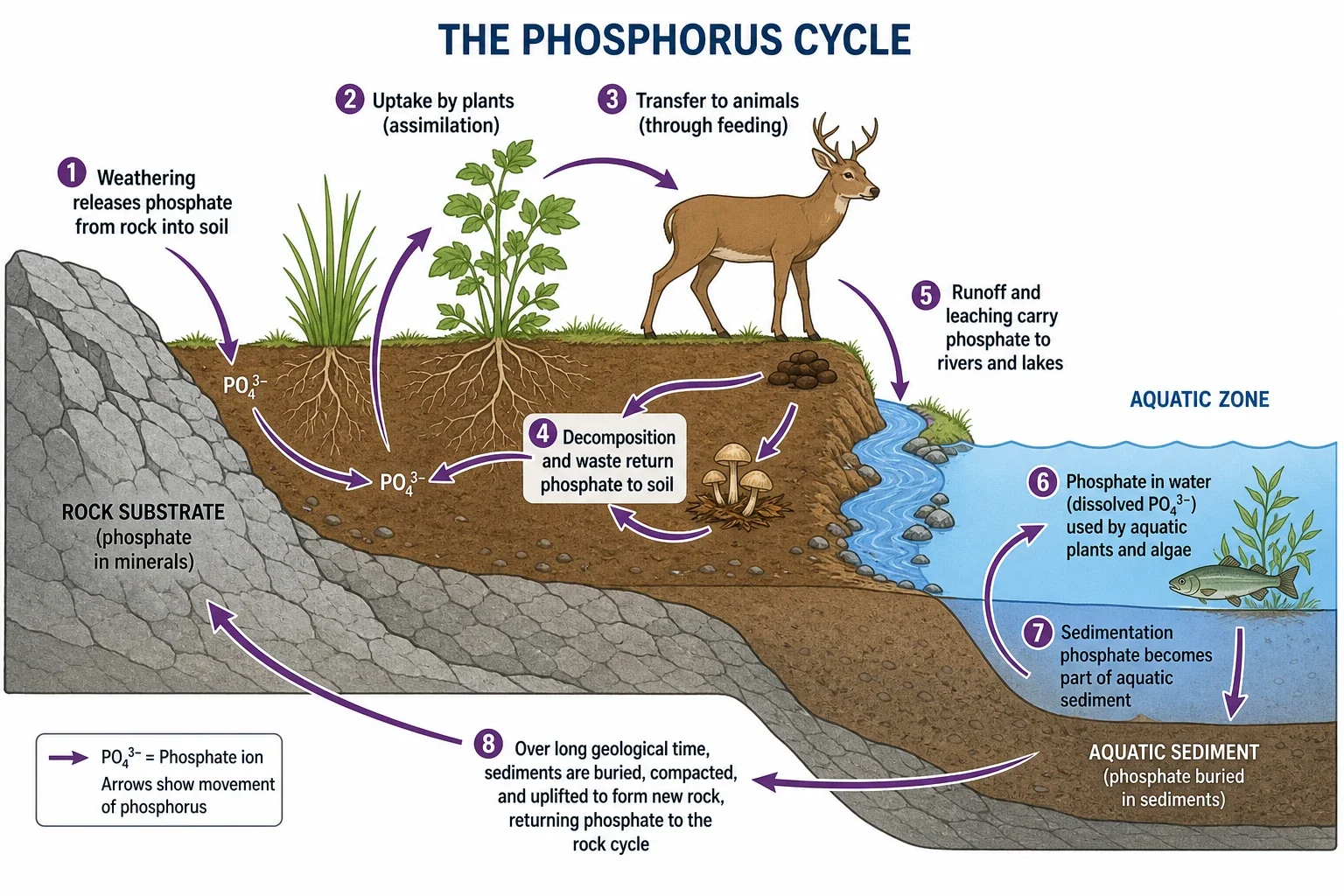
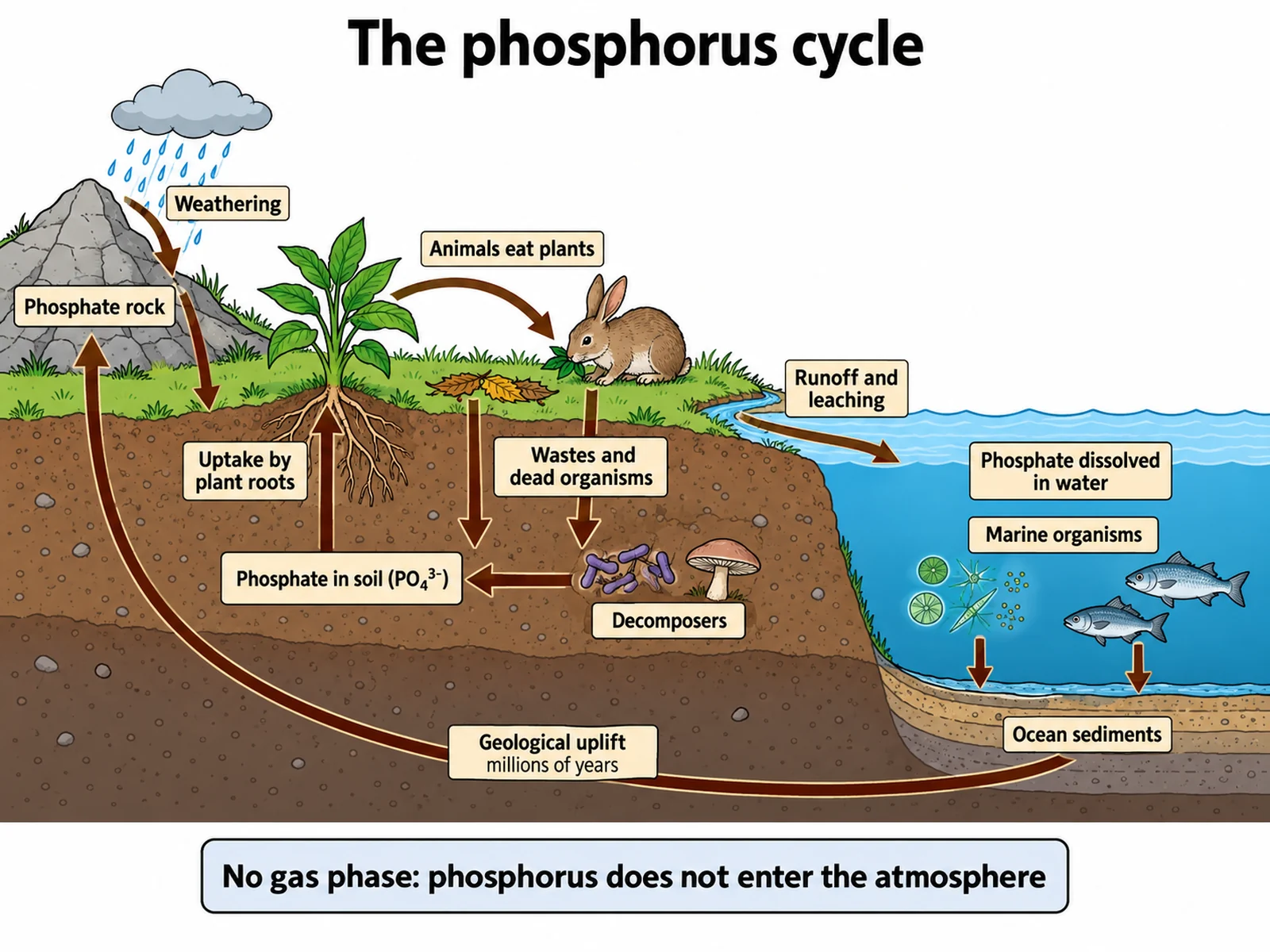
A labeled phosphorus cycle, the eight steps in order, a simple loop to copy by hand, a blank worksheet with a word bank, a college flow chart of pools and fluxes, and the fertilizer runoff that causes dead zones.
提示詞
Create a labeled phosphorus cycle diagram titled "The phosphorus cycle". Draw a phosphorus cycle landscape cross-section on a white background, land on the left and the sea on the right, with an empty sky apart from one small rain cloud over the hill: a grey rocky hill with rain falling on it, brown soil with a leafy plant and its roots, fallen leaves, a rabbit eating a leaf, rod-shaped bacteria and a mushroom in the soil, a stream running into the sea, plankton and two fish in the water, and layered sediment on the sea floor. Dark brown arrows run from the rain into the rock and down into the soil, from the soil up into the roots, from the plant to the rabbit, from the leaves and the rabbit down to the decomposers, from the decomposers to the soil phosphate, from the land into the sea, from the plankton and fish down to the sediment, and in one long curve under the ground from the sea-floor sediment back up to the rocky hill. No arrow enters the sky. Label the twelve parts in readable dark text on cream label boxes: 1 = Phosphate rock (the rocky hill), 2 = Weathering (rain on the rock), 3 = Phosphate in soil (PO4 3-), 4 = Uptake by plant roots, 5 = Animals eat plants, 6 = Wastes and dead organisms, 7 = Decomposers, 8 = Runoff and leaching, 9 = Phosphate dissolved in water, 10 = Marine organisms, 11 = Ocean sediments, 12 = Geological uplift (millions of years). Add the caption "No gas phase: phosphorus does not enter the atmosphere" in a box along the bottom.
用這個範例
提示詞
Create a phosphorus cycle diagram titled "The phosphorus cycle" as an illustrated cross-section on a white background: a grey rock substrate on the left labeled "Rock substrate (phosphate in minerals)", soil with grasses and a leafy plant, a deer, droppings and mushrooms, a stream running into a lake on the right labeled "Aquatic zone", a fish and water plants, and a brown sediment layer labeled "Aquatic sediment (phosphate buried in sediments)". Number eight purple arrows with circled numbers and short captions: 1 "Weathering releases phosphate from rock into soil", 2 "Uptake by plants (assimilation)", 3 "Transfer to animals (through feeding)", 4 "Decomposition and waste return phosphate to soil", 5 "Runoff and leaching carry phosphate to rivers and lakes", 6 "Phosphate in water (dissolved PO4 3-) used by aquatic plants and algae", 7 "Sedimentation: phosphate becomes part of aquatic sediment", 8 "Over long geological time, sediments are buried, compacted, and uplifted to form new rock". Small key: "PO4 3- = phosphate ion; arrows show movement of phosphorus". Nothing in the sky.
Numbered steps
用這個範例
提示詞
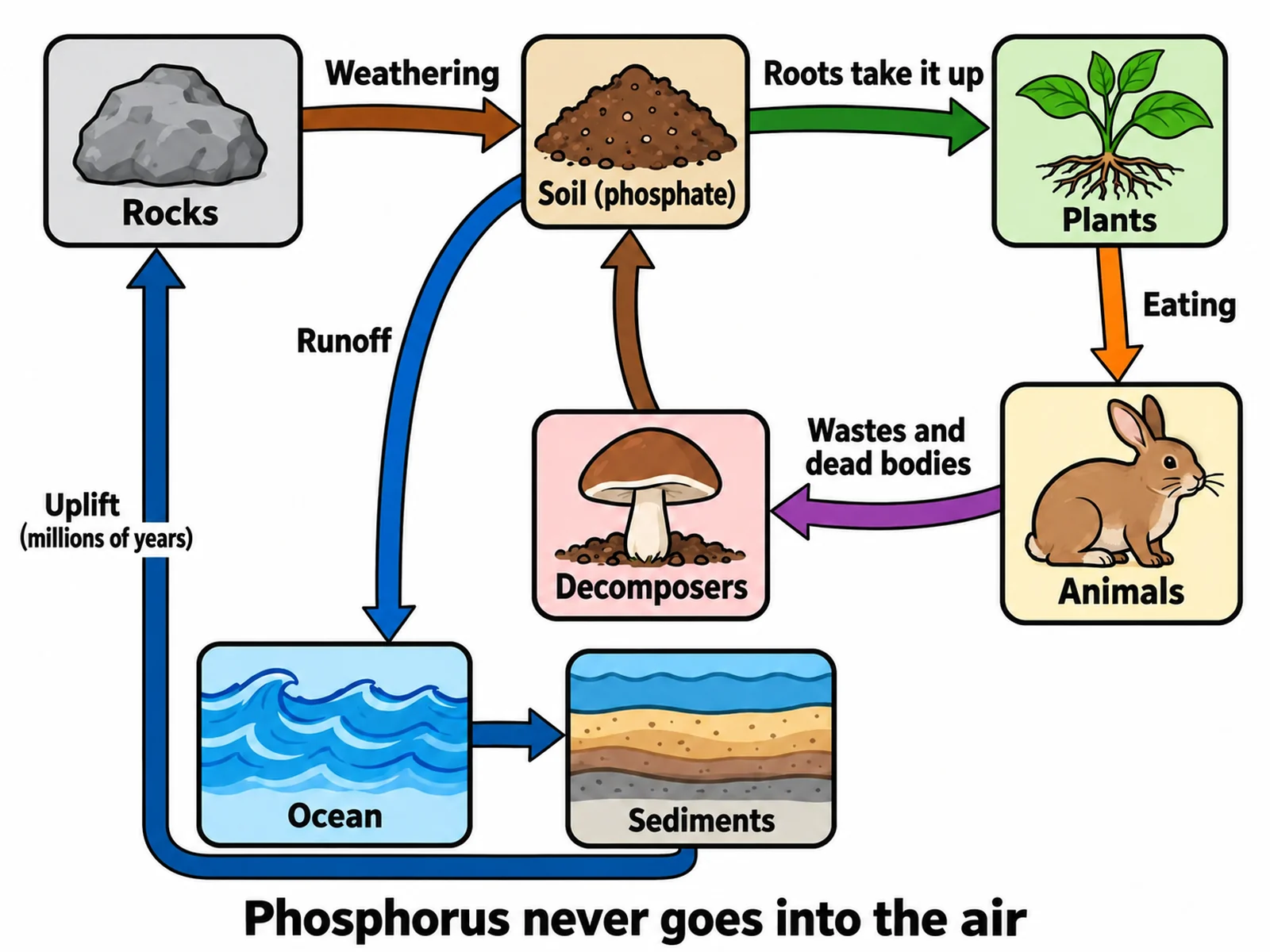
Create a simple phosphorus cycle diagram that is easy to copy by hand, on a white background, with bold flat colours, thick dark outlines, large text, and plenty of white space. Draw rounded boxes with a picture in each, joined by thick arrows: "Rocks" to "Soil (phosphate)" labeled "Weathering", then "Plants" labeled "Roots take it up", then "Animals" labeled "Eating", then "Decomposers" labeled "Wastes and dead bodies", then an arrow from "Decomposers" back up to "Soil (phosphate)". Add one side branch from the soil labeled "Runoff" down to "Ocean", then an arrow to "Sediments", then a long arrow back to "Rocks" labeled "Uplift (millions of years)". Caption: "Phosphorus never goes into the air".
Simple loop to copyMiddle school
用這個範例
提示詞
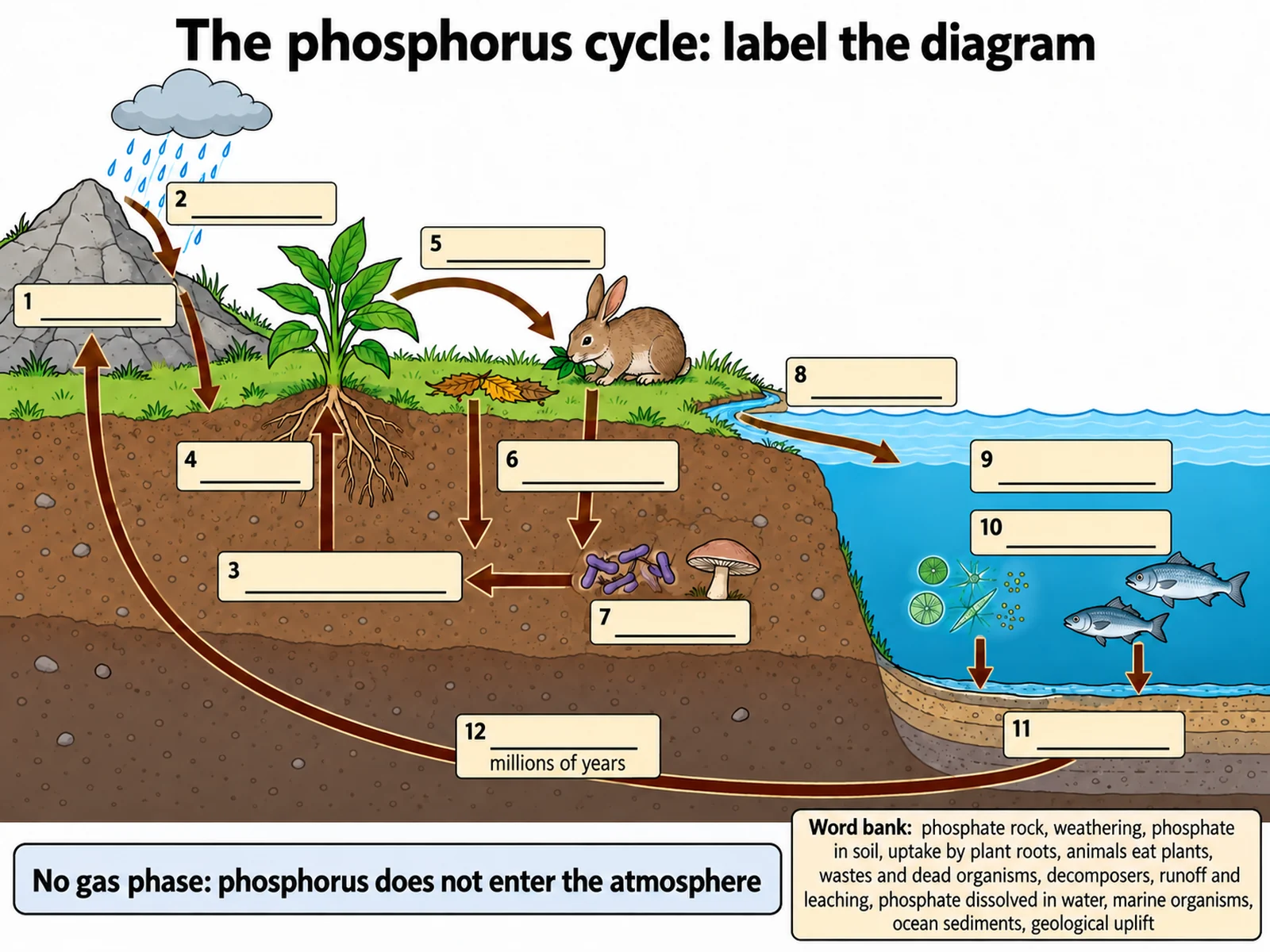
Create a blank phosphorus cycle worksheet titled "The phosphorus cycle: label the diagram". Draw a phosphorus cycle landscape cross-section on a white background, land on the left and the sea on the right, with an empty sky apart from one small rain cloud over the hill: a grey rocky hill with rain falling on it, brown soil with a leafy plant and its roots, fallen leaves, a rabbit eating a leaf, rod-shaped bacteria and a mushroom in the soil, a stream running into the sea, plankton and two fish in the water, and layered sediment on the sea floor. Dark brown arrows run from the rain into the rock and down into the soil, from the soil up into the roots, from the plant to the rabbit, from the leaves and the rabbit down to the decomposers, from the decomposers to the soil phosphate, from the land into the sea, from the plankton and fish down to the sediment, and in one long curve under the ground from the sea-floor sediment back up to the rocky hill. No arrow enters the sky. Put twelve cream answer boxes, each with its number and an empty ruled line and no text, at these targets in this order: 1 = Phosphate rock (the rocky hill), 2 = Weathering (rain on the rock), 3 = Phosphate in soil (PO4 3-), 4 = Uptake by plant roots, 5 = Animals eat plants, 6 = Wastes and dead organisms, 7 = Decomposers, 8 = Runoff and leaching, 9 = Phosphate dissolved in water, 10 = Marine organisms, 11 = Ocean sediments, 12 = Geological uplift (millions of years). Keep the words "millions of years" under box 12 and the caption "No gas phase: phosphorus does not enter the atmosphere". Add a word bank box listing the twelve terms: phosphate rock, weathering, phosphate in soil, uptake by plant roots, animals eat plants, wastes and dead organisms, decomposers, runoff and leaching, phosphate dissolved in water, marine organisms, ocean sediments, geological uplift.
Worksheet with word bank
用這個範例
提示詞
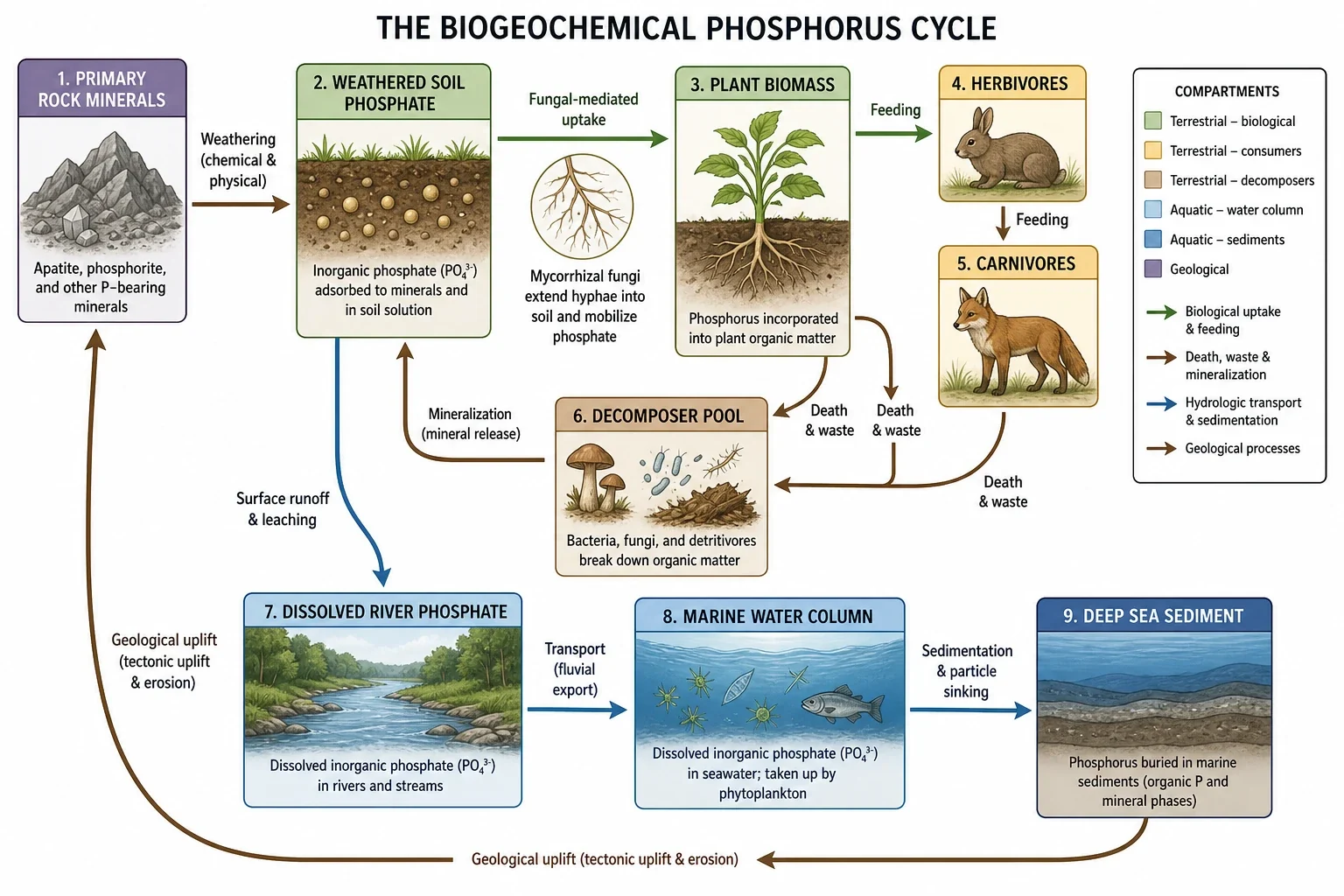
Create a college-level phosphorus cycle flow chart titled "The biogeochemical phosphorus cycle" on a white background, with nine numbered, titled boxes, each with a small illustration and a one-line note: 1 "Primary rock minerals" (apatite, phosphorite and other P-bearing minerals), 2 "Weathered soil phosphate" (inorganic phosphate PO4 3- adsorbed to minerals and in soil solution), 3 "Plant biomass", 4 "Herbivores", 5 "Carnivores", 6 "Decomposer pool" (bacteria, fungi and detritivores), 7 "Dissolved river phosphate", 8 "Marine water column" (taken up by phytoplankton), 9 "Deep sea sediment". Arrows: "Weathering (chemical and physical)" 1 to 2; "Fungal-mediated uptake" 2 to 3 with an inset of mycorrhizal hyphae; "Feeding" 3 to 4 and 4 to 5; "Death and waste" from 3, 4 and 5 to 6; "Mineralization" 6 to 2; "Surface runoff and leaching" 2 to 7; "Transport" 7 to 8; "Sedimentation and particle sinking" 8 to 9; "Geological uplift" 9 back to 1. Colour-code the arrows and add a legend. No arrow to the atmosphere.
Numbered with keyFlow chart of poolsCollege / AP
用這個範例
提示詞
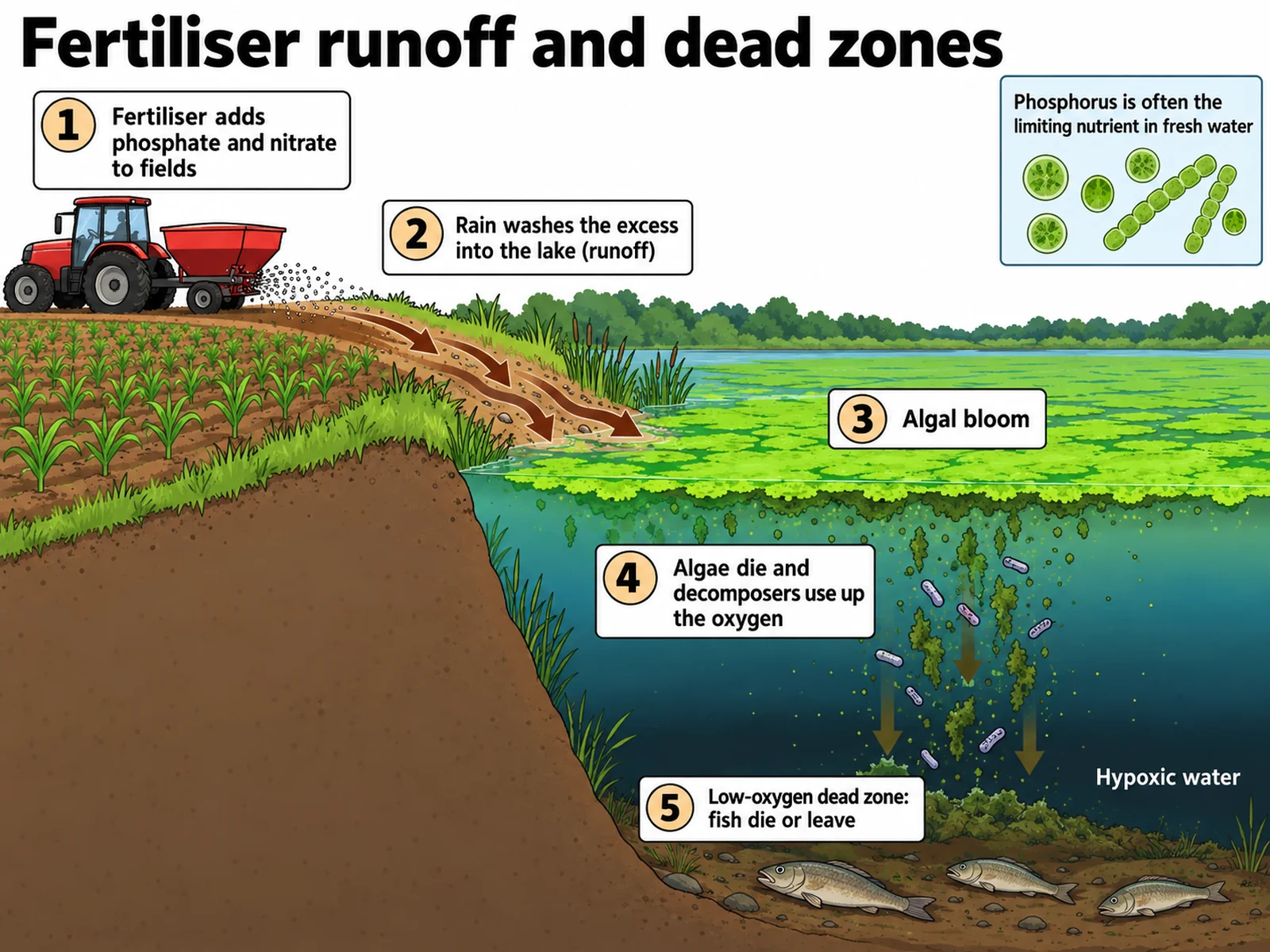
Create a labeled eutrophication diagram titled "Fertiliser runoff and dead zones" as five numbered steps across a farm and a lake on a white background. Step 1 "Fertiliser adds phosphate and nitrate to fields" with a tractor spreading fertiliser over young crops. Step 2 "Rain washes the excess into the lake (runoff)" with brown arrows from the field into the water. Step 3 "Algal bloom" with a thick green layer on the lake surface. Step 4 "Algae die and decomposers use up the oxygen" with dead algae sinking and bacteria among them. Step 5 "Low-oxygen dead zone: fish die or leave" with dead fish on the lake bed and the label "Hypoxic water". Inset: "Phosphorus is often the limiting nutrient in fresh water" with drawings of algal cells. No arrows into the air.
Fertilizer runoff
用這個範例
How to make a phosphorus cycle diagram
1
Pick the layout, level, and labels
A landscape cross-section, a simple loop to copy, numbered steps, a college flow chart, or the fast and slow loops side by side. Set the level from elementary to college, add human impacts if you need them, and choose labeled, numbered, or a blank worksheet.
2
Generate the cycle
The generator draws each reservoir as a picture or box and each process as an arrow from source to destination, from weathered rock through living things to the sea floor and back by uplift, with nothing rising into the sky.
3
Check it, make the key, export
Follow every arrow, look for an empty sky and the word phosphorus spelled right, and make the answer key from the same result if it is a worksheet. Then download the PNG for a worksheet, slide, or poster.
Phosphorus cycle key facts
Form in nature
Phosphate ion, PO₄³⁻
Main stores
Phosphate rock (apatite) and ocean sediments
Gas phase
None significant
Taken up by roots as
H₂PO₄⁻ and HPO₄²⁻
Return to land
Uplift of sediment over millions of years
Time dissolved in the ocean
20,000–100,000 years on average
In the human body
85% in bones and teeth
Main human use
Fertilizer and feed supplements (over 95% of U.S. phosphate rock)
World phosphate rock reserves
About 74 billion t, two-thirds in Morocco
Often limiting in
Fresh water
What a phosphorus cycle diagram shows
A phosphorus cycle diagram traces one element through the living and non-living parts of the Earth and back to where it started. It has two kinds of parts. Reservoirs are the places phosphorus is stored: phosphate rock, soil, plants, animals, dead organic matter, fresh water, the sea, and the sediment on the sea floor. Processes are the arrows that move it between them: weathering, uptake, feeding, decomposition, runoff, sedimentation, and uplift. If every reservoir is named and every arrow is labeled and points the right way, the diagram already answers most exam questions on the topic.
What sets this diagram apart from the carbon, nitrogen, and water cycles is what is missing: the sky. Phosphorus has no significant gas phase, so a correct phosphorus cycle runs entirely along the ground, through the water, and under the Earth’s surface. A good phosphorus cycle diagram makes that absence obvious, often with a caption, because it is the single fact examiners check most.
The phosphorus cycle step by step
Read the cycle in this order and draw one arrow for each step. The first four steps make the fast loop on land; the last four make the slow loop through the sea and the rock.
Weathering: rain, frost, plant roots, and weak acids break down phosphate rock and release phosphate ions (PO₄³⁻) into the soil and the water running through it.
Uptake: plant roots absorb dissolved phosphate from the soil water, usually helped by mycorrhizal fungi, and build it into DNA, RNA, ATP, and membrane phospholipids.
Feeding: herbivores get phosphorus by eating plants, carnivores by eating herbivores. Animals have no other source.
Decomposition: bacteria and fungi break down wastes, fallen leaves, and dead bodies and release the phosphorus as phosphate again (mineralization), ready for the next plant.
Runoff and erosion: rain washes dissolved phosphate and phosphate-rich soil particles into streams, rivers, lakes, and eventually the sea.
Aquatic uptake: algae and phytoplankton absorb the phosphate and pass it along the aquatic food web.
Sedimentation: dead organisms, shells, bones, and wastes sink, and their phosphorus settles into sediment on the lake or sea floor.
Burial and uplift: over millions of years the sediment is buried, compacted into sedimentary rock, and raised above sea level by tectonic movement, and weathering begins again.
How to draw a simple diagram of the phosphorus cycle
If a worksheet or exam asks you to draw a simple diagram of the phosphorus cycle, you need six boxes, seven arrows, and one rule. Draw the boxes in a ring: rocks, soil (phosphate), plants, animals, decomposers. Join them with arrows labeled weathering (rocks to soil), absorbed by roots (soil to plants), eaten (plants to animals), wastes and dead remains (plants and animals to decomposers), and decomposition (decomposers back to soil). Then draw the side branch that makes it a real cycle: runoff from the soil to an ocean box, an arrow down to sediments, and a long arrow from the sediments back to the rocks labeled uplift, millions of years.
The rule is to keep the sky empty. Do not draw clouds sending phosphorus down or arrows sending it up. If you have one more minute, write PO₄³⁻ in the soil box and add the words “no gas phase” as a caption. A simple phosphorus cycle diagram drawn this way is complete enough for most middle and high school mark schemes, and it is the version the Simple loop layout on this page generates for you.
Labeled phosphorus cycle: which terms to include at each level
The right number of labels depends on the class. These are the sets the level menu uses when your description does not list its own labels.
Elementary: rocks, soil, plants, animals, decomposers, and ocean, with “rain breaks down rock” on the first arrow.
Middle school: add the process names weathering, uptake, eating, decomposition, runoff, sedimentation, and uplift.
High school: phosphate rock, weathering, phosphate in soil (PO₄³⁻), uptake by plant roots, consumption, wastes and dead organisms, decomposers, runoff and leaching, phosphate dissolved in water, marine organisms, ocean sediments, and geological uplift.
College and AP: add apatite, soil solution phosphate as H₂PO₄⁻ and HPO₄²⁻, phosphate bound to soil minerals, mycorrhizal fungi, organic phosphorus, mineralization, phytoplankton, sinking particles, burial, and tectonic uplift.
Any level: a clean unlabeled drawing for students to annotate, or a blank worksheet with numbered lines and its answer key.
Why the phosphorus cycle has no gas phase
Carbon, nitrogen, sulfur, and water all form gases at everyday temperatures, so their cycles include the atmosphere and atoms can travel around the planet in days. Phosphorus does not. At the Earth’s surface it is almost always bound to oxygen as phosphate, which forms solid minerals or dissolves in water, so it moves only as fast as rock weathers, water flows, and sediment settles.
Two small exceptions are worth knowing, and worth leaving off a standard diagram. Wind carries phosphorus in mineral dust, volcanic ash, and sea spray, and OpenStax notes that these can be significant phosphate sources. And traces of phosphine gas (PH₃) form in some oxygen-free environments, such as marsh mud. Both are particles or traces, not a gas reservoir, which is why textbooks describe the phosphorus cycle as having no atmospheric phase.
Two loops, two speeds
A phosphorus cycle diagram is really two loops joined at the soil. The fast loop runs between soil, plants, animals, and decomposers. A phosphate ion can pass through it in days to years, and on undisturbed land most phosphorus is recycled this way many times, because decomposers return it to the soil close to where it was used.
The slow loop runs through the sea and the rock. Once phosphate reaches the ocean, OpenStax gives its average residence time in seawater as 20,000 to 100,000 years before it settles into sediment. The trip back to land takes far longer: the sediment must be buried, turned to rock, and lifted above sea level by plate movement, over millions of years. The phosphate rock mined today shows this history: the U.S. Geological Survey notes that phosphate rock resources occur principally as sedimentary marine phosphorites. Drawing the two loops at different sizes, or marking “days to years” and “millions of years”, is the clearest way to show why phosphorus is the slowest of the major biogeochemical cycles.
Phosphorus in soil: why so little is available to plants
Soil can hold a lot of phosphorus while plants still run short of it, because most of it is locked away. Only the small amount dissolved in the soil water can be absorbed, and roots take it up as the ions H₂PO₄⁻ and HPO₄²⁻, as Schachtman and colleagues review in Plant Physiology.
In acidic soils, phosphate binds tightly to iron and aluminium compounds; in alkaline soils it forms calcium phosphates. Either way it stops being available to roots.
Much of the soil’s phosphorus is organic, in dead plant and microbial material, and becomes available only when decomposers mineralize it.
Mycorrhizal fungi, which form partnerships with the roots of most land plants, extend fine threads far beyond the roots and deliver phosphate to the plant in exchange for sugars.
Phosphate barely moves in soil, so roots must grow towards it. That is also why most phosphorus lost from farmland leaves attached to eroded soil particles rather than dissolved in water.
Phosphorus in lakes and the ocean
Phosphorus reaches lakes and the sea dissolved in river water and bound to eroded soil. In the sunlit surface layer, algae and phytoplankton absorb it quickly, so surface water is often almost empty of phosphate. When plankton and the animals that eat them die, they sink, and most of their phosphorus is released again by decomposition as it falls through the deep water. Where currents bring that deep water back to the surface, in upwelling zones, the returning phosphate feeds some of the most productive fisheries on Earth.
Only a small fraction of the phosphorus in each sinking particle is finally buried in the sediment, but over geological time that burial is the cycle’s exit from the ocean. In fresh water, OpenStax notes that phosphorus is often the limiting nutrient, so even small additions can trigger rapid algal growth. For a college diagram, choose the Flow chart of pools layout to show river water, the marine water column, and deep-sea sediment as separate boxes.
Why living things need phosphorus
DNA and RNA: every nucleotide carries a phosphate group, and the alternating sugar and phosphate groups form the backbone of each strand.
Energy: ATP, the molecule cells use to transfer energy, is adenosine with three phosphate groups; breaking off the last one releases energy for cell work.
Membranes: the phospholipids that make up every cell membrane have a phosphate-containing head.
Bones and teeth: in vertebrates, calcium phosphate in the form of hydroxyapatite gives bones and teeth their hardness. The NIH Office of Dietary Supplements notes that about 85% of the phosphorus in the human body is in bones and teeth.
Signals: adding and removing phosphate groups switches many proteins on and off, which is how cells pass signals along.
How humans have changed the phosphorus cycle
People now move phosphorus faster than the natural cycle does. Phosphate rock is mined and turned into fertilizer and animal feed supplements: the U.S. Geological Survey reports that more than 95% of the phosphate rock mined in the United States is made into phosphoric acid for these products, that world mine production was about 220 million tons in 2023, and that world reserves are about 74 billion tons, of which Morocco holds 50 billion. The USGS also notes that there are no substitutes for phosphorus in agriculture.
Once it is on the land, much of this phosphorus does not stay there. Crops take up only part of each application; the rest builds up in the soil or leaves in runoff and eroded soil, joined by phosphorus from manure, sewage, and detergents. To show this on a diagram, choose a human-impact setting: it adds a mine, a fertilized field, a town, and the runoff arrows that carry the extra phosphorus into rivers and lakes.
Eutrophication: from fertilizer runoff to dead zones
Eutrophication is the part of the phosphorus cycle most people have seen for themselves, as a green, smelly lake. Draw it as a side branch from the runoff arrow, in this order:
Fertilizer, manure, and sewage add phosphate (and nitrate) to the land and to wastewater.
Rain and runoff carry the excess into lakes, rivers, and coastal waters.
Algae, no longer held back by the limiting nutrient, grow into a bloom that turns the water green and shades the plants below.
The bloom dies, and bacteria decomposing the dead algae use up the dissolved oxygen.
The water becomes hypoxic: fish and other animals that can swim away leave, and the rest die. NOAA calls nutrient pollution the primary cause of human-made dead zones, such as the one that forms each summer in the Gulf off the Mississippi River.
Check your phosphorus cycle diagram before you hand it in
Look at the sky: no phosphorus arrow should go up into it or come down from it.
Read the title: the element is spelled phosphorus.
Follow every arrow from source to destination: weathering goes from rock to soil, uptake from soil to roots, runoff downhill.
Check the animals: they get phosphorus only from food, never from soil or air.
Find the decomposers: there must be an arrow back to soil phosphate from wastes and dead organisms.
Close the loop: sediment returns to land only by burial and uplift, and that arrow should say millions of years.
Remove anything borrowed from the nitrogen cycle, such as fixation, nodules, or nitrifying bacteria.
Using a blank phosphorus cycle worksheet in class
Start with the simple loop as a copy-and-label task, then hand out the landscape worksheet once students know the eight steps.
Make the answer key from the same result, so every numbered line on the worksheet matches the key.
Use the word bank version for a scaffolded lesson and the plain blank version for a test; the word bank is listed in a different order from the numbers, so it gives nothing away.
Pair the phosphorus worksheet with the nitrogen cycle and ask students to find three differences; the comparison table above lists the ones examiners look for.
Finish with the eutrophication diagram to connect the cycle to fertilizer use and water quality.
Most common phosphorus cycle diagram mistakes
These are the errors that turn up most often in student drawings, in images found online, and in AI output. Check each one before a diagram is printed.
常見錯誤正確做法
常見錯誤An arrow carries phosphorus up into the air or down in the rain
正確做法No gas phase: phosphorus moves only through rock, soil, water, and living things
常見錯誤Titled “The phosphorous cycle”
正確做法The element is phosphorus (-us); phosphorous (-ous) is an adjective for certain compounds
常見錯誤Ocean sediment turns straight back into soil
正確做法Sediment is buried, becomes rock, and is lifted back onto land over millions of years
常見錯誤The weathering arrow points from the soil to the rock
正確做法Weathering releases phosphate from rock into the soil and water
常見錯誤An arrow runs from the soil straight into an animal
正確做法Animals get phosphorus from the food they eat; roots and microbes take up the dissolved phosphate
常見錯誤Dead organisms and wastes are a dead end
正確做法Decomposers mineralize organic phosphorus back to phosphate in the soil
常見錯誤Nitrogen fixation or root nodules on a phosphorus diagram
正確做法Those belong to the nitrogen cycle; phosphorus has no fixation step
常見錯誤Living algae blamed for the dead zone
正確做法Bacteria decomposing the dead bloom use up the oxygen
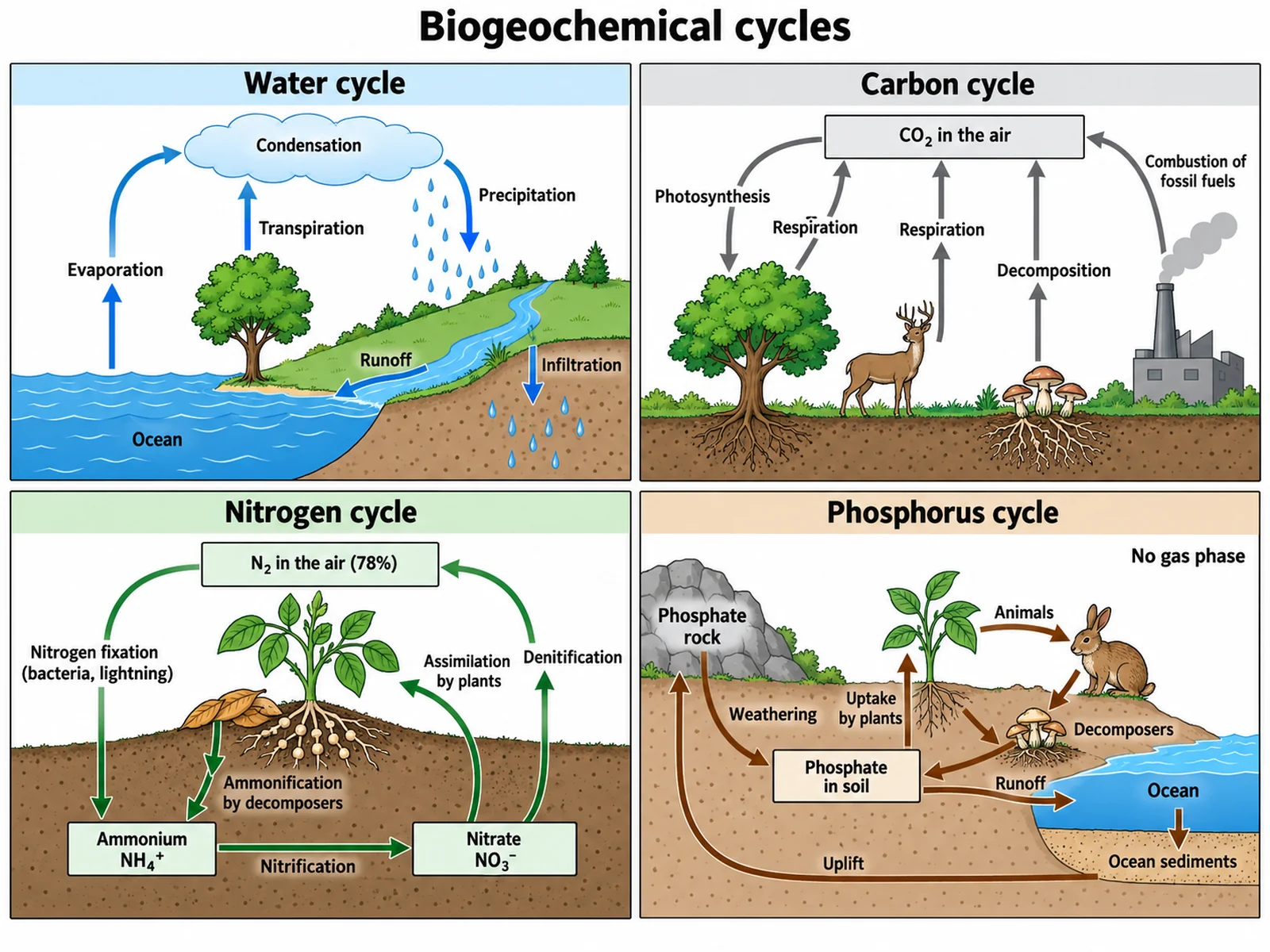
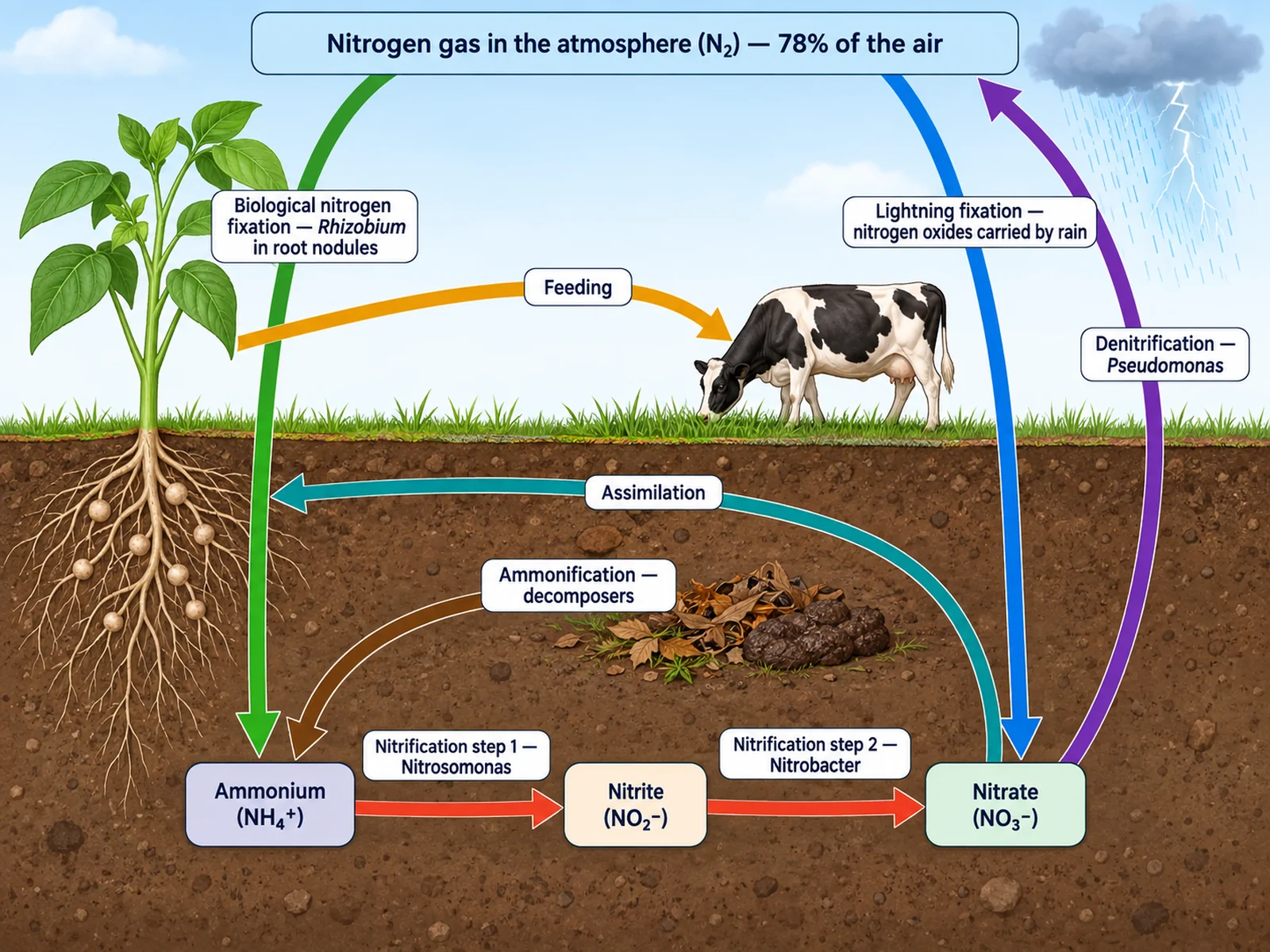
Phosphorus cycle vs nitrogen cycle
Exams pair these two cycles more than any others, because both elements are essential nutrients that run off farmland, yet they travel in completely different ways.
Phosphorus cycle
Nitrogen cycle
Largest reservoir
Phosphate rock and ocean sediments
The atmosphere, as N₂ gas (about 78% of air)
Gas phase
None significant
Yes: N₂, plus N₂O, NO, and ammonia
How it enters food webs
Weathering releases phosphate; roots absorb it
Bacteria or lightning fix N₂; roots absorb ammonium and nitrate
Key microbes
Decomposers; mycorrhizal fungi help uptake
Nitrogen-fixing, nitrifying, and denitrifying bacteria
Form plants take up
Phosphate (H₂PO₄⁻, HPO₄²⁻)
Nitrate (NO₃⁻) and ammonium (NH₄⁺)
Main return path
Sediment to rock, then uplift (millions of years)
Denitrification back to the air (fast)
Human impact
Mining phosphate rock for fertilizer; runoff
Haber–Bosch fertilizer; runoff; N₂O emissions
Usually limiting
Fresh water
Many land ecosystems and much of the ocean
Phosphorus Cycle Diagram FAQ
It is a drawing that follows phosphorus from where it is stored to where it is used and back again. The boxes or pictures are the reservoirs: phosphate rock, soil, plants, animals, decomposers, rivers and the sea, and ocean sediments. The arrows are the processes that move phosphorus between them: weathering, uptake by roots, feeding, decomposition, runoff, sedimentation, and geological uplift. A correct diagram is a closed loop with no arrow going up into the air, because phosphorus has no gas phase.
Generate carbon, nitrogen, and water cycle diagrams, rock cycle figures, blank labeling worksheets with matching answer keys, and revision-ready science illustrations with the same SciFigure AI workflow.